China’s robotic revolution
Updated: 2015-11-14 00:07
By WANG YING and WU YIYAO in Shanghai(China Daily USA)
|
||||||||


 |
|
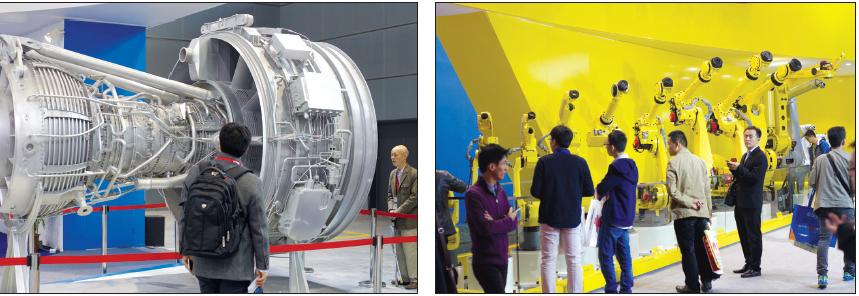
A wide range of high-tech equipment was on show at the event that attracted more than 2,000 exhibitors from across the world. PHOTOS BY GAO ERQIANG / CHINA DAILY |
To achieve this, SEARI has entered a partnership with Boston-based company Rethink Robotics — the latter will deploy its smart, Sawyer and Baxter robots to the Chinese manufacturing community to improve production processes by implementing flexible and affordable automation.
“Chinese manufacturers are facing similar challenges as their counterparts around the world, such as rising wages and labor shortage,” said Scott Eckert, president and CEO of Rethink Robotics.
“In order to stay competitive in a global manufacturing economy, these companies are looking at collaborative robots to help them become more efficient and responsive to customer demands.”
Ji’er Machine Tool Group, one of China’s largest metal forming machinery and equipment companies with a history of nearly eight decades, has since the 2000s been transforming its facilities into “digital” ones by adopting digitized, three-dimension design softwares and electronic systems.
The benefits that these new technologies afford have been telling — the company can now manufacture 15 major automobile parts per minute, up from the previous record of 12, representing a 25 percent increase in capacity that has helped its auto-maker clients gain a competitive edge.
Other technologies such as enterprise resource planning (ERP) and manufacturing execution systems (MES) have enabled companies like Zoomlion Heavy Industry Science & Technology Co Ltd to boost their productivity levels by three times — after adopting smart management systems, five team leaders can manage a department of up to 500 employees.
Experts believe that there is still much potential for Chinese companies to upgrade their facilities to smart, digitized ones, and this will in turn create opportunities for developers of both hardware and software.
“The automotive sector is currently a major consumer of industrial robots in China — it accounts for about 51.1 percent of the nation’s total robot application. But we have also seen great market potential for more robots to be used in service industries such as food processing and catering,” said Dai.
China had already surpassed Japan as the world’s largest industrial robot market in 2013, and a total of 45,000 units of industrial robots were sold across the country in 2014.
Zhou Bo, deputy mayor of Shanghai, said that the city has now become a national center of robot research, development and production, contributing to about 70 percent of the nation’s output. He added that China’s industrial robot market is expected to maintain a growth rate of 20 to 25 percent in coming years.
According to a global study by the International Federation of Robotics which was released earlier this year, China will be home to the most number of industrial robots in the world by 2017, with operating unit numbers estimated to be more than 400,000.
Contact the writers at wang_ying@chinadaily.com.cn and wuyiyao@chinadaily.com.cn
- Valletta summit enhances political will to solve migration crisis amid concerns about EU consolidation
- S Korean court upholds life sentence for ferry captain
- China, US prepare for dialogue to fight cybercrime
- Myanmar's opposition to independently form government
- Obama signs executive order on lifting sanctions against Liberia
- Reputed New York mobster, 80, cleared in 1978 'Goodfellas' heist

 Top 10 regions that led the shopping spree on Singles Day
 Traditional Yuju Opera faces dilemma
 Eat more beans, peas, lentils and chickpeas, UN says
 Veterans Day marked across the United States
 Antalya: Beautiful place where G20 will be held
 Interesting trends revealed by Singles Day
 10 delicious soups you can't miss in cold winter days
 Xi-Ma meeting lauded in US
Most Viewed
Editor's Picks

|

|


|

|

|

|
Today's Top News
Obama, Netanyahu at White House seek to mend US-Israel ties
China, not Canada, is top US trade partner
Tu first Chinese to win Nobel Prize in Medicine
Huntsman says Sino-US relationship needs common goals
Xi pledges $2 billion to help developing countries
Young people from US look forward to Xi's state visit: Survey
US to accept more refugees than planned
Li calls on State-owned firms to tap more global markets
US Weekly
|

|