Photochemical smog
Updated: 2013-02-18 08:04
(China Daily)
|
||||||||


The latest research conducted by the Chinese Academy of Sciences found a large amount of nitrogen-containing organic compounds in the recent smog and haze in Beijing, Tianjin and Hebei province.
Such compounds are the key components of the photochemical smog, in which the compounds react with sunlight and produce airborne particles and ground-level ozone, both of which are potentially harmful, Wang Yuesi, the leader of the research, told China Youth Daily.
Photochemical smog shrouded Los Angeles during the 1940s and 1950s, resulting in hundreds of premature deaths and 2,000 traffic accidents in a single day in 1954.
According to the United States Environmental Protection Agency, exposure to nitrogen dioxide may impair lung function and increase respiratory infections in young children. Exposure to high industrial levels of nitrogen oxides may even cause death.
Experts blamed motor vehicle exhaust as the main cause of PM2.5 in Beijing - it accounts for one-fourth of the source.
Chen Liangfu, a researcher at the Chinese Academy of Sciences, said that the diameter of small particles in the air will double or even triple when they encounter water vapor, decreasing visibility by eight or nine times and forming smog and haze.
- Wu Wencong
(China Daily 02/18/2013 page5)
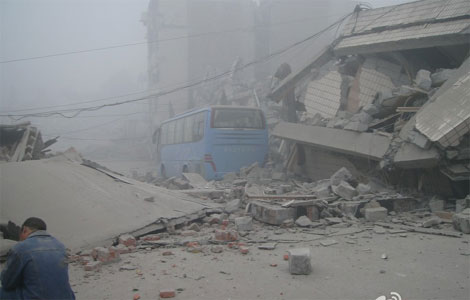
 In Photos: 7.0-magnitude quake hits Sichuan
 Li Na on Time cover, makes influential 100 list
 FBI releases photos of 2 Boston bombings suspects
 World's wackiest hairstyles
 Sandstorms strike Northwest China
 Never-seen photos of Madonna on display
 H7N9 outbreak linked to waterfowl migration
 Dozens feared dead in Texas plant blast
Most Viewed
Editor's Picks

|

|


|

|
|
|
Today's Top News
Live report: 7.0-magnitude quake hits Sichuan, heavy casualties feared
Boston suspect cornered on boat
Cross-talk artist helps to spread the word
'Green' awareness levels drop in Beijing
Palace Museum spruces up
First couple on Time's list of most influential
H7N9 flu transmission studied
Trading channels 'need to broaden'
US Weekly

|

|