Forex purchases rise for third straight month
Updated: 2013-04-12 07:31
By Wei Tian in Beijing and Yu Ran in Shanghai (China Daily)
|
||||||||


|
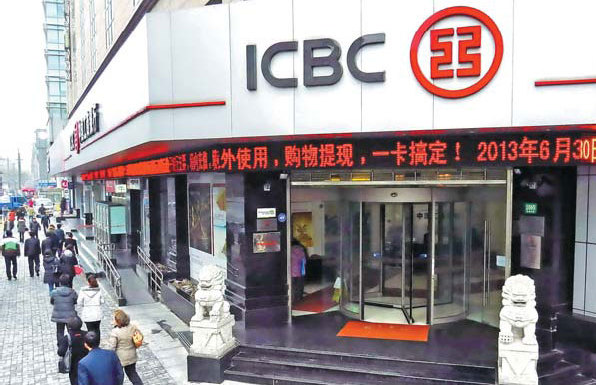
An Industrial and Commercial Bank of China Ltd outlet in Shanghai. China's financial institutions added 295.4 billion yuan ($47.67 billion) in the purchase of foreign exchange in February. Provided to China Daily |
Economists expect central bank to control capital flows, drain liquidity
Foreign exchange purchases grew for the third consecutive month in February, releasing liquidity while adding pressure to authorities' selection of monetary policy.
China's financial institutions added 295.4 billion yuan ($47.67 billion) in the purchase of foreign exchange, after the figure recorded a historic high in January of 683.7 billion yuan, according to the latest figures from the People's Bank of China.
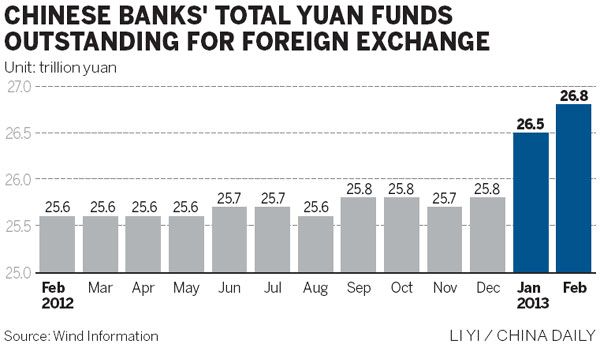
As of the end of February, Chinese financial institutions' total yuan funds outstanding for foreign exchange amounted to 26.83 trillion yuan.
The surprise increase came amid expectation of a rising yuan as the world's second-largest economy gradually recovers, as well as the developing countries launching a new round of quantitative easing.
Analysts attributed the continual increases to companies' willingness to hold assets in yuan as its value has risen. On Wednesday, the yuan hit a record high against the US dollar.
"The capital inflow and China's widening trade surplus in the first quarter are the major reasons for the yuan's appreciation pressures," said Wang Tao, chief economist with UBS Securities.
Although the February figure was much less than January's, Xie Yaxuan, head of macroeconomic research with China Merchant Securities, said the figure is still large, especially for a month that has fewer workdays than usual.
"Taking into consideration the trade deficit in March and a strong appreciating momentum of the yuan, there might be an arbitrage fund in the inflow of international capital," he said.
Xie Dongming, an economist in treasury research and strategy and global treasury at OCBC Bank, said: "The rise in foreign exchange purchase in February can be recognized as a global development of the RMB, especially with the offshore trading system getting more mature with an increase in cross-border deals.
"The arbitrage behavior is hard to eliminate, but the central government probably will release certain policies to control the capital flows appropriately," he said.
Xie added that foreign exchange purchase won't stay so high under the trade deficit reported in March.
E Yongjian, a researcher with the Bank of Communications, said, "The foreign exchange purchase for this year will see a significant increase over last year, though there are still uncertainties."
He said the rising foreign exchange purchase has ruled out the possibility for easing measures, such as bank reserve ratio rate cuts, but an increase is unlikely either because of the pressure of fewer deposits faced by banks.
The interest rate will also remain unchanged to guard against further surge in capital inflow, he added.
Peng Wensheng, chief economist at China International Capital Corp, said, "The monetary policies will be set to neutral."
To mop up excess liquidity from the rising foreign purchase, the central bank has been draining liquidity via open market operations.
This week, 76 billion yuan has been removed from the money markets through 28-day repos in the bank's regular open market operations.
Taking into consideration the 59 billion yuan in central bank repos and bills maturing, the central bank actually withdrew 17 billion yuan from the markets, a softer move from a week earlier, which analysts read as the bank's attempt to keep moderate liquidity to support the tepid economic recovery in the context of lower-than-expected inflation data.
China's consumer price index rose 2.1 percent year-on-year in March, down from a 10-month high of 3.2 percent in February, and the producer price index, which measures wholesale inflation, fell for the 13th consecutive month.
However, the mild inflation and relatively gentle recovery suggest little possibility of monetary tightening, while ample liquidity in the markets makes policy easing equally unlikely, according to analysts.
The Chinese economy saw its slowest growth in 13 years in 2012, increasing 7.8 percent, but growth began to show signs of recovery in the fourth quarter of last year.
China is due to release key economic data for the first quarter next week.
Contact the writers at weitian@chinadaily.com.cn and yuran@chinadaily.com.cn
Xinhua contributed to this story.
(China Daily 04/12/2013 page13)

 In Photos: 7.0-magnitude quake hits Sichuan
 Li Na on Time cover, makes influential 100 list
 FBI releases photos of 2 Boston bombings suspects
 World's wackiest hairstyles
 Sandstorms strike Northwest China
 Never-seen photos of Madonna on display
 H7N9 outbreak linked to waterfowl migration
 Dozens feared dead in Texas plant blast
Most Viewed
Editor's Picks

|

|


|

|

|

|
Today's Top News
Live report: 7.0-magnitude quake hits Sichuan, heavy casualties feared
Boston suspect cornered on boat
Cross-talk artist helps to spread the word
'Green' awareness levels drop in Beijing
Palace Museum spruces up
First couple on Time's list of most influential
H7N9 flu transmission studied
Trading channels 'need to broaden'
US Weekly

|

|