Double role
Updated: 2014-11-27 06:48
By Xu Fan(China Daily USA)
|
||||||||


Germany showcases 'seriously entertaining' movies to woo Chinese audiences. Xu Fan reports.
German movies can be both entertaining and serious. That seems to be the theme for the 2014 Festival of German Cinema in China, which is being presented jointly by Goethe-Institut and German Films in Beijing, Chengdu, Hangzhou and Shenzhen through Nov 29.
The festival presents a chance for Chinese audiences to watch 15 humor-laced German movies, all of which were released in the past two years.
|
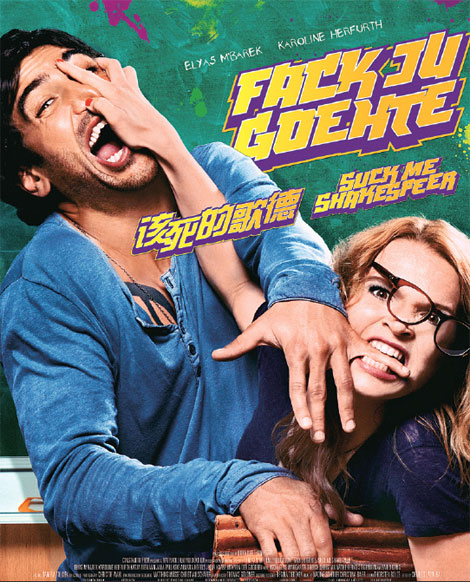
Suck Me Shakespeer, a school-years comedy, is among the films being shown at the 2014 Festival of German Cinema in China. Provided to China Daily |
Doris Dorrie, honorary patron of the festival, tells China Daily that she is "surprised" by Chinese audiences' interest in German comedies. The Hannover-born female director is known for showing human weaknesses of her characters through comical depictions.
The festival will showcase four of her films: The Whole Shebang (a comedy about mothers and daughters), Bliss, The Hairdresser and Cherry Blossoms-Hanami.
"My films are quite interesting," says Dorrie, sitting inside a glass-paneled room, waiting to do media interviews. "A lot of people think we don't have comedies, as Germans appear serious. But we do have (them)."
The 59-year-old writer-director recalls her first tour of China with Men in 1988, when the movie became unexpectedly popular on the mainland, and she found Chinese audiences laughing at the same scenes that Germans would find funny.
Men was watched by 5 million viewers in Germany and triggered a new wave of romantic comedies in that country, according to the festival's official website.
Her comments are echoed by Peter Anders, director of Goethe-Institut China.
Anders says "serious" and "entertaining" aren't mutually exclusive terms.
"Even things that inspire deep pondering can also be entertaining. Entertaining doesn't mean shallow, and thinking can be happy and entertaining," he says.
Suck Me Shakespeer, a school-years comedy, is among the films being shown at the festival.
The Bora Dagtekin-directed production that features an ex-con's life at a school and his secretive attempts to search for his robbed money, topped the German box office by drawing more than 7 million viewers in 2013-14. It was the most commercially successful German movie last year, the festival's organizers say.
Zhang Yifan, vice-chairman of the Film Association of Zhejiang Province, says the festival's theme "seriously entertaining" represents the characteristics of German movies.
"It admits the movies can entertain the public and should also educate them," he says, "Most Chinese cinema screens are bombarded by Hollywood popcorn blockbusters. It's a rare chance for Chinese moviegoers to watch these in-depth productions."
Do German moviemakers worry about competition from Hollywood? Here's what the interviewees say:
"Normally, it is a cultural phenomenon for mass taste. German films only get an average budget of 4 million euros ($4.97 million), while most Hollywood big-budget movies can get an investment as high as $70 million," Dorrie says on why Hollywood action blockbusters become global favorites.
German moviemakers feel the heat from Hollywood's giant studio productions not just owing to comparatively lower local moviemaking budgets, but also due to the relatively limited appeal of the German language to global audiences, who are used to watching movies in English even with subtitles.
"We care more about telling stories of everyday lives. Some of them are quite good," she says, adding that some German movies are similar to independent Chinese features, such as Eleven Flowers (directed by Wang Xiaoshuai), but haven't been watched by many Chinese.
Florian Stetter, an actor in the festival's opening film Stations of the Cross, says art-house productions such as the one in which he stars, while exploring facets of humanity, also make significant contributions to the development of German cinema.
"We need such stories. They tell about people's lives," he says, adding that the German government has policies that promote art-house works, such as reducing taxes.
Contact the writer at xufan@chinadaily.com.cn
(China Daily USA 11/27/2014 page8)

 The plight of pregnant women in rural China
 Rescue dogs show skills in NW China
 Top 10 largest hotel chains in China
 10 'mosts' about foreigners in China
 DreamWorks-themed ice sculpture festival kicks off in Macao
 Folk art shines at East China fair
 Goodbye, my brothers!
 9 global hubs for renminbi trading
Most Viewed
Editor's Picks

|

|


|

|

|

|
Today's Top News
Microsoft reported to be facing $137 million bill for back taxes
Partnership with private firms fuels China's growth
BMO Global Asset Management Launches ETFs in Hong Kong
BlueFocus aims to acquire Canadian company
Anti-corruption move gains traction
Maryland's new first lady thankful
Amazon answers China's 'Double 11' with Black Friday
Tencent-HBO deal can feed big appetite for content in China
US Weekly
|

|