Understanding consumers key to survival
Updated: 2015-04-30 16:12
By Zheng Yangpeng(China Daily USA)
|
||||||||


Market gets more competitive as shoppers become sophisticated and demanding, but also emotional in terms of what they buy
The drama of Chinese consumers going crazy for high-tech toilet seats being sold in Japan during the Lunar New Year holiday has led to a kind of "soul-searching" back home.
For Chinese manufacturers, it is a huge embarrassment because most of the "smart" electronic seats are actually made in China. Beyond embarrassment, it also said something about Chinese consumers' changing thinking that deserves careful study by foreign companies that are vying for a piece of the world's second-largest consumer market.
For Jeff Walters, a partner and managing director of the Boston Consulting Group and an expert on China's consumer goods sector, it revealed multiple facets of the Chinese consumer story.
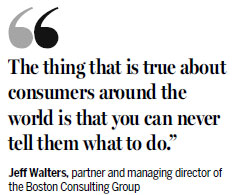
"The thing that is true about consumers around the world is that you can never tell them what to do. A lot of the time, consumers move faster than companies," he said.
Looking at consumer companies in China, there is a wide range of performance. One reason is that the market "only gets more competitive", Walters said.
Another is that the business model that worked in the past decade does not work now. Companies are figuring out a new model. What is behind that is the shift of the whole macro-context.
"The past 10 years were more about the emergence of real 'consumers' who for the first time were able to buy basic goods," he said.
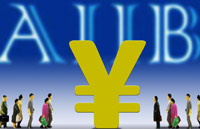
Now China is seeing the emergence of an upper-middle class, with a minimum monthly salary of 12,000 yuan ($1,960), who are buying branded everyday goods, such as personal care items and food, he said.
In the past, availability, a well-known brand and some assurance of quality were enough to ensure a company's sales in China, Walters said. But now companies must either convince consumers to buy more often, or to buy a better version of the product.
"You are not going to buy more shampoo when you get richer. Successful companies have got to convince consumers to buy better products with higher prices. That's the game that lots of companies are playing.
"What that involves is how to please consumers and persuade them that if you buy this product, you feel better. That can only be done through really understanding how people feel, what they want and what they are concerned about," he said.
This is what consumer experts call the "emotional side".
On the technical, or functional side, is how to convince consumers that the product on which you spent 20 yuan actually delivers much more than the one that cost 10 yuan.
All of it gets more challenging in China's market, where consumers are notorious for their lack of brand loyalty. In China, there is just an explosion of choices, and consumers are willing to try new things and switch brands, he said.
The flourishing of e-commerce here also reduced big companies' traditional advantages: a key one was "distribution", he said. Smaller companies found it difficult to get their products into millions of stores in hundreds of cities. But e-commerce made it much easier and quicker to reach millions of customers.
Just like the story of Chinese consumers who flock to Japan to buy toilet seats, two-thirds of Chinese consumers' luxury product spending has taken place overseas.
Western luxury brands have long been "thinking of Chinese consumers in a global context", in Walters' words. That mindset required these companies to "reorganize" themselves so the scenario could be "advertise in China, sell in South Korea".
"As consumers travel abroad more and more, they experience different ways of life in different countries. They not only go to tourist sites but also to supermarkets. That only raises the bar," he said.
All these challenges made foreign companies struggle to adapt, and many have complained that the market is not what they thought it was.
But Walters said there are so many sectors that it is hard to look at an average profit margin. If you are in a category where consumers are willing to pay more for quality, you have a better chance to be profitable. If you are in a category where consumers will not trade up, it is tougher.
In addition, according to Walters, it is hard to be profitable if you are not the leader in a category, even if you are in third or fourth position. A minimum size is also necessary.
"If your annual sales are less than $300 million in China, very few companies make money. Once you cross the threshold, it is much easier to make money," he said.
Contact the writer at zhengyangpeng@chinadaily.com.cn
(China Daily USA 04/30/2015 page15)

 China's top 10 GDP provinces in Q1
 Photos capture marvelous landscapes of China
 Mass exodus from Kathmandu
 Running on water: a nearly impossible feat
 Ten photos you don't wanna miss - April 30
 'Comfort women' survivor attends protest of Jpapan PM
 Ten photos you don't wanna miss – April 29
 China's rescue team searches for survivors in Nepal
Most Viewed
Editor's Picks
|

|


|

|

|

|
Today's Top News
Freddie Gray tried to hurt himself in police van
Abe betrays history's conscience
China trainmakers seek control of Bombardier's rail unit
New rich set sights on tech, media and telecom sectors
US rapped for stance on Japan
Obama, Abe talk much about China
Japan PM protested at US Capitol, San Francisco
Chinese students caught in riot scene
US Weekly

|

|