Wei Yang: Focusing on critical battles
Updated: 2015-05-01 09:57
By Dong Leshuo in Washington(China Daily USA)
|
||||||||


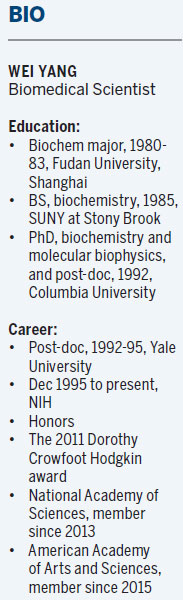
On April 22, 2015, the American Academy of Arts and Sciences, one of the oldest and most prestigious honorary societies in the US and a leading center for independent policy research, announced its newly elected members.
Wei Yang was the only Chinese mainland name among the 197 new inductees.
"I am deeply honored by my election to this distinguishedacademy and humbled to join the company of its illustriousmembers," Yang said.
Two years ago, Yang was elected to the National Academy of Sciences, another top honor in world of science.
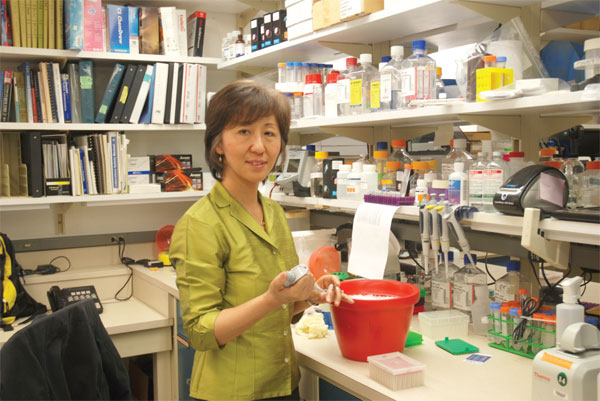
Researching structural biology at the National Institutes of Health (NIH), Yang leads a team studying the recombination, repair and replication of DNA, the molecule that encodes the genetic blueprint of living organisms and viruses.
"All our research projects are related to human diseases, for which we are looking for cures," Yang said.
Yang has worked on HIV-1 reverse transcriptase, which has been successfully targeted by drugs to treat AIDS patients.
"It is fundamental research that leads to molecular understanding first and eventually to clinical applications," she said.
Yang started her journey in the field of molecular biology as a PhD student in biochemistry and molecular biophysics at Columbia University.
"Environment is very important. If you are on a right track, everything becomes easier," Yang said.
"My advisor at Columbia, Dr Wayne Hendrickson, once said that science is his religion. He devoted all his time and energy to science. His pursuit of pure science and his curiosity and motivation to find out how things work greatly influenced me."
"I have decided to work on research topics that are related to human health and the quality of life since then," Yang said.
"Our research is to find out unknowns," she explained. "Not only are the answers unknown, but the paths that could lead to the answers are also unknown.
"Therefore conducting research is like taking an adventure with a great deal of excitement as well as risks," she continued. "Sometimes we think that we have got an answer, but we could be misled. It is very gratifying to be the first person in the world to know how a molecule works."
Yang published her first paper in Science in 1990, which "was quite a breakthrough," she said.
She was only 27, a fairly young age to publish a "CNS" paper - referring to the three most prestigious publications in the world of science: Cell, Nature and Science - which is considered a career milestone.
But Yang was just getting started. "In science, when you get an answer, you see more questions," Yang said.
Following her post-doctoral fellowship at Yale, a real life lesson came in 1998, three years after she had joined NIH.
Yang came up with something that she thought was "a surprising and important discovery". But when she submitted the paper to the CNS journals, it was rejected by all three.
"I felt like the criticism was directed at me rather than my work," Yang said.
"It was a big blow to me that made me rethink whether I should continue a career in research at all," she said.
"I called my advisor Wayne at Columbia to ask for his advice. He helped me write a letter to the editor of Cell, Ben Lewin, asking him to reconsider the decision," she said.
After a re-review, Lewin published Yang's paper, and another six months later. Since 1990, she has published nearly 100 in various journals.
"This experience gave me a lot of confidence that the criticism was about the paper, and not about me," she said. "From then on I've learned to appreciate rather than to be afraid of criticism."
"Taking rejection well is a lesson that everyone has to learn. From my own experience, getting rejected gives one a new starting point, no matter from what perspective," Yang said.
"In science, if you never get rejected, that means you have been too conservative and undervalued your work," she said.
"Only if you go through frustration and failure and continue to move forward, do you really begin to understand and learn what is important," Yang said.
With what she has achieved now, it's hard to imagine that when Yang came to the US 32 years ago she was "at the bottom of society".
It was really getting out of her "comfort zone" for Yang to leave Shanghai in 1983. She was not only the youngest child in a well off family, but a junior at Fudan University, one of China's top universities, at a time when going to a university was a luxury in China.
"It was a dream that when you came to the US, a totally unknown world, everything was going to work out fine," she said.
But when Yang first landed in the US, she had "no familiarity with American culture, no English language skills, no college degree, no money and no work permit."
"One could just give up the studies and become an illegal immigrant working in Chinese restaurants or laundries. But that life was not for me. There was no way out except through higher education," Yang said.
Yang had to earn a living on her own while catching up with her studies. She earned $500 to $600 a month working in a Chinese restaurant. College tuition plus room-and-board cost her $4,000 a semester.
To make the tuition count, Yang took six courses (18 credits) in her first semester at the University of New York at Stony Brook. With limited English comprehension, she struggled in each class. The difficulties seemed overwhelming.
"However, I found myself greatly interested in learning for the first time in my life, because the opportunity to sit in a classroom could not be taken for granted," she said.
Yang attributed her persistence in science partly to her indomitable personality.
"I have two elder brothers who, as older siblings often do, took advantage of me owing to our age difference and physical strength, I just never gave in and learnt to stand up for myself," she said.
"You can not fight and win every battle, but you can learn to focus on the critical ones," Yang said.
Serving as the Washington DC-Baltimore chapter president of the Society of Chinese Bioscientists in America (SCBA), Yang has been working to raise awareness of the contributions of Chinese scientists.
The SCBA is a non-profit organization founded in 1984 to promote research in biosciences.
"Chinese scientists have made tremendous contributions to biomedical research, but Chinese tend to be quiet and have not gained their deserved share of recognition," Yang said.
"We want to increase our visibility through our initiatives."
Following closely developments in the 80-20 initiative, Yang also admires the use of legal avenues to eliminate discrimination and raise the social status of Chinese Americans.
80-20 is a national, nonpartisan, political action committee dedicated to winning equal opportunity and justice for all Asian Americans through swing bloc voting.
"Though I've never been unfairly treated, either because I am a Chinese American or a woman, we are aware and concerned about the status quo, when Chinese scientists make critical contributions but are not given proper credit and promotion," she said.
"The yardstick for scientific achievement should be how much you have done. Chinese scientists need to get into leadership roles and promote the whole community."
leshuodong@chinadailyusa.com
|
Wei Yang, member of National Academy of Sciences and the American Academy of Arts & Sciences, in her lab at the National Institutes of Health. Dong Leshou / China Daily |
(China Daily USA 05/01/2015 page11)
 Across Canada (May 1)
 China's top 10 GDP provinces in Q1
 Photos capture marvelous landscapes of China
 Mass exodus from Kathmandu
 Running on water: a nearly impossible feat
 Ten photos you don't wanna miss - April 30
 'Comfort women' survivor attends protest of Japan PM
 Ten photos you don't wanna miss – April 29
Most Viewed
Editor's Picks

|

|


|

|
|

|
Today's Top News
Abe betrays history's conscience
Vancouver property developer identified as Chinese fugitive: report
Freddie Gray tried to hurt himself in police van
China trainmakers seek control of Bombardier's rail unit
New rich set sights on tech, media and telecom sectors
US rapped for stance on Japan
Obama, Abe talk much about China
Japan PM protested at US Capitol, San Francisco
US Weekly

|

|