In so many words...
Updated: 2015-05-06 07:35
By Li Wenfang(China Daily USA)
|
||||||||


Scholar wrestles with illness, and his dictionary finally sees the light of day. Li Wenfang reports in Guangzhou.
A Chinese academic has been lauded after battling through cancer to complete the first update of a comprehensive Chinese-French dictionary for more than two decades.
The second edition of the Grand Contemporary Chinese-French Dictionary aims to keep pace with a language increasingly influenced by the Internet.
It includes translations of popular Web words, such as weibo (micro blog), and new phrases, including ditanjingji (low-carbon economy), fangnu (people tied to mortgage) and tuangou (group buying).
Published by Foreign Language Teaching and Research Press, the book contains more than 7 million French words and Chinese characters, almost twice the size of the first edition.
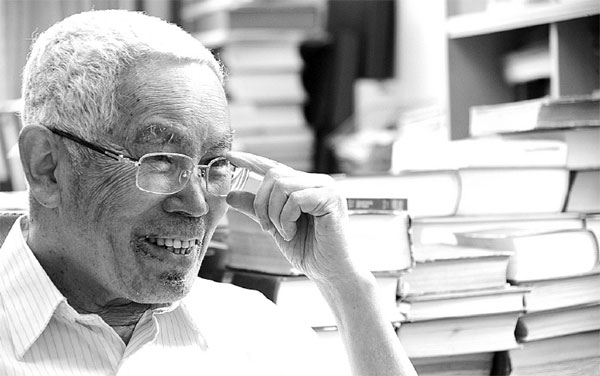
Chief compiler Huang Jianhua, 79, a former president of Guangdong University of Foreign Studies, says the dictionary better caters to both Chinese and French readers, as it labels distinctive Chinese words that often confuse foreigners.
Unlike Chinese-English dictionaries, which are numerous and cover multiple sectors, he says it is harder to compile a Chinese-French dictionary.
"That is why we have included as much information as possible in a single dictionary, to serve the reader," says Huang, who was a student of Liang Zongdai, a renowned poet and translator, at Sun Yat-sen University. "In some cases, we provide a few translations for one word for readers to contemplate."
The book also includes words and phrases widely used in Taiwan, Hong Kong and Macao, as well as some from local dialects.
"It's very informative, providing plenty of examples related to context and usage," says Raymond Rocher, a French professor at Guangdong University of Foreign Studies. "In a word, it helps to find different equivalents according to the different context.
"Huang's bilingual dictionary is definitely a valuable aid to language students and a working tool to professional translators. Moreover, it is easy to use for Chinese or French speakers aiming for efficiency in translation."
Rocher says that one of the main challenges of the project was to find not only an equivalent word but also collocations and phrases to be translated into French.
Liu Qing, vice-president of the Lexicographical Society of China, described the book as a scientific and authoritative work covering a wide range of academic fields, from humanity to natural sciences.
Huang was in his 60s in 1998 when the publishers commissioned his university to produce the dictionary's second edition, which the Ministry of Education later listed as a special project in social sciences.
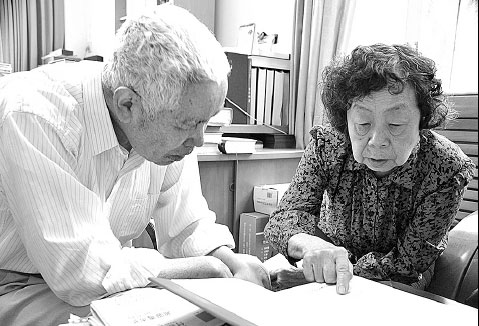
He and his wife, Yu Xiumei, who also taught French at the university, were the only compilers who worked on the dictionary from beginning to end.
In 2008, with 20 percent of the dictionary uncompleted, Huang was diagnosed with lung cancer and had to undergo surgery. Finding it difficult to breathe after his operation, he spent time in rehabilitation before resuming his work.
The cancer returned and spread to his bones in 2012, and the side effects from his treatment again hampered progress on the dictionary.
Some people offered to help, including Huang's daughter, who proposed paying native speakers in France to review unfinished sections.
A doctorial degree candidate and a young teacher later volunteered their time free of charge.
"I've known professor Huang since my days as cultural attache responsible for linguistic and educational cooperation in South China," Rocher says. "As a great scholar in the long Chinese tradition, humble and sincere, full of humanity, he compiled his dictionary with a strong determination and a hardworking attitude."
When the work was published in December, alumni of the university living overseas told Huang that the dictionary could be used to help foreigners learn Chinese, including those at Confucius Institutes.
Cao Deming, president of Shanghai International Studies University, says the dictionary will not only help train French translators to satisfy the needs in Sino-French economic and cultural exchanges, but also facilitate the spread of Chinese culture.
"French and Chinese languages are quite different in their cultural expressions," Rocher says. "Huang's dictionary is a cultural bridge for a better understanding between China and French-speaking countries.
"Knowing that China is going global in Europe and Africa, I have no doubt the Chinese-French dictionary will be a precious tool for better cooperation."
As some people prefer an Internet search to opening a bulky book, the publisher has announced plans to publish a digital version in the near future.
Contact the writer at liwenfang@chinadaily.com.cn
|
Huang Jianhua and his wife, Yu Xiumei, are the major compilers of the latest edition of the Grand Contemporary ChineseFrench Dictionary. Photos By Zou Zhongpin / China Daily |
(China Daily USA 05/06/2015 page10)
 China joins rehearsal for Victory Day parade in Moscow
 Man impresses with home-made excavator
 Blossoms a boon for tourism
 Camel caravan on the Silk Road
 Met Museum celebrates China with annual gala
 Ten photos you don't wanna miss - May 5
 Tree house hotel in Jinan
 Six reasons stopping Apple Watch from ticking in China
Most Viewed
Editor's Picks
|
|

|

|
|
|
Today's Top News
Metgala draws Chinese fashion bloggers' criticism
US authorizes ferry service to Cuba
China Daily's website takes top spot in readership
Xi will honor soldiers during Russia trip
China reforms can benefit
US: experts
Shanghai bans families of govt officials from owning firms
Chinese companies demonstrate presence at OTC
Most Americans believe US wealth distribution unfair: poll
US Weekly
|

|