Debt reform takes a lower priority to stabilizing growth
Updated: 2015-06-02 07:11
By Zheng Yangpeng(China Daily USA)
|
||||||||


Recent policy directives from the Chinese authorities point toward a renewed emphasis on "stabilizing growth". The shift is broad, but the most straightforward implication is that the target of sheding debt pileup could become more elusive.
The latest signal of a priority shift came on May 25, when the National Development and Reform Commission loosened restrictions on bond issues by State-owned enterprises. Issues will not be subject to a quota as long as the proceeds are used to invest in "seven key sectors", which span a broad range of industries.
Analysts worry that this shift will give SOEs too much leeway to repackage their projects and sell them to the NDRC. Local government's off-balance sheet financing vehicles account for a majority of the issuers.
A week earlier, the Ministry of Finance, the People's Bank of China and financial regulators jointly issued a directive, instructing commercial banks to keep extending loans to LGFVs' projects if work had commenced before the end of 2014. Banks were also told to extend the maturity of such loans if LGFVs could not repay the debts on time.
The shift is "the most significant policy easing so far in 2015", Deutsche Bank AG economist Zhang Zhiwei said immediately after the directive. "It is a 180-degree reversal of the fiscal policy from tightening to loosening."
The easing in conditions for LGFV funding was not an isolated move. Last December, the State Council issued a landmark document, known as Circular 62, limiting the ability of local governments to offer tax breaks and other preferential policies to companies in their jurisdictions. Investors and local governments cried foul, as competing preferential policies from local governments for years constituted a major appeal to investors, domestic and overseas alike. The circular was put on hold by the central government, a move that was celebrated by investors.
At the center of the policy mix is Beijing's determination to bolster investment and meet the 2015 GDP growth target of "about 7 percent". Expansion in the first quarter sank to a six-year low of 7 percent. To realize the full-year goal, the reform agendas embodied in Circular 62 and other policies have to give way.
Reform advocates have been quick to criticize the latest moves, saying the changes were proof that the authorities are reluctant to abandon the credit-and investment-fueled growth path. They pointed out that this "downshift-response-improvement-dip again" cycle played out in 2012, 2013 and 2014. Will it happen again this time?
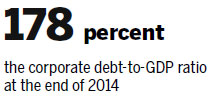
In recent years, despite government pledges that the economy would deleverage, leverage has actually risen. At the end of 2014, the corporate debt-to-GDP ratio stood at 178 percent, while total debt (government, household and corporate) was 244 percent of GDP. In Asia, that figure was surpassed only in the more developed and wealthier economies of Japan, South Korea and Singapore.
Austerity proponents argued that with such a highly leveraged corporate sector, no wonder that the interest rate cuts and liquidity injections of the past six months had failed to generate a turnaround. Indebted corporations have little appetite for new credit. When they do borrow, it is to repay old debt. Banks became ever more cautious in lending to these companies, despite ample liquidity.
Conclusion? Any credit loosening should be conditioned on meaningful deleveraging.
However, another school of economists think differently. They contend that the current mix is just a temporary collection of counter-cyclical policies. They doubt that a painful deleveraging process, rife with defaults and bankruptcy, is necessary or feasible in China.
Helen Qiao, chief greater China economist at Morgan Stanley, said Chinese policymakers' plan is to focus on growth, in the hope that a larger economy will reduce the relative weight of the debt. The danger of forceful deleveraging, she said, is that when debt contracts, GDP also does - sometimes even faster.
"We used this very approach to emerge from the 1997-2002 difficult period."
Sounds like an explanation that both camps can grudgingly accept. But is it feasible?
Tom Orlik, a Bloomberg economist, noted that nominal GDP growth, which is a proxy for return on investment, fell to 5.8 percent in the first quarter from 8.5 percent in the third quarter of 2014.
"With potential returns falling faster than the cost of credit, it's no wonder businesses aren't clamoring to borrow," he said.
Comparing the growth of credit and GDP in China, it is difficult to envision that Qiao's approach will materialize. Outstanding renminbi loan expanded 14 percent in the first quarter, while GDP expanded just 7 percent.
Can GDP growth catch up with credit expansion? If not, we will probably see the debt ratio keep rising. The stake is being indulged in the "expedience" and refrain from a painful reform agenda.
(China Daily USA 06/02/2015 page16)
- Bridging rural-urban gap in education from start
- Overseas study consultancy offers scholarships to top 5 US universities
- China trying to reach 13 people near MERS patient
- Gaokao countdown begins with incense and prayers
- Children's Day celebrated across China
- Ballet dancers perform at Zhalong National Nature Reserve in China's Qiqihar

 Anxious wait for family members of passengers on capsized ship
 Key facts in the 12 hours after ship capsizes in Yangtze River
 Massive operation launched to rescue ship passengers
 Farmers bet on the bull market
 Top 10 largest banks in the world
 Ten injured in crane accident in Manhattan
 Forum trends: Becoming 'a little more Chinese'
 Giraffe survives for five years with zig-zag neck
Most Viewed
Editor's Picks

|

|


|

|

|

|
Today's Top News
Ship carrying 458 people sinks in Yangtze River
Win-win solution is US should seek in Aisa
Woman behind Silicon Valley sex bias suit appealing verdict
Defense hawk Senator Lindsey Graham launches presidential bid
Chinese soldier
gets UN award
Nation's astronauts eager for foreign missions
China committed to upholding peace, stability in South China Sea
Li's trip a watershed in China-Latin America ties
US Weekly

|

|
