New hovercraft makes debut in naval drill
Updated: 2015-07-23 07:38
By Zhao Lei(China Daily USA)
|
||||||||


The People's Liberation Army navy gave a Ukraine-made Zubr-class hovercraft its debut during a recent drill, indicating the Chinese navy has achieved a stronger landing capability.
In the landing exercise carried out in mid-July by a squadron under the PLA navy's South Sea Fleet, the assault force sent tens of amphibious combat vehicles to approach the landing site. However, the vehicles were stopped by the defending force using "effective measures", China Central Television reported.
The assault force then dispatched several "new-type" hovercraft, which successfully broke the defense and made the landing, the State broadcaster said, noting this is the first time the new craft had taken part in a drill.
The craft have strong carrying capacity, fast speed and a long range, according to CCTV.
PLA Daily said the drill accomplished its goal of testing combined landing tactics and maneuvers.
China began using hovercraft in its navy in the mid-1990s and has developed a small family of such craft. However, the domestically developed models have limited operational capabilities because of their small size and short range.
China's first Zubr LCAC hovercraft was built at the Feodosiya Shipbuilding Company in Ukraine and adapted to Chinese needs, according to a report on China Radio International.
The Zubr-class of military hovercraft is the world's largest. It is designed to sealift landing assault units, as well as to transport and plant mines, the CRI report said.
Development of Zubr landing ships started in the former Soviet Union in 1978, and the first serial ship joined the Soviet navy in 1988. It can carry three main battle tanks with an overall weight of 150 tons or 10 armored personnel carriers weighing up to 131 tons plus 140 marines, or eight infantry fighting vehicles weighing up to 115 tons. If not equipped with armor, Zubr is capable of carrying 366 men, CRI reported.
The introduction of the Zubr-class craft would substantially improve the PLA navy's amphibious combat capability, according to Zhang Junshe, a senior researcher at the PLA Naval Military Studies Research Institute.
"With the craft's fast speed and strong firepower, it can ferry a large landing force to the shore within a short period, without suffering serious casualties or being delayed by naval mines or bad coastal conditions," he said.
"Its deployment enhances the PLA navy's ability to rapidly project power at sea, strengthening the nation's capability to safeguard its maritime interests."
zhaolei@chinadaily.com.cn
|
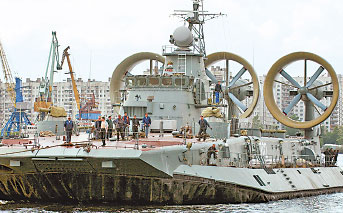
Kerkyra, a Zubr-class air-cushioned landing craft, moors in St. Petersburg in June 2004. Dmitry Lovetsky / AP |
(China Daily USA 07/23/2015 page3)

 The highs and lows of a stock market investor
 Culture insider: 7 things you may not know about Major Heat
 Future of Great Wall in Hebei province looks bleak
 A look back at picturesque host cities of the Winter Olympics
 Top 10 best-paid H-share listed CEOs
 UN displays Chinese actress Gong Li's portrait at exhibit
 Family wades across flood to catch train
 Drought hits NE China
Most Viewed
Editor's Picks

|

|


|

|

|

|
Today's Top News
Obama to meet extended family members in Kenya
More Chinese companies become world top 500
Ministry denies set date for nationwide two-child policy
US tells Chinese bank to combat money laundering
Xi, Obama exchange views on visit, Iran over phone
Wading through South China Sea sticking points
Drought forces Californians to make lifestyle changes
Thousands flock to donate sperm on Taobao's new service
US Weekly

|

|