Chills and thrills
Updated: 2016-03-07 08:27
By Yang Feiyue(China Daily USA)
|
||||||||


Chinese travelers are warming up to winter. Domestic destinations where ice and snow take center stage hosted record visitor numbers following the first frost since the country won the Winter Olympics bid. Yang Feiyue reports.
Cold spots got hot this winter.
China's successful 2022 Winter Olympics bid has won the season a new place in Chinese hearts - and itineraries.
Record numbers of travelers became snow bunnies rather than snowbirds, and headed toward the nippy north rather than the steamy south.
All three of Northeast China provinces, and North China's Inner Mongolia and Northwest China's Xinjiang Uygur autonomous regions - even Beijing's ski slopes - saw record crowds during the cold months.
Many made the trips from balmier, lower latitudes.
"Tourism related to ice and snow has sizzled this year," says Liu Sha, an account executive with the China CYTS Tours Holding Co's group tour center.
Skiing proved particularly popular.
It's what enticed Qin Jian from southern China's Guangzhou, capital of Guangdong province, to bring his 9-year-old son for six days in January in Harbin, capital of China's northernmost province, Heilongjiang.
"He loves skiing. But I'd only been able to take him to indoor facilities since it almost never snows where we live," Qin says.
"I wanted him to experience it in nature. He loves the sport more after the trip."
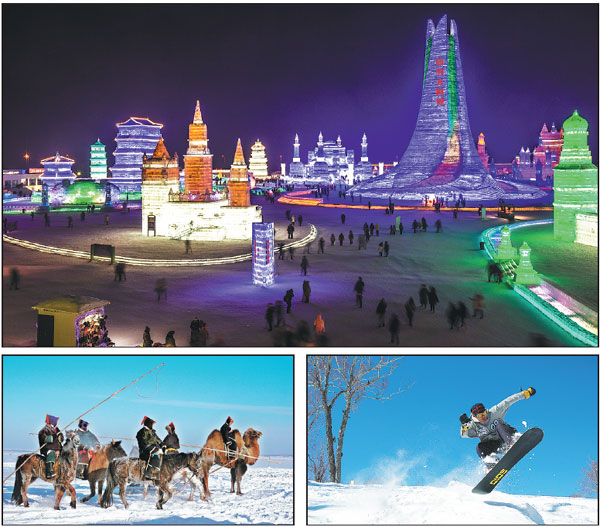
They skied on the frozen Songhua River and wandered among Harbin Ice and Snow Amusement World's ice sculptures and lanterns.
The father and son were among the record 1.1 million visitors of the site, said to be the world's largest of its kind, over the 70 days ending on Feb 29.
Liu says this winter saw significant increases in trips in which parents brought children. Southern regions served as primary sources of snow bunnies.
Northeastern destinations, such as Heilongjiang's Yabuli - celebrated for skiing - and Xuexiang, and the Changbai Mountains that span Heilongjiang, Jilin and Liaoning provinces, ranked among the most popular, Liu adds.
Heilongjiang visits surged most - by more than a third - during February's weeklong Spring Festival holiday compared with last year's, the provincial tourism authority reports.
Heilongjiang expects 10 to 20 percent annual growth over the next five years, says the tourism authority's deputy director, Hou Wei.
Its Yabuli skiing area's visits surged nearly 68 percent to 84,000 during the festival. Spending leapt almost 130 percent to 44 million yuan ($6.7 million).
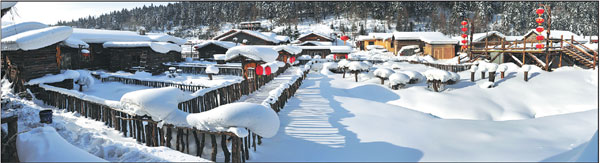
About twice as many festival travelers - 116,000 - descended on the farmhouses submerged in snow in Xuexiang in the province's north compared with the previous Spring Festival.
Harbin's Sun Island received about 138,000 visits during the holiday.
Heilongjiang's travel authorities attribute the quantitative shifts to qualitative causes.
"Attractions' improvements are a major fuel source for the boom," Hou says.
Ice and Snow World has increased its ice chutes' total to 32, including a 320-meter-long corridor that claims to be the world's longest.
Sun Island's annual international snow-sculpture expo upped the ante with such architectural creations as a 50-meter-high Russian church.
Light shows and fireworks encouraged night visits.
Three of Yabuli's mountain ski tracks were connected, and new bunny hills were completed this year.
Xuexiang introduced recreational-vehicle campsites.
Heilongjiang launched five winter routes late last year, starting from Harbin and continuing to other regions.
"We want to ride the wave of the successful 2022 Winter Olympics bid to encourage more people from the south to visit Heilongjiang and experience its winter tourism," Hou says.
The local government is working to design interprovincial courses with Inner Mongolia, Jilin and Liaoning.
An emphasis on integrating ethnic customs - camel beauty pageants, nighttime dance parties among livestock and yurt stays - with sublime snowscapes has enthused Inner Mongolia's wintertime influx.
"Scenic spots and hotels stayed closed during winter a few years ago," says Dong Limin, head of the region's tourism authority's tourism promotion department.
"But they've remained open over the past two winters to cater to demand."
The region received 3.3 million visits over Spring Festival, up nearly 12 percent year-on-year.
Eastern areas, such as Hulun Buir, Hinggan and Xilingol, host horse races, hot springs and slopes. The warmer west, including the capital, Hohhot, enables outdoor activities like temple fairs, lantern shows and religious rituals.
In Lengjicun, known as "China's coldest village" in Inner Mongolia's Genhe city, where temperatures dive below -40 C, visitors enjoy tossing hot water from glasses to see it freeze into "frost flowers" midair, Dong says.
Aoluguya offers deer encounters. Arxan and the Greater Hinggan Mountains shine with rime.
Inner Mongolia's local government plans to expand ski resorts, and the Matryoshka Plaza, featuring Russian restaurants and art performances.
"We'll support locals offering household catering and accommodation services," Dong says.
Despite its general lack of snow, even Beijing saw an 8.6 percent increase over last year's visits to ski resorts.
Hebei province's Chongli county's visits increased by over 17 percent to 180,000 tourists, who mostly came to ski.
Even southern China received more snow-seeking tourists.
January's international children's ski festival at Xilin Snow Mountain in Sichuan province's capital, Chengdu, helped it become southern China's hottest winter tourism spot, says a report from Chinese online travel-service provider Lvmama.
The report explains those born in the '80s have been the major force behind winter tourism.
Qin says he'll explore other frigid destinations if his son maintains interest in winter sports.
The recent cold months' visitor records suggest he's far from alone in the icy seasons to come.
China has caught winter fever.
Contact the writer at yangfeiyue@chinadaily.com.cn
|
Farmhouses are submerged in snow in Xuexiang, a place in Mudanjiang in the north of Heilongjiang province that has snow seven months a year. Provided To China Daily |
|
Top: The Ice and Snow Amusement World is a highlight of Harbin in winter. Above left: Ethnic Mongolian herdsmen stage a lassoing competition in Hulunbuir in the Inner Mongolia autonomous region. Above right: A snowboarder at Yabuli ski resort in Heilongjiang province. Photos Provided To China Daily |
(China Daily USA 03/07/2016 page10)
- Former US First Lady Nancy Reagan dies at 94
- Solar Impulse 2 back in the air after battery upgrade
- Jailed 'El Chapo' desperate to be extradited
- S. Korea, US to launch formal talks on THAAD
- Kim Jong Un says to further strengthen nuclear weapons in quality
- Spanish Princess testifies in tax fraud trial
 The world in photos: Feb 29 - Mar 6
 Boao airport all set for upcoming Asian forum
 Snapshots from the 'two sessions'
 Turn of virtual reality cameras at two sessions
 China's home-made expedition mothership 'Zhang Qian' to be launched in March
 Top 10 countries boosting China's tourist inflows
 Airplane restaurant to open in Wuhan
 World premiums at Geneva Motor Show
Most Viewed
Editor's Picks
|
|

|

|
|
|
Today's Top News
What ends Jeb Bush's White House hopes
Investigation for Nicolas's campaign
Will US-ASEAN meeting be good for region?
Accentuate the positive in Sino-US relations
Dangerous games on peninsula will have no winner
National Art Museum showing 400 puppets in new exhibition
Finest Chinese porcelains expected to fetch over $28 million
Monkey portraits by Chinese ink painting masters
US Weekly

|

|
