Quiet leader runs Boston's City Council
Updated: 2016-03-25 11:50
By Hezi Jiang in New York(China Daily USA)
|
||||||||


Harvard grad Michelle Wu is city's first Asian-American council president
When Michelle Wu walks into a room and meets people for the first time, they often ask her which elected official she works for.
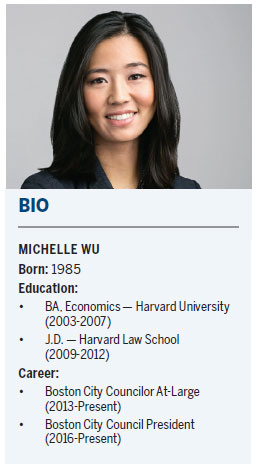
Wu, 31, is the first Asian American, first woman of color and third woman to become president of Boston's City Council in its 106-year history.
A graduate of Harvard College and Harvard Law School, she is also the first Chinese American and first female Asian-American city councilor, as well as the youngest current member.
Wu was born and raised in Chicago, where her parents immigrated to from Taiwan. Both sides of her grandparents are from the Chinese mainland. Her father's side is from Beijing and mother's is from Sichuan and Guangdong. Wu has been learning Mandarin and about traditional Chinese culture since being a child, and she is fluent in Mandarin.
As she was growing up, Wu said she was a typical Asian-American girl - shy and obedient. She played piano and the violin, studied hard and got a scholarship to Harvard, where she started as a pre-med student because she knew her mother wanted one of her four children to be a doctor.
In her spare time, she volunteered in Boston's Chinatown to teach citizenship classes. Later, Wu switched to an economics major at Harvard and eventually took a job as a management consultant at the Boston Consulting Group.
Soon after graduation, Wu at the age of 22 found herself as the caretaker of her mother, who had begun struggling with mental illness, and two sisters. Her parents divorced, so she left her job and returned to Chicago.
To support the family, she opened a 25-seat tea house, but only dealing with the city council for months to get a permit. The tea house served loose leaf tea and Chinese dumplings and hosted poetry readings and open mic nights.
"When I saw what my mom went through, something that changed her life so quickly and permanently, it really made me understand how limited time is, and that if you want to make a difference, you should try to do it as soon as you can," said Wu in an interview.
Her experience in Chicago of trying to open the tea house involved a lengthy process of delays and bureaucracy, all of which made her decide to pursue a career in city politics.
Wu returned to Boston with her mother and two sisters in 2009 and started at Harvard Law School.
During the first two years of study, she interned at City Hall, where she created a Restaurant Roadmap guide to opening a restaurant in Boston, and spearheaded the "Boston Food Truck Challenge", which led to three food trucks opening on City Hall Plaza. She also worked at a medical center where she provided legal services to low-income patients.
It was during her last year of law school that Wu learned how to campaign.
A former student of US Senator Elizabeth Warren while at the law school, Wu worked as the constituency director for Warren's 2012 campaign. She coordinated outreach to all constituency groups, including communities of color, the LGBT community, veterans and women.
"I saw how important politics is and how a campaign that ran differently from usual can bring a lot more people into the political process," said Wu. "We talked about the campaign with many groups who were usually not involved, seeing that people really do want to participate."
After deciding to run for the post of at-large councilor for the city council, Wu built a team of multi-language speakers (she speaks not only Mandarin, but also Spanish), and went into Boston communities to meet people.
Boston has a population of about 656,000, and an Asian population of about 59,000, according to statistics.
Wu said the Asian-American community was important to her campaign. Some from the community volunteered to help her raise money and put up election signs. "They really helped get my name recognition up," said Wu.
In 2013, she was elected a Boston City councilor at-large. Boston Globe columnist Adrian Walker wrote that her success was easy to understand: "She was smart, had a strong grasp of the issues, and campaigned like crazy."
As a freshman councilor, Wu didn't take much time before bringing up major legislation and creating new programs.
She kept drawing on personal experiences for policy ideas. Being the first Boston councilor to give birth while serving in office, Wu pushed legislation to give some city workers six weeks of paid parental leave after the birth or adoption of a child.
According to the Globe, the measure caught the attention of President Barack Obama, who said in a Labor Day speech in Boston that the city should be "proud of what you're doing for working families".
She also worked on a measure that guarantees that transgender municipal employees and their dependents have access to gender reassignment surgery, hormone therapy and mental health services. And she helped to lift Boston's ban on bring-your-own-bottle to support small local restaurants.
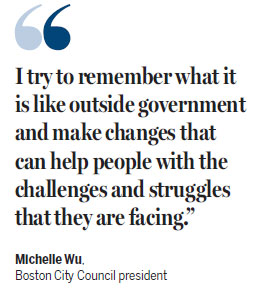
"I try to remember what it is like outside government and make changes that can help people with the challenges and struggles that they are facing," said Wu.
When she ran for re-election to the council, Wu focused on early childhood education and mental health. She was re-elected in 2015. She has been a favorite of progressives and young voters, wrote Walker.
After being re-elected, Wu said she thought about what she wanted to see in the next council president and realized that her own track record was a match.
"I decided to run for council president," said Wu, mother of a 1-year-old boy.
"I think that the leader of the council should be highlighting the work the council is doing. For the last two years, I've been publicizing a newsletter about all the things we talk about at the council, and I set up a website so people could keep track of those issues."
The 12 other members of the council voted for her.
"You always hear about the new Boston versus the old Boston," Councilor Salvatore LaMattina told the Globe last November. "We need to get rid of that and just be one Boston. And Michelle is the one to do that. She'll be an awesome city council president."
Bill Linehan, the former council president, told the newspaper that Wu earned his vote because she is thoughtful and sticks to her decisions, even under duress.
Wu made history for Boston, and also gave Asian-American children one more role model to look up to, said Zhao Gang, a Chinese immigrant. Zhao and his friends initiated the group Friends of Michelle Wu, raising money and calling on new immigrants from China to vote for her.
"Unlike some very outspoken and attention-seeking politicians, Michelle possesses many great qualities of Chinese. She is quiet and polite, and she does more than she says, and that's what makes our Chinese community so proud," Zhao told China Daily.
Wu has been invited to speak to many young people at Mandarin schools in the Boston area, and Zhao said she has encouraged children to embrace their heritage and dream big.
"We all face stereotypes, assumptions people will make about us. It's a matter of being aware of that and being confident in your own ability to lead," Wu said.
"I'm aware of the fact that I don't look like what many people expect a leader to look like. I'm not very tall. I'm not very loud, but I know I'm still an effective leader. My leadership involves more collaboration and more focus on issues, and I'm comfortable with that."
hezijiang@chinadailyusa.com
|
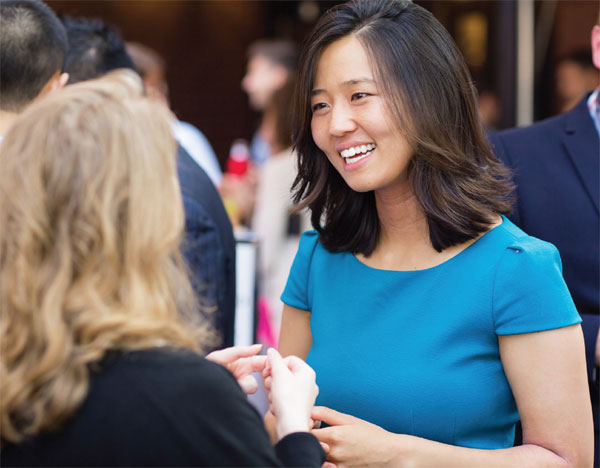
Boston City Council President Michelle Wu meets with a constituent. provided to china daily |
(China Daily USA 03/25/2016 page11)
- Pentagon chief says Europe needs to accelerate anti-IS efforts
- Jeb Bush endorses Cruz's election bid
- Chinese passenger may sue Virgin Atlantic
- People pay condolence to victims of Brussels attacks
- Police issue wanted notice for suspect after Brussels attacks
- China eyes cooperation plan for Lancang-Mekong countries

 First lady Peng Liyuan leads fight against tuberculosis
 Faces at Boao Forum for Asia Annual Conference
 In photos: Lunar eclipses visible in eastern China
 Chinese chasing Spring blossoms around the country
 Migrant couple returns to hometown to raise chickens
 Victims of Brussels attacks commemorated
 In photos: Brussels rocked by multiple explosions
 Raul Castro and Obama hold talks in Havana
Most Viewed
Editor's Picks
|
|

|

|

|
|
Today's Top News
Marriott unlikely to top Anbang offer for Starwood: Observers
Chinese biopharma debuts on Nasdaq
What ends Jeb Bush's White House hopes
Investigation for Nicolas's campaign
Will US-ASEAN meeting be good for region?
Accentuate the positive in Sino-US relations
Dangerous games on peninsula will have no winner
National Art Museum showing 400 puppets in new exhibition
US Weekly

|

|
