Skilled labor advantage for competitiveness
Updated: 2016-05-13 07:35
By Amitendu Palit(China Daily USA)
|
||||||||


In the Global Manufacturing Competitiveness Index of 2016 produced by Deloitte and the US Council on Competitiveness, China retained the top ranking it has held since 2013; the United States moved up to number two, and Germany dropped to number three.
The report predicts the US will overtake China as the world's most competitive country in manufacturing by 2020. While China scored 100 in the current competitiveness index it is predicted to fall to 93.5 in 2020, while the US, which scored 99.5 in the current index, is forecast to score 100 by 2020. Thus the report expects the US to become much more competitive than China in manufacturing by the end of the decade.
The Manufacturing Competitiveness Index is prepared on the basis of responses collected from a diverse group of senior global executives belonging to different industries. The impression of these executives points to the US emerging as the most competitive manufacturing country in the world. This impression is being driven by the importance of advanced technology in determining manufacturing competitiveness.
Unlike low labor costs and small innovations, which have been the main determinants of manufacturing competitiveness for the last three or four decades, sophisticated technology is expected to become the main source of industrial competitiveness in the near future.
This is the result of the change in the organizational character of manufacturing. High value-added manufacturing industries, such as aeronautics, automobiles, chemicals, defense, electronics, machinery and pharmaceuticals are becoming more automated in process and function and are therefore employing less labor. Value additions in these industries now come from technological advances that improve efficiencies.
The vital role of advanced technology in promoting the competitiveness of future global manufacturing is well understood. But will that make the US the most competitive manufacturing country in the world within five years?
The forecast for the rankings of the global manufacturing competitiveness index seem to assume that the US will lead the rest of the world in improvements in advanced technology. This is possible given the US's history of innovations, particularly in digital technology. But that may not be enough to make it the number one in manufacturing.
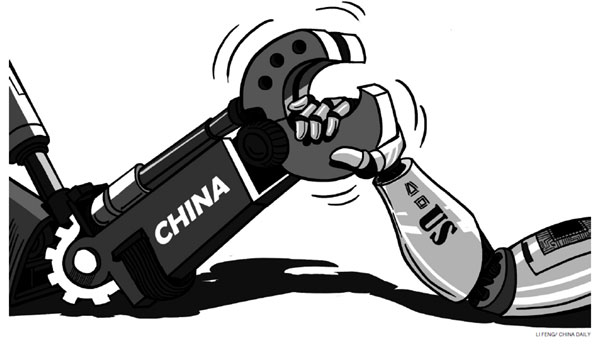
The rankings appear to have underestimated the importance of skilled labor in determining competitiveness. It is true that high value-added manufacturing is now dominated by lean work forces and advanced technologies. It is also true that many manual labor functions have been replaced by digital functions over time. But skilled labor is still essential for ensuring the efficient application of advanced technologies. The requirement for such skills has probably only increased after digitization.
The US might not have enough skilled laborers to meet this requirement. Even if it does, businesses might have to pay very high costs for such labor. This is where many countries in the Asia-Pacific, particularly China, continue to remain competitive.
Skilled labor (including industrial robots) continues to be deployed at cheaper costs in Asian manufacturing, compared with the US and Europe. Indeed, the US dependence on foreign skilled labor remains high, as can be seen from the continuation of the H1B and L1 visa schemes that allows US companies to employ foreign workers in specialty occupations that require theoretical or technical expertise or allow companies operating in the US and abroad to transfer certain classes of employee from their overseas operations to the US. Both these visas continue to draw a large number of applications from US businesses looking to recruit foreign workers in spite of the schemes being heavily criticized for taking away local jobs.
Thus the prediction for the 2020 Manufacturing Competitiveness Index might well be incorrect.
The author is senior research fellow and research lead (trade and economic policy) at the Institute of South Asian Studies (ISAS), National University of Singapore.
(China Daily USA 05/13/2016 page17)
- GP system planned after student death uproar
- Overseas help asked for return of suspects
- Harvard University welcomes first Chinese student speaker at commencement
- Officials provide personal touch in legal disputes
- Wenchuan Earthquake eight years later: never forget
- Students' allegations of poisoning dismissed
- First joint EU-China civil exercise begins in Shanghai
- Uncertainty over EU referendum vote impacts UK economy: Think-tank
- Canadian miner sells world's most expensive rough diamond for record $63 million
- German, Cuban FMs hold talks on bilateral cooperation
- Putin prevails in Sochi all-star ice hockey game
- US guided-missile destroyer visits Tonga

 Karst wonderland in Southwest China
 Love on the rubble: wedding stories after deadly quake eight years ago
 High-tech gadgets shine at CES Asia in Shanghai
 Cannes Film Festival opens amid terror threat
 Supporters of Rousseff clash with police as her removal looms
 Lego opens world's largest store at Shanghai Disney
 Exhibition of table setting art held in Beijing
 Shanghai Disney Resort starts internal test run
Most Viewed
Editor's Picks
|

|


|

|

|

|
Today's Top News
Liang avoids jail in shooting death
China's finance minister addresses ratings downgrade
Duke alumni visit Chinese Embassy
Marriott unlikely to top Anbang offer for Starwood: Observers
Chinese biopharma debuts on Nasdaq
What ends Jeb Bush's White House hopes
Investigation for Nicolas's campaign
Will US-ASEAN meeting be good for region?
US Weekly

|

|
