Celebrating the bridges of Suzhou Creek
Updated: 2016-06-11 07:48
By Zhou Wenting in Shanghai(China Daily)
|
||||||||


Besides being vital transport infrastructure, the numerous bridges along Shanghai's most well-known creek are also icons in their own right
The Suzhou Creek, nicknamed by the locals as a "natural museum of bridges" because of the sheer number of such structures on it, will soon be getting yet another addition to its collection.
The Shanghai government recently announced that a new Changping Road Bridge will be built in the area where the Shanghai Railway Station is at and where there are already seven bridges located roughly 480 meters apart from one another, citing the need to alleviate traffic congestion caused by a boom in the population of vehicles.
|
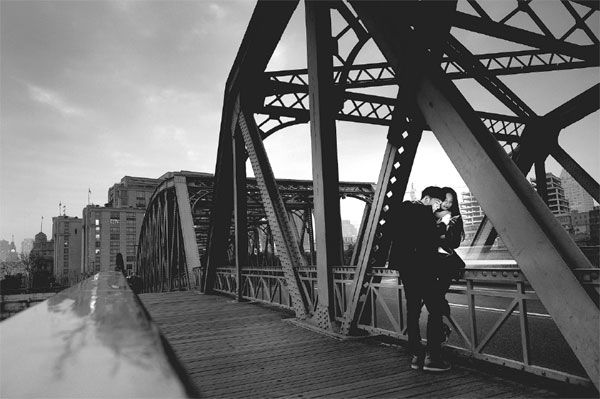
Shanghai's Waibaidu Bridge, a city icon, is a popular meeting place for couples. Photos by Gao Erqiang / China Daily |
|
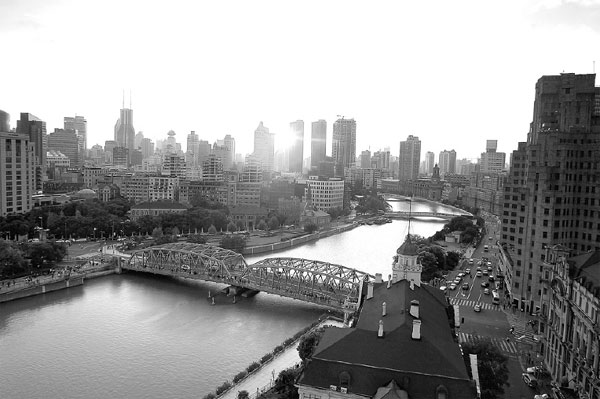
A view of Waibaidu Bridge at dawn. |
Construction of bridges over the Suzhou Creek, which snakes 17 km westward from downtown Shanghai and links the municipality with the city of Suzhou as well as other inland cities in Jiangsu province, began more than a century ago.
Most of the bridges along the eastern side of the creek were built before the 1940s and had European elements incorporated into them. Those on the west of the creek were introduced as the city started expanding.
The most famous of them all is arguably Waibaidu Bridge, or the Garden Bridge, situated at the confluence of the Huangpu River and the Suzhou Creek. Having been around for more than 140 years, this bridge is often seen in movies and promotional posters for Shanghai.
Numerous tour buses stop near the bridge every day as it is the starting point of the former concessions in the city. The wooden flooring on both sides of the bridge serves as an observation deck for tourists. From this point, people can enjoy the view of the rustic building clusters on the Bund, the narrow and old streets that criss-cross each other behind the waterfront stretch, and the breathtaking skyline of the Lujiazui financial district across the Huangpu River.
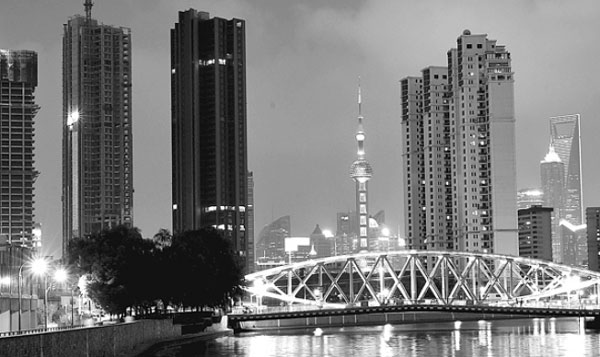
The bridge is itself a marvel to behold as well. Come nightfall, colorful neon lights illuminate the structure, turning it from a mere transportation tool to a romantic spot for lovers. In fact, engaged couples can often be spotted having their wedding photos taken at the bridge. The more adventurous ones even scamper onto the center of road when there is a short lull in traffic.
In 1856, the Wells Bridge was built over the Suzhou Creek, but it was barely utilized after locals complained about the toll charges. When a toll-free bridge was built 17 years later, people called it "waibaidu", which means "going across for free" in Mandarin and Shanghainese. This wooden bridge was then refurbished as a steel truss structure in 1907.
It is a tradition in Shanghai for a grandmother to carry her one-month-old grandchild across the bridge, as this symbolizes that the newborn has left behind all the twists and turns and will hence be able to get through life safely and smoothly.
"Waibaidu Bridge is a Shanghai icon. When my daughter was a baby she had a photo taken there with her grandmother too. It's been a family tradition for us to do so," said a Shanghai native Wang Xuefen.
In 2007, Howarth Erskine Co Ltd, the British company that designed the Waibaidu Bridge, reminded the authority in Shanghai that the bridge had reached its service limit of 100 years. About a year later, the bridge underwent a major overhaul as workers took it apart and sent the components to Shanghai Shipyard.
"We found out that many of its steel parts had severely rusted. Other parts had even turned into crisp, thin iron sheets. The renovation was indeed a timely thing to have," said Hu Jingcheng, head of the bridge project at Shanghai Shipyard.
According to Hu, 215 tons of steel parts were replaced and 63,000 rivets, which accounted for 40 percent of those on the original structure, were swapped with new ones.
"The renovation was carried out according to the original design of the bridge by the British company and we did our best to restore the historic bridge to its initial state. Before the replacements took place, our workers carefully studied the chemical and mechanical components of the steel on the bridge and searched for the best replacements," said Hu, who added that the new structure will require renovation only half a century later.
Wang Changfeng, a 59-year-old Shanghai native, said that the engineers have done a great job with giving the bridge a new lease of life.
"It looks no different from what it was during my childhood days. The bridge used to creak when heavy motor cars went across, but now that noise is gone," he said.
Similarly, Zhejiang Road Bridge, which is next to Waibaidu and has been standing for more than a century, underwent repair and was restored in 2015.A temporary repair plant was set up on the north bank of the creek for this project.
A large-scale renovation project involving 17 other bridges along Suzhou Creek also started in 2009. The facade of each bridge was repainted and cameo walls and lights were added to spruce up the atmosphere around the bridge.
"The renovation of a bridge may cost more than 100 million yuan ($15 million), but it is a worthy investment, not just because it is an upgrade in traffic infrastructure, but because it also helps in the continuation of historical and cultural features of Shanghai. In terms of heritage, each of the bridges is priceless," said Lin Xiang, Party chief of Shanghai Municipal Investment (Group) Corporation.
Besides the bridges that run along it, Suzhou Creek is also, unfortunately, well-known for its stench. Ever since about a century ago when the creek was used as a waterway for the transportation of goods, textile mills, chemical plants and various types of factories on both sides of it in the Zhongshan Park area have contributed to the pollution of the river.
"Suzhou Creek has always been associated with smelliness and pollution. My friend and I used to go to the riverbank to watch the sewage flowing out from the chemical plants when I was a little girl. We didn't know it was pollution. We thought it was a red waterfall," said Huang Qi, a 59-year-old Shanghai resident.
The city government finally decided to clean up the creek in the 1990s, relocating all the plants and introducing to the area riverside parks, yacht clubs as well as tall residential and office buildings. Today, the area is a popular place among the locals to enjoy a scenic stroll.
In the past decade, two more bridges were later built in that particular area to improve human and vehicular traffic. Overpasses were also built at several intersections for people to enjoy the view of the creek.
Contact the writer at zhouwenting@chinadaily.com.cn
Notable bridges along Suzhou Creek
Zhejiang Bridge: Locals call this the "garbage bridge" as residents used to dump rubbish at a site near the bridge. The waste would then be transported to a wharf before boats shipped it away. Before the bridge was constructed in 1908, there was a wooden bridge at this same place built in the 1880s and people now call it "the old garbage bridge".
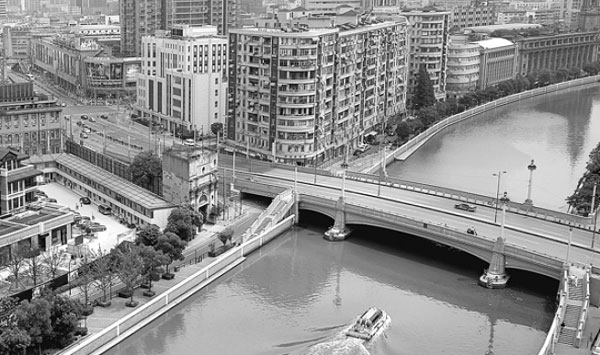
Fujian Bridge: First built in 1875, this has been dubbed "Laozha Bridge", or the old gate bridge, as there used to be an ancient stone gate at the site. The bridge reached its service limit in 1962 and was subsequently rebuilt in 1968. A steel pedestrian bridge was also built at that time and it is called "Xinzha Bridge", or the new gate bridge.
Wuning Bridge: Inspired by the Alexander III Bridge in Paris and built in the 1950s, this bridge features four pillars at each of its four corners. Sculptures of human figures stand atop each of these pillars. In 2008, the authorities in Putuo district, where the bridge is located, began renovating it to celebrate the upcoming Shanghai World Expo in 2010.
(China Daily 06/11/2016 page5)
- Suspected IS terrorists arrested in Germany
- Japanese boy abandoned by parents in Hokkaido forest found alive
- China to build Africa's biggest university library
- 'Kill list' found in UCLA campus shooter's residence: Police
- Swiss declare Alps tamed as Gotthard rail tunnel opens
- China urges Japan to properly settle Chinese forced laborers issue

 Shanghai Disneyland all set for official opening on Thursday
 British pageantry on parade for Queen's official birthday
 Carrying bricks to selling carrots: Life of child laborers
 Graduate revisits same university spot 19 years later
 Euro powers land in France for UEFA EURO 2016
 The most unusualgaokao candidates in 2016
 Elderly man carries on 1000-year old dragon boat craft
 Row your dragon boat, cute pandas in Yunnan!
Most Viewed
Editor's Picks
|
|

|

|
|

|
Today's Top News
Abe's blame game reveals his policies failing to get results
Ending wildlife trafficking must be policy priority in Asia
Effects of supply-side reform take time to be seen
Chinese State Councilor Yang Jiechi to meet Kerry
Chinese stocks surge on back of MSCI rumors
Liang avoids jail in shooting death
China's finance minister addresses ratings downgrade
Duke alumni visit Chinese Embassy
US Weekly

|

|
