New reform drives governance style
Updated: 2015-01-13 08:31
By Xiao Gongqin(China Daily)
|
||||||||


 |
|
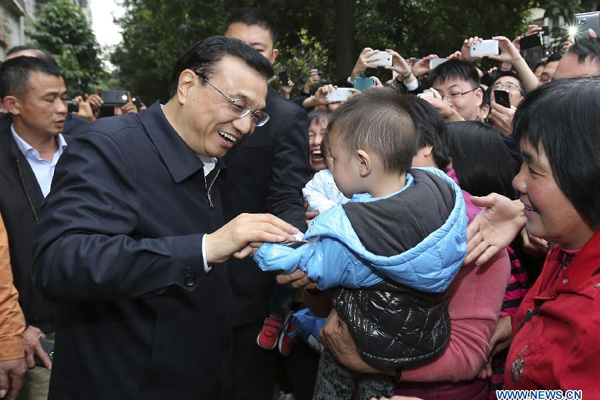
Chinese Premier Li Keqiang (L front) visits a community in Guangzhou, capital of south China's Guangdong province, Jan 5, 2015.Li said China should count on reform, opening up and structural adjustment to improve economy during a three-day tour of south China's Guangdong province. [Photo/Xinhua] |
The wave of reform initiated by the Chinese leadership led by President Xi Jinping in 2012, has brought the country a new round of major changes 36 years after the late Chinese leader Deng Xiaoping launched the reform and opening-up policy in the late 1970s.
Unprecedentedly high anti-graft pressure was the first step Xi took after assuming office, and this has been one of the most significant moves. By empowering the central disciplinary agency of the governing Communist Party of China, and punishing both senior and lower-level corrupt officials, Xi and his team have succeeded in putting a yoke on the once rampant corruption.
Regulating officials' other improper behavior was another essential move that helped ease tensions between people and the government - it at least dissuaded power from being arrogant and continuing to trample on people's dignity. During the process, Xi repeatedly and strictly enforced the CPC's discipline instead of raising any new slogan that applied only on paper, which shows his strong political skills.
The past system, in which redundant officials shared and traded power with one another, not only caused low efficiency, it also led to corruption gangs that threaten the governance of the Party. In order to make sure his reform measures are effectively implemented, Xi has given up the old bureaucratic system and formed several special task forces, such as the ones on national security, on deepening reform, and on financial affairs, which have raised efficiency and prevented distortion.
Concerning the economy, Xi has taken a step forward by stressing that the market should play the decisive role in allocating resources, pointing out clearly the route to a full market economy. The launch of the China (Shanghai) Pilot Free Trade Zone and the following-up of provinces and municipalities such as Guangdong, Tianjin and Fujian are best examples of his design.
Politically, Xi has advocated the rule of law and made a series of moves to warn local authorities not to interfere in legal affairs.
The majority of these measures are highly risky because they overturn some of the authorities' past practices. If the measures prove successful, they might encourage the people's calls for more democracy and evoke doubts about the ruling legitimacy of the CPC; if they fail, they would arouse universal anger, leading to mass protests and a more chaotic situation that make any further reform impossible.
- Inspection teams to cover all of military in anti-corruption drive
- Tornado, heavy rain batters Central China's Hunan
- Beijing's five-year plan: Cut population, boost infrastructure
- Palace Museum discovers relics buried for over 600 years
- Disney promises ‘safe, pleasing service of high quality’
- Couple detained for selling their two sons
- Rousseff: Accusations against her 'untruthful'
- Almost one-sixth of Brazil's confirmed microcephaly cases linked to Zika
- Impeachment trial against Rousseff recommended to senate
- With nomination secured, Trump to aim all guns at Hillary Clinton
- Obama sips Flint water, urges children be tested for lead
- Massive protests against Abe mark Japan's Constitution Memorial Day

 Raging wildfire spreads to more areas in west Canada
 World's first rose museum to open in Beijing
 Teapot craftsman makes innovation, passes down techniques
 Top 8 iOS apps recommend for mothers
 Five things you may not know about the Start of Summer
 Art imagines celebrities as seniors
 Japanese animator Miyazaki's shop a big hit in Shanghai
 Star Wars Day celebrated around world
Most Viewed
Editor's Picks
|

|


|

|

|

|
Today's Top News
Liang avoids jail in shooting death
China's finance minister addresses ratings downgrade
Duke alumni visit Chinese Embassy
Marriott unlikely to top Anbang offer for Starwood: Observers
Chinese biopharma debuts on Nasdaq
What ends Jeb Bush's White House hopes
Investigation for Nicolas's campaign
Will US-ASEAN meeting be good for region?
US Weekly

|

|