Population policy change needs more moves
Updated: 2015-01-14 08:33
By Stuart Basten(China Daily)
|
||||||||


 |
|
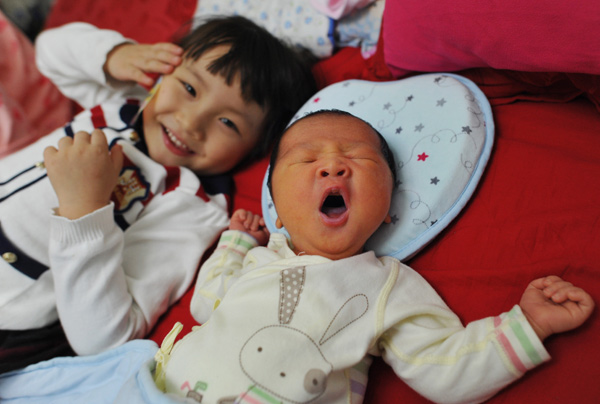
A girl plays with her newborn brother at a hospital in Nanjing, Jiangsu province,on Oct 24. 2014. [Photo/CFP] |
The latest change in the family planning policy which allows couples to have a second child if one (or both) of them is the only child of his/her parents is just more than a year old. The rationale of the policy shift was to ensure the "long-term balanced development" of the population in the face of projections of further decline in the fertility rate, a shrinking of the overall population and rapid aging. It was forecast that the change would lead to an extra 1 million to 2 million births per year.
Figures from the National Health and Family Planning Commission suggest that by the end of December nearly 1 million couples had sought permission to have a second child, and about 920,000 of them had been given the go-ahead. However, many forecasts from around the country are being made smaller, and there is much uncertainty about how many of these couples will actually go on to have their second child.
In some ways, this should come as little surprise. National and local surveys have repeatedly shown that many couples intend to have only one child despite being eligible to have a second. The stated reasons for this preference for small families are consistent: economic pressure. This can be divided into "direct" and "indirect" costs.
Direct costs related to the everyday costs of living and, of particular concern to parents in surveys, the cost of educating their children. The indirect costs - which can exaggerate the direct costs - revolve around the lost income and the impact on the career of many couples, usually women.
While a lucky few in the (upper) middle class can afford these costs (and, indeed, may well have chosen to pay the "social maintenance fees" associated with breaking the family planning policy before the reform), for many it is a simple trade-off between the number of children and the amount that can be "invested" in them.
But what about the future? Before the latest reform in the family planning policy, questions were asked about why a national two-child policy was not implemented. The main reason given was that there was a fear of a "baby boom" which could put strain on public and social services and lead to unbalanced population growth. A year on, it seems those fears could be misplaced.
- Inspection teams to cover all of military in anti-corruption drive
- Tornado, heavy rain batters Central China's Hunan
- Beijing's five-year plan: Cut population, boost infrastructure
- Palace Museum discovers relics buried for over 600 years
- Disney promises ‘safe, pleasing service of high quality’
- Couple detained for selling their two sons
- Rousseff: Accusations against her 'untruthful'
- Almost one-sixth of Brazil's confirmed microcephaly cases linked to Zika
- Impeachment trial against Rousseff recommended to senate
- With nomination secured, Trump to aim all guns at Hillary Clinton
- Obama sips Flint water, urges children be tested for lead
- Massive protests against Abe mark Japan's Constitution Memorial Day

 Raging wildfire spreads to more areas in west Canada
 World's first rose museum to open in Beijing
 Teapot craftsman makes innovation, passes down techniques
 Top 8 iOS apps recommend for mothers
 Five things you may not know about the Start of Summer
 Art imagines celebrities as seniors
 Japanese animator Miyazaki's shop a big hit in Shanghai
 Star Wars Day celebrated around world
Most Viewed
Editor's Picks

|

|


|

|

|

|
Today's Top News
Liang avoids jail in shooting death
China's finance minister addresses ratings downgrade
Duke alumni visit Chinese Embassy
Marriott unlikely to top Anbang offer for Starwood: Observers
Chinese biopharma debuts on Nasdaq
What ends Jeb Bush's White House hopes
Investigation for Nicolas's campaign
Will US-ASEAN meeting be good for region?
US Weekly

|

|