Time to end the cyber-spying blame game
Updated: 2015-01-21 16:16
By Shen Yi(Chinadaily.com.cn)
|
||||||||


|
 |
|
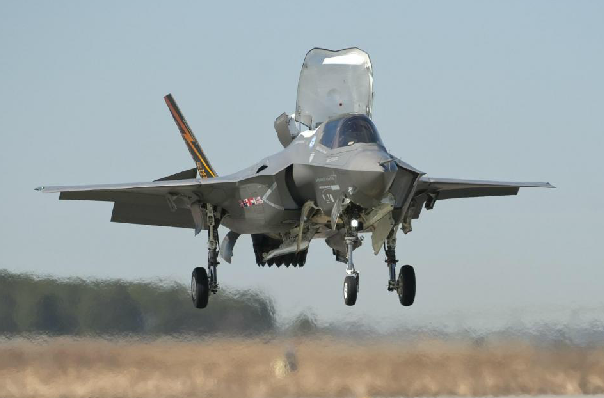
The F-35 Lightning II, also known as the Joint Strike Fighter (JSF), integrates advanced very low observable stealth into a supersonic, highly agile 5th generation fighter. [Photo/Agencies] |
Responding to a report in a German magazine that Chinese cyber spies stole sensitive data on defense programs, such as the United States’ F-35 Lightning II fighter jet, China’s Foreign Ministry spokesman Hong Lei said on Monday that such allegations are “totally groundless and unproven”.
Such baseless accusations are not new for China, which itself has been at the receiving end of cyberattacks. Chinese cyber-spying might have increased the cost of the F-35 Joint Strike Fighter’s and delayed its production, said Aviation Week, a New York-based information and services provider specializing in aerospace and intelligence, in 2012.
These allegations are being leveled at China to “prove” that it “stole” data on the US fighter jet to develop its own Chengdu J-20 and Shenyang J-31.
But they seem rather contradictory in the light of the explanation given by Michael Hayden, former director of Central Intelligence Agency, to defend the US after former National Security Agency operative Edward Snowden exposed Washington’s surveillance program in 2013. The NSA surveillance program, Hayden said, was designed to collect intelligence to safeguard state security, while China’s “cyber-hacking” served as a tool for Beijing to launch unfair economic competitions.
Assuming that China did collect information from cyberspace to improve its fighter jets, how is it not fair? Didn’t it help the country to safeguard its national security? At the most, it only shows that China’s intelligence organ did a good job, for that is exactly what the US wants the NSA to do for its own national security.
Allegations of cyber espionage, especially by the West, have always been aimed at slandering China — that it has made technological breakthroughs only by plagiarizing Western innovations. This perception remains unchanged since Washington issued the Cox Report in 1999 accusing China of using spies to steal nuclear weapons’ technology from the US.
- Inspection teams to cover all of military in anti-corruption drive
- Tornado, heavy rain batters Central China's Hunan
- Beijing's five-year plan: Cut population, boost infrastructure
- Palace Museum discovers relics buried for over 600 years
- Disney promises ‘safe, pleasing service of high quality’
- Couple detained for selling their two sons
- Rousseff: Accusations against her 'untruthful'
- Almost one-sixth of Brazil's confirmed microcephaly cases linked to Zika
- Impeachment trial against Rousseff recommended to senate
- With nomination secured, Trump to aim all guns at Hillary Clinton
- Obama sips Flint water, urges children be tested for lead
- Massive protests against Abe mark Japan's Constitution Memorial Day

 Raging wildfire spreads to more areas in west Canada
 World's first rose museum to open in Beijing
 Teapot craftsman makes innovation, passes down techniques
 Top 8 iOS apps recommend for mothers
 Five things you may not know about the Start of Summer
 Art imagines celebrities as seniors
 Japanese animator Miyazaki's shop a big hit in Shanghai
 Star Wars Day celebrated around world
Most Viewed
Editor's Picks

|

|


|

|

|

|
Today's Top News
Liang avoids jail in shooting death
China's finance minister addresses ratings downgrade
Duke alumni visit Chinese Embassy
Marriott unlikely to top Anbang offer for Starwood: Observers
Chinese biopharma debuts on Nasdaq
What ends Jeb Bush's White House hopes
Investigation for Nicolas's campaign
Will US-ASEAN meeting be good for region?
US Weekly

|

|