HK political reform subject to Basic Law
Updated: 2015-02-02 07:44
By Zhang Dinghuai(China Daily)
|
||||||||


 |
|
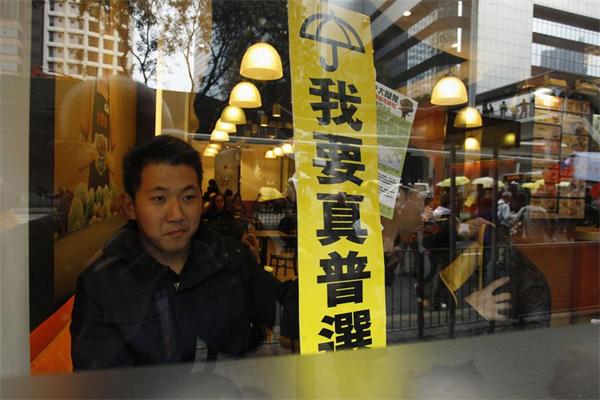
A protester inside a restaurant displays a banner which reads "We want real universal suffrage" as other protesters march past on a street in Hong Kong February 1, 2015. |
Hong Kong opposition Civil Human Rights Front organized a march themed "We want real universal suffrage rather than pseudo democracy" on Sunday, which was the first street protest in the city after last year's 79-day "Occupy Central" movement.
Since the discussion on universal suffrage began in Hong Kong, opposition groups have used slogans to negate the development of a democratic political system in the city. In fact, "Occupy Central" leaders used such slogans as their core "political appeal" to demand universal suffrage in the election of Hong Kong's chief executive (CE).
Discussions on Hong Kong CE election should be under the premise that Hong Kong, as a society, respects the rule of law and must focus on three basic questions.
First, what is the criterion for universal suffrage? Is there an international unified criterion for it? Hong Kong opposition groups assume that only allowing parties to nominate their candidates or individuals to contest the CE election is real universal suffrage. They also say this is the international criterion. This argument is a subjective assumption that belies common sense.
The difference in nomination mechanisms is not the criterion for "true" or "false" universal suffrage. As long as just one candidate is not nominated to contest one post, it's a competitive democratic election. Beijing has vowed to adopt universal suffrage for the 2017 Hong Kong CE election to demonstrate the universality and equality of voters' rights. If all the qualified voters have equal right to vote and the election guarantees "one-person, one-vote", the Hong Kong CE election will be an example of universal suffrage.
Second, what is Hong Kong's legal status as part of China and what is the nature of the 2017 Hong Kong CE election? Hong Kong is a Special Administrative Region of China. The Chinese central government implemented the "One Country, Two Systems" policy after Hong Kong's reunification with the motherland in 1997 and granted it special status, under which Hong Kong enjoys a high degree of autonomy in economic and political matters.
- Global health entering new era: WHO chief
- Brazil's planning minister steps aside after recordings revelation
- Vietnam, US adopt joint statement on advancing comprehensive partnership
- European border closures 'inhumane': UN refugee agency
- Japan's foreign minister calls A-bombings extremely regrettable
- Fukushima impact unprecedented for oceans: US expert
 Stars of Lijiang River: Elderly brothers with white beards
 Wealthy Chinese children paying money to learn British manners
 Military-style wedding: Fighter jets, grooms in dashing uniforms
 Striking photos around the world: May 16 - May 22
 Robots help elderly in nursing home in east China
 Hanging in the air: Chongqing holds rescue drill
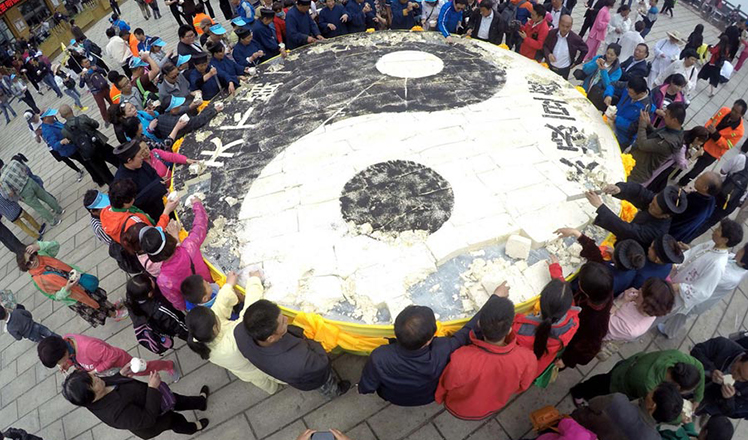 2.1-ton tofu finishes in two hours in central China
 Six things you may not know about Grain Buds
Most Viewed
Editor's Picks
|
|


|
|

|
|
Today's Top News
Liang avoids jail in shooting death
China's finance minister addresses ratings downgrade
Duke alumni visit Chinese Embassy
Marriott unlikely to top Anbang offer for Starwood: Observers
Chinese biopharma debuts on Nasdaq
What ends Jeb Bush's White House hopes
Investigation for Nicolas's campaign
Will US-ASEAN meeting be good for region?
US Weekly

|

|