New normal to improve living standards
Updated: 2015-03-03 08:14
By Dan Steinbock(China Daily)
|
||||||||


 |
|
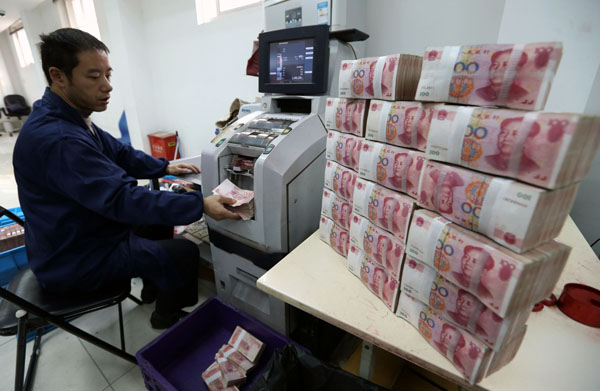
A bank employee prepares bank notes at an Industrial and Commercial Bank of China Ltd cash center in Wuxi, Jiangsu province. [Photo provided to China Daily] |
China's central bank cut the benchmark deposit and loan interest rates by 25 basis points from Sunday, which has been widely interpreted as an effort to prop up economic growth, which has been slowing.
The slowing growth in China reflects the demise of the rapid industrialization period, as well as China's demographic transition. The share of working-age people in the total population has been declining since 2010. Internationally, growth deceleration reflects slower demand in stagnant Europe and Japan, and lingering recovery in the United States.
Policymakers were able to keep growth above 7 percent last year, despite the weak investment in real estate and manufacturing, thanks to the government's "mini-stimulus" and the central bank's liquidity.
And, despite much pessimistic speculation at home and even more abroad, the government's annual target of 10 million new jobs was reached by October, well before the year-end.
But what about 2015?
In China, reliable and comprehensive labor market data is still scarce. The official registered unemployment rate has barely moved in the course of the past decade. Although it includes the unemployed that voluntarily register with authorities, it excludes critical segments - rural population, migrant workers and new graduates.
The surveyed unemployment rate, which focuses on labor-age population in large and medium-size cities, provides an alternative picture of the employment trends. It was 5 to 6 percent before the global crisis in 2008 and stabilized at 5 percent, after the government's huge stimulus package. Currently, it is estimated at 5.1 percent.
Obviously, the government's stimulus policies and the central bank's liquidity injections have supported the labor market. Additional easing is to be expected as long as import growth remains sluggish and headline inflation is at a five-year low.
- Global health entering new era: WHO chief
- Brazil's planning minister steps aside after recordings revelation
- Vietnam, US adopt joint statement on advancing comprehensive partnership
- European border closures 'inhumane': UN refugee agency
- Japan's foreign minister calls A-bombings extremely regrettable
- Fukushima impact unprecedented for oceans: US expert

 Stars of Lijiang River: Elderly brothers with white beards
 Wealthy Chinese children paying money to learn British manners
 Military-style wedding: Fighter jets, grooms in dashing uniforms
 Striking photos around the world: May 16 - May 22
 Robots help elderly in nursing home in east China
 Hanging in the air: Chongqing holds rescue drill
 2.1-ton tofu finishes in two hours in central China
 Six things you may not know about Grain Buds
Most Viewed
Editor's Picks
|

|


|

|

|

|
Today's Top News
Liang avoids jail in shooting death
China's finance minister addresses ratings downgrade
Duke alumni visit Chinese Embassy
Marriott unlikely to top Anbang offer for Starwood: Observers
Chinese biopharma debuts on Nasdaq
What ends Jeb Bush's White House hopes
Investigation for Nicolas's campaign
Will US-ASEAN meeting be good for region?
US Weekly

|

|