Workplaces changing to benefit of women
Updated: 2015-04-20 08:48
By Cai Hong(China Daily)
|
||||||||


 |
|
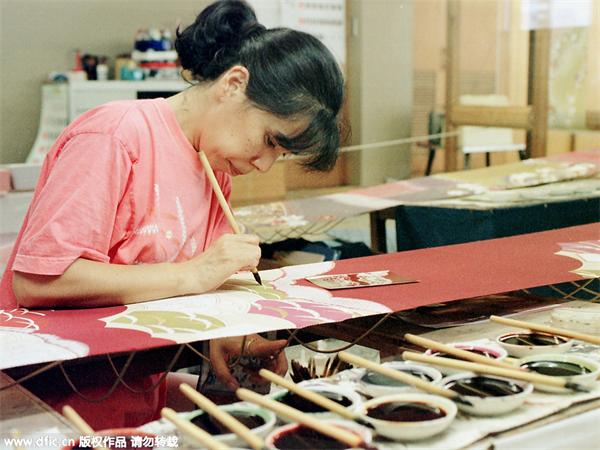
A Japanese worker paints fabric panels in Kyoto. [Photo/IC] |
The weather is getting warmer in Tokyo and many Japanese men are accompanying their young children to parks on the weekends, to play football or catch, or walk with them in the woods. The mothers are always not present.
This is something of a sea change for Japanese men who have a reputation for being lazy at home.
A poll of the Organization for Economic Cooperation and Development's member countries last year found that Norwegian men pitched in the most - 180 minutes a day - with housework and related chores while Japanese men did the least - only 62 minutes a day.
There is a reason for Japanese men's unhelpfulness at home.
In Japan's corporate culture, many employees - almost all men - are more devoted to their company than to their family. They routinely work long hours. They accept reassignment to remote locations without question. They carouse with colleagues and corporate clients till late at night.
Many young Japanese fathers today say they would like to be more involved in raising their children, but very few feel at liberty to take the child-care leave to which they are entitled by law.
Such a work style is possible for a man married to a stay-at-home woman who excuses him duties at home, but it is a different story for a woman with children.
About 70 percent of Japanese women leave the labor force after giving birth to their first child. Only about one-third of Japanese mothers with young children work, compared with 50 to 60 percent in the United States, Britain and Germany, and 75 percent in Sweden.
It is not fair to just blame Japan's corporations for Japanese women's retreat from workplaces. There are not enough child-care centers in Japan. Women are often caught in a Catch 22 situation: they cannot secure a job until a child-care slot is available, and they are not eligible for such a slot until they have a job.
Many women, as a result, choose to stay at work rather than have children.
- Global health entering new era: WHO chief
- Brazil's planning minister steps aside after recordings revelation
- Vietnam, US adopt joint statement on advancing comprehensive partnership
- European border closures 'inhumane': UN refugee agency
- Japan's foreign minister calls A-bombings extremely regrettable
- Fukushima impact unprecedented for oceans: US expert

 Stars of Lijiang River: Elderly brothers with white beards
 Wealthy Chinese children paying money to learn British manners
 Military-style wedding: Fighter jets, grooms in dashing uniforms
 Striking photos around the world: May 16 - May 22
 Robots help elderly in nursing home in east China
 Hanging in the air: Chongqing holds rescue drill
 2.1-ton tofu finishes in two hours in central China
 Six things you may not know about Grain Buds
Most Viewed
Editor's Picks

|

|


|

|

|
|
Today's Top News
Liang avoids jail in shooting death
China's finance minister addresses ratings downgrade
Duke alumni visit Chinese Embassy
Marriott unlikely to top Anbang offer for Starwood: Observers
Chinese biopharma debuts on Nasdaq
What ends Jeb Bush's White House hopes
Investigation for Nicolas's campaign
Will US-ASEAN meeting be good for region?
US Weekly

|

|