More investment needed in educating China's West
Updated: 2015-04-24 16:09
By Li Yang(chinadaily.com.cn)
|
||||||||


 |
|
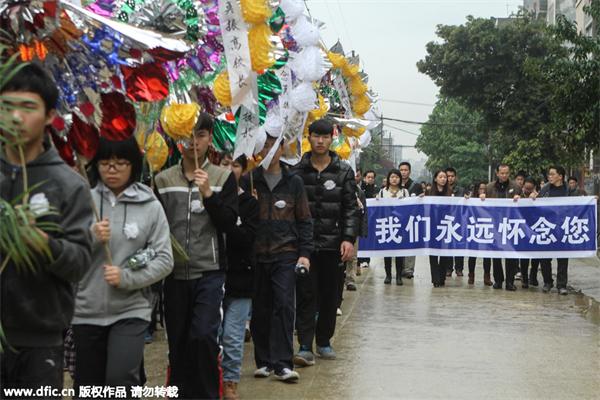
Crowds of alumni gather in the Du’an Yao autonomous county in Hechi on March 15, to bid a farewell to their beloved headmaster, Mo Zhengao. [Photo/IC] |
When a beloved 58-year-old middle school principal of Du'an, Guangxi Zhuang autonomous region, died in early March, mourning wreaths were sold out in the county, and thousands turned up to bid him farewell in his funeral. He had donated all his savings to sponsor poor students, and more than 20,000 students from his school had made it to university in the past 30 years.
Later that month, another middle school principal in Rongxian, Guangxi, came under fire for ordering students to line up and perform exercises in the heavy rain to greet local officials who were bundled in thick coats and sheltered by umbrellas.
The sharp contrast between the two principals in Guangxi stirred a wide debate over the education in backward regions.
The explosion of people's thirst for knowledge and technology in East China after the "cultural revolution" (1966-76) ushered in an economic boom in China's coastal areas. Yet, education seems to be drifting out of reach for China's wider west, long regarded as suppliers of cheap labor and natural resources for the coastal areas.
As China's economic growth slows to 7.4 percent last year, the lowest in about 20 years, and continues to dip, this region comes under the spotlight. China's west cannot copy the growth model of East China, which has caused serious pollution. The central authority encourages the region to develop service industries and environmentally friendly emerging industries, and metes out tailor-made regional integration development initiatives, like the Yangtze River Economic Belt, the Silk Road Economic Belt and the 21st Century Maritime Silk Road to promote the relocation of production factors in the backward region.
Guangxi is at the crossroad of the two Silk Road strategies. However, it is almost impossible to create a suitable social and economic environment to accommodate the free flow of production factors in the region without a good education system, or a pro-knowledge atmosphere.
Guangxi's economy is only one sixth of its neighbor Guangdong province, despite its rich natural resources.
To boost the economic rise of the western region, the central government should firstly improve the efficiency of local education, and make the schools cradles for the professionals and technicians that local industries desperately need, or entrepreneurs that can start their own businesses.
- Global health entering new era: WHO chief
- Brazil's planning minister steps aside after recordings revelation
- Vietnam, US adopt joint statement on advancing comprehensive partnership
- European border closures 'inhumane': UN refugee agency
- Japan's foreign minister calls A-bombings extremely regrettable
- Fukushima impact unprecedented for oceans: US expert
 Stars of Lijiang River: Elderly brothers with white beards
 Wealthy Chinese children paying money to learn British manners
 Military-style wedding: Fighter jets, grooms in dashing uniforms
 Striking photos around the world: May 16 - May 22
 Robots help elderly in nursing home in east China
 Hanging in the air: Chongqing holds rescue drill
 2.1-ton tofu finishes in two hours in central China
 Six things you may not know about Grain Buds
Most Viewed
Editor's Picks

|
|

|
|
|

|
Today's Top News
Liang avoids jail in shooting death
China's finance minister addresses ratings downgrade
Duke alumni visit Chinese Embassy
Marriott unlikely to top Anbang offer for Starwood: Observers
Chinese biopharma debuts on Nasdaq
What ends Jeb Bush's White House hopes
Investigation for Nicolas's campaign
Will US-ASEAN meeting be good for region?
US Weekly

|

|