How graft harms the environment
Updated: 2015-04-30 07:43
By Li Yang(China Daily)
|
||||||||


 |
|
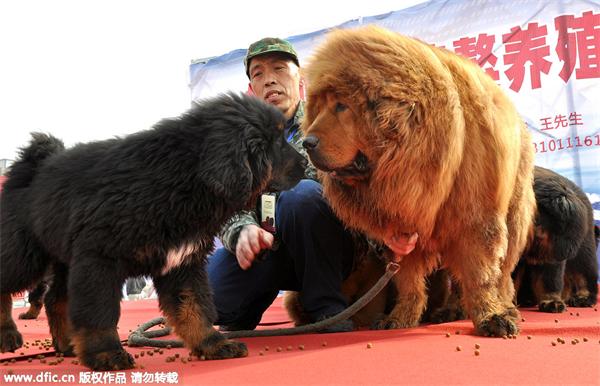
Tibetan mastiffs are displayed during an exhibition in Handan, central Chinas Hebei province, 23 March 2013. |
Tibetan mastiff owners usually give their pets a glorious funeral to honor their lifelong faithfulness and services as shepherd dogs. But recently some of the prized animals almost ended up in hot pot restaurants, because their raisers could not afford to feed them any more after failing to find buyers for them.
The reason, many say, is the anti-corruption campaign.
Last month, dog lovers saved 20 Tibetan mastiffs and hundreds of other dogs from a truck in Beijing's suburbs that was carrying them to eateries in Northeast China, by paying $5 each for them.
In the 10 years up to 2013, the price of a purebred Tibetan mastiff increased from about a few thousand dollars to $200,000, because they were popular with businesspeople and civil servants as gifts. But now there are almost no buyers.
There has been a slump in the trade of jade and valuable wood too. A piece of bloodstone of the size of a thick book from the mountains in Guangxi Zhuang autonomous region was worth up to $1 million until about two years ago. But now a bloodstone of that size can be sold only after being cut it into small pieces for $2 each. The extraction of jade and chopping of trees to make expensive furniture or showpieces caused widespread damage to the mountains and forests. And all because of corrupt officials, who developed a special liking for exclusive and exotic items.
Likewise, their demand for Tibetan mastiffs led to massive mixed breeding of the species and threatening its genetic pool. This means corruption has harmed the environment and ecology as well.
The Tibetan mastiff, jade and valuable wood markets have become popular topics of discussion among people, because it is an open secret that the temperature of these markets signify the level of corruption in society. The authorities should, therefore, strengthen supervision of these markets.
The government is encouraging people to start their own business and pursue innovation by simplifying the registration process for small startups. But it is equally important to show zero-tolerance to corruption in order to build a healthy business environment in which small startups could succeed.
If the authorities really want to see small businesses prosper and become innovative, they have to keep their eyes open to all sorts of developments, including the markets for dogs, stones and pricey wood.
The author is a writer with China Daily.
liyang@chinadaily.com.cn
- Global health entering new era: WHO chief
- Brazil's planning minister steps aside after recordings revelation
- Vietnam, US adopt joint statement on advancing comprehensive partnership
- European border closures 'inhumane': UN refugee agency
- Japan's foreign minister calls A-bombings extremely regrettable
- Fukushima impact unprecedented for oceans: US expert

 Stars of Lijiang River: Elderly brothers with white beards
 Wealthy Chinese children paying money to learn British manners
 Military-style wedding: Fighter jets, grooms in dashing uniforms
 Striking photos around the world: May 16 - May 22
 Robots help elderly in nursing home in east China
 Hanging in the air: Chongqing holds rescue drill
 2.1-ton tofu finishes in two hours in central China
 Six things you may not know about Grain Buds
Most Viewed
Editor's Picks
|
|

|

|
|

|
Today's Top News
Liang avoids jail in shooting death
China's finance minister addresses ratings downgrade
Duke alumni visit Chinese Embassy
Marriott unlikely to top Anbang offer for Starwood: Observers
Chinese biopharma debuts on Nasdaq
What ends Jeb Bush's White House hopes
Investigation for Nicolas's campaign
Will US-ASEAN meeting be good for region?
US Weekly

|

|