Dressed to kill
Updated: 2013-03-29 07:16
By Chen Yingqun, Yang Yingsen and Zhan Lisheng (China Daily)
|
||||||||


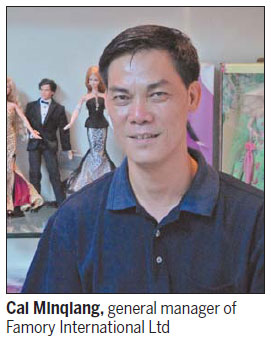
Chaozhou company shows the world that Chinese can also be masters of high fashion
Chinese companies have long been criticized for their lack of creativity, with the main strategy often being to follow Western firms in the same industry. But clothing company Famory International Ltd is quite the opposite.
The wedding and evening dress company based in Chaozhou has made a name for itself and the city by impressing overseas companies with the uniqueness of its products, which combine traditional Chao embroidery with Western dress styles.
"Creative designs are the essence of products. If a brand cannot show new things to the markets, then half of its vitality has been taken away," says Cai Minqiang, general manager of Famory International Ltd.
With a team of about 30 designers and more than 300 assistants, the company releases more than 6,000 styles of dresses a year. Its designs won many international brands' recognition, such as Vera Wang, David's Bridal and Mon Cheri in the United States and Pronovias in Europe.
Famory's predecessor was the state-owned Chaozhou Chao Embroidery Factory, which was formed through the merger of 13 local Chao embroidery workshops in 1955, and was the only factory that made embroidery products.
When Cai entered the factory in 1977, this factory was struggling as market demand decreased. In his spare time, Cai began collecting and recording stitching techniques of Chao embroidery, which has more than 1,000 years of tradition.
"I've collected about 200 embroidery techniques, just to learn the embroidery skills, but I didn't expect that these will actually become a wealth for me as well as for the company," he says.
Cai says that the factory started doing processing with supplied materials and designs for clients in Hong Kong in early 1980s, but the whole situation didn't see much change until 1984.
That June, a Hong Kong client asked them to help make a sample for a US customer, by attaching pearls weighing 2 kilograms on a silk dress.
"Attaching pearls on silk that is as thin as a cicada's wing is very difficult, as it'll easily break the material or make it out of shape. The client had talked to many companies but no one took the job, so they came to the hometown of Chao embroidery to seek a solution," says Cai, who was the head of the evening dress making department then.
It took the most experienced workers one week to figure out the solution, after trying many stitching techniques. For the following six months, the factory got orders of 20,000 beaded dresses from the client and it made the factory profitable.
"This experience enlightened me that when the traditional art is connected with the fashionable Western dresses, it could mean good business opportunities," he says.
Around 1988, the factory started to collaborate with European and US brands, which brought its beaded dresses to the Western markets and received praise.
To expand the production, the factory imported professional wedding and evening dress production lines. By 1993, it could make about 150,000 wedding dresses a year. In 1995, it also imported 20 lace production lines, with an annual production of more than 10 million yards of lace.
But Cai Minqiang was not satisfied with making products for other brands. In 1993, the stated-owned factory was transformed into a company, and started building its own designer team. In 1996, it registered its own brand Famory in the US, which symbolizes "famous" and "memory".
"At that time, most companies had not realized the importance of designers," Cai says.
"When they began to see how important designs are, we already had in place a well-organized designer team that could design thousands of styles a year for clients to pick up."
The company has now seven units and branches in Hong Kong and Germany. It produces 600,000 to 800,000 dresses a year, the market prices of which range from $700 to $1,200. More than 95 percent of its products are sold in the Western markets, of which, about 30 percent are under its own brand.
Cai says all these achievements can be attributed to their focus on cultivating designer teams for the past two decades.
A milestone for Famory was its own show for the Milan Fashion Week in 2006. It was the first time that some Chinese brands were introduced to the West officially. That show brought Famory $1 million of orders on the spot and great compliments, but for Cai, it also reflected the gap between Chinese designers and their Western counterparts. That inspired Cai to cultivate local designers.
That same year, the company invested 15 million yuan and launched the Famory Cup National Wedding Dress Design competition and Famory Cup National Evening Dress Design Competition. Providing workshops, cloth materials and techniques, Famory has helped local designers and students complete many excellent works.
Cai says that the company has been busy preparing about 48 new designs that will be showcased at the forthcoming China Fashion Week. Once again, Famory is ready to surprise the audience again.
Contact the writers through chenyingqun@chinadaily.com.cn
(China Daily 03/29/2013 page12)
 Li Na on Time cover, makes influential 100 list
 FBI releases photos of 2 Boston bombings suspects
 World's wackiest hairstyles
 Sandstorms strike Northwest China
 Never-seen photos of Madonna on display
 H7N9 outbreak linked to waterfowl migration
 Dozens feared dead in Texas plant blast
 Venezuelan court rules out manual votes counting
Most Viewed
Editor's Picks

|

|


|

|
|

|
Today's Top News
Boston bombing suspect reported cornered on boat
7.0-magnitude quake hits Sichuan
Cross-talk artist helps to spread the word
'Green' awareness levels drop in Beijing
Palace Museum spruces up
First couple on Time's list of most influential
H7N9 flu transmission studied
Trading channels 'need to broaden'
US Weekly

|
|