US cities make pitch to high-spending Chinese, Brazilian tourists
Updated: 2015-03-25 11:32
By Amy He in New York(China Daily USA)
|
||||||||


 |
|
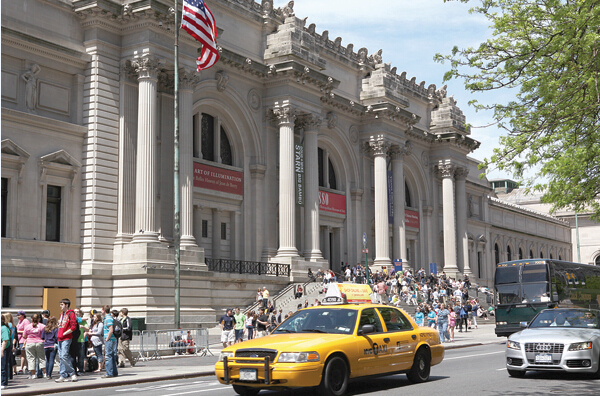
The Metropolitan Museum of Art in New York City. The city announced its new target of 67 million annual visitors by 2021, hoping to woo international tourists like the Chinese and Brazilians, who are big spenders on trips. [Provided by NYC & Company] |
New York City hopes to reach 67 million annual visitors by 2021, and a big part of the plan is attracting big spenders from places like China and Brazil.
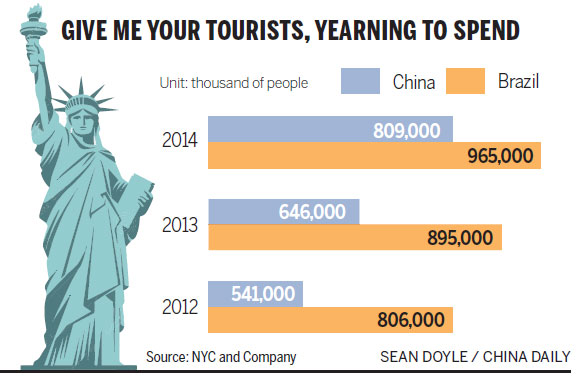
Of that 67 million goal, New York expects 16 million will come from international markets, and 51 million stateside. Based on city figures, 965,000 tourists came from Brazil, and 809,000 from China last year, which ranked Nos. 2 and 3 in international tourism to the city.
"China's been growing a little faster in percentage from a rate-of-growth perspective, so China's been a huge growth market for us," said Christopher Heywood, spokesman for NYC & Company, the city's official tourism bureau. "Brazil in the last few years has also been [growing], and it still will grow this year, but our big focus is on China."
An informal survey by China Daily of major US tourist cities finds that the Chinese and Brazilians are substantially increasing their visits.
New York expects 1 million visitors from China by the end of 2018, Heywood said.
Only a few years ago, Brazil and China were not ranked in the top three international markets for New York, but have overtaken European markets such as France, Germany, and Italy.
"One thing about Brazil and Chinese is they don't mind coming in the winter months, so for Lunar New Year, a lot of our Chinese visitors come during that period," Heywood said. "The Brazil market, they don't mind the novelty of being in the snow and being in the cold, so they don't mind coming in those winter weather months, which is exactly the time of year we want to fill the gap and create more demand during the first quarter," Heywood said.
Las Vegas is seeing a steady increase of travelers from the two countries, which along with Australia, have been major growth markets for the gambling capital, despite not having direct flights to any of the three countries.
"Our market share and growth has been very good, and our growth in Las Vegas over the last three years has been slightly higher than the growth to the US from China, so we feel very comfortable about that," said Rafael Villanueva, senior director of international sales for the Las Vegas Convention and Visitors Authority.
"We realize that we're not going to go out there and get gobs and millions immediately, so we want to do it correctly," he said. "As the second-tier cities in China start opening up, that's going to be our volume market."
Those are the visitors who are going to the US to experience what Villanueva called the "sampler plate". He said "they came and visited 10 cities in the two to three weeks they were here, and now they're coming to the US to spend a little more time in San Francisco, Los Angeles and Las Vegas".
Las Vegas welcomed 300,000 visitors from China in 2013, up from 263,000 in 2012, and 187,000 from Brazil in 2013, up from 161,000.
"The great thing about the Brazilians is that they're here for everything we have," Villanueva said. "They're the ones that want to shop like crazy; they want to go see the shows and entertainment. They love to come to Las Vegas because it also fits into the mix where they can go have dinner at 9 or 10 at night, which they can't do in other places, and that's the time when they have dinner back home. They're here to hit the nightclubs, no matter what age."
For Miami, Brazil makes up the largest international tourist source. Nearly 800,000 Brazilians visited Miami in 2014, and from 2011 to 2014, Miami saw 15.5 percent growth from Brazil. The city is the US destination for 38 percent of Brazilian tourists.
"Many of them come for shopping," according to Gisela Marti, vice-president of marketing and tourism at the Greater Miami Convention and Visitors Bureau. "Things are so expensive in Brazil. They also love our attractions and sightseeing. They also enjoy the ambiance; there's a very international ambiance in Miami. There's a large Brazilian community in Miami, so there's a large sense of feeling at home also."
The Chinese, on the other hand, make up a much smaller portion of Miami's visitors, but there is growth, Marti said. The city doesn't have specific data on the number of Chinese tourists, only air studies completed by the city's airport air service consultant, and it estimates that the Miami market generated 55,000 Chinese passengers in 2014.
"This past February for the New Year holidays, we had close to 1,000 visitors just in the month," Marti said. "Many of them were going on cruises or just staying in Miami for a few days before heading back home."
amyhe@chinadailyusa.com
 Families mourn victims of Airbus A320 crash
 38,000 Brazilian troops to safeguard 2016 Rio Olympics
 Top 9 cities in China with highest cost of living
 Would you take a challenge for charity?
 Snow blankets Chicago after spring storm
 Haze descends on Paris
 Tokyo's plans to build new US base possibly scuppered
 Conversation topics only heard in China
Most Viewed
Editor's Picks

|

|


|

|

|

|
Today's Top News
China, US work to clear legal hurdles
Cockpit voice recorder of crashed German plane found
US states reach out to China
Chinese investors well received
US states seek China ties at investment summit
Small US businesses using RMB for transactions: Survey
Iconic Chinese play hits America
Christie's has richest Asia Week
US Weekly

|

|