China buys from the world, while remaining at home
Updated: 2015-10-07 09:03
By Wang Chenxi(China Daily)
|
||||||||


 |
|
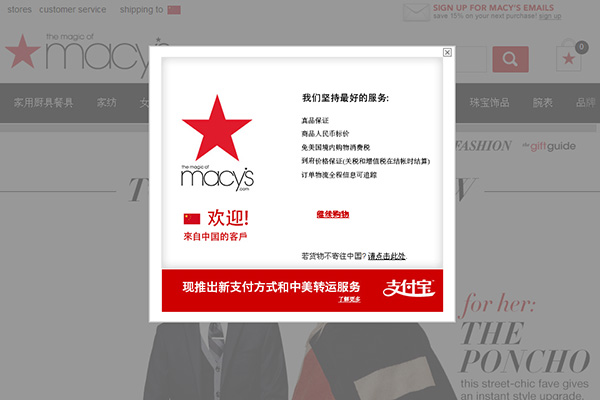
The homepage of US retailer Macy's has a pop-up in Chinese, saying all goods are priced in yuan and can be delivered to China. [Photo from Macy's website] |
For e-commerce giant Amazon and its competitors, including Alibaba, new opportunities have opened since last year.
On Aug 20 last year, Amazon China announced it would begin cross-border online shopping in the Shanghai Free Trade Zone. Chinese buyers could go to Amazon websites in the US and other countries to buy online and receive shipments in a week to 10 days with lower delivery costs.
Amazon has tactically changed the "proxy" mode of overseas online shopping, whereby a Chinese buyer pays a proxy to buy goods abroad, and the proxy dispatches the goods as personal items.
The proxy mode has several risks, such as fake goods provided by the proxy, delivery delays, and documentation and tax issues during Customs clearance.
Amazon's bonded warehouses mode is easier and cheaper. With the help of data collected over the years, Amazon can forecast orders and send goods in advance by sea to Shanghai Free Trade Zone bonded warehouses. Amazon sends the items from Shanghai after a Chinese buyer makes a purchase.
Big players in China's e-commerce sector, such as Alibaba and 360buy, have followed Amazon to open overseas channels. They cooperate with foreign retailers to sell seafood from Alaska, avocados from Mexico, or even million-yuan jetpacks designed in New Zealand. Many e-commerce companies also use bonded warehouses to import mass consumption goods, such as infant formula powders, diapers, vitamin pills and cosmetics.
Improved logistics and supply systems will further unlock overseas market potential. According to the 2015 China Cross-border Online Buyer Report issued by Internet industry consultancy iResearch, only 15.3 percent of online shoppers have bought from overseas. They chose foreign-made commodities because of better quality (67.8 percent) and price (65.5 percent), and because goods are unavailable in China (52 percent).
Chen Fengying, head of the World Economy Research Center at the China Institutes of Contemporary International Relations, says overseas shopping will boost the world economy and create jobs abroad.
"We are now not only makers, but also buyers. A growing part of China's 1.3 billion population is entering the middle class with surging demand. It is the whole world's opportunity."
- Russian warplanes hit IS targets in Syria
- Senior US envoy to visit Japan, S Korea, China
- Russia, US agree to cooperate in solving Syria crisis: Russian FM
- Iranian President calls Iran deal victory over war
- LatAm experts praise Xi on yuan, globalization
- Evidence found of summertime water flows on Mars: study
-
 Rising yuan use may lift IMF basket prospects
  China wins first Nobel in medicine
-
Gary Locke: Candor key to relations
-
Saving Chinese folk songs
 Candlelight vigil for Oregon shooting victims
 Chinese people's pursuits in different eras
 Ten highlights from Xi's trip to US and UN
 Top 10 life-changing benefits from Xi's US visit
Most Viewed
Editor's Picks

|

|


|

|

|

|
Today's Top News
Tu first Chinese to win Nobel Prize in Medicine
Huntsman says Sino-US relationship needs common goals
Xi pledges $2 billion to help developing countries
Young people from US look forward to Xi's state visit: Survey
US to accept more refugees than planned
Li calls on State-owned firms to tap more global markets
Apple's iOS App Store suffers first major attack
Japan enacts new security laws to overturn postwar pacifism
US Weekly

|

|