Fortune squandered without recycling
Updated: 2012-08-06 09:40
By Zheng Xin (China Daily)
|
||||||||


Careless e-waste disposal pollutes environment
|
 |
|
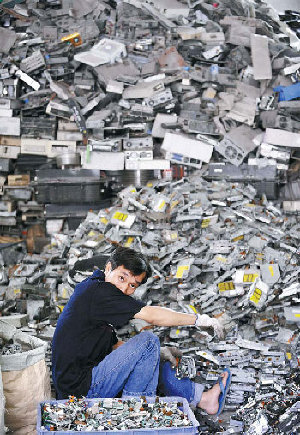
A worker at an e-waste disposal workshop in Shantou, Guangdong province, has a rest on May 31. [Photo/ Xinhua] |
Few people realize that the unwanted gadgets could be a gold mine - literally.
About 320 metric tons of gold and more than 7,500 tons of silver - together worth $21 billion - are used each year in manufacturing electronic devices.
Most of those valuable metals are lost - less than 15 percent are recovered through "urban mining" of e-waste, according to a report by the United Nations University in July.
China is the second-largest producer of e-waste, with an estimated 2.3 million tons of such waste generated annually, trailing only the United States, by 0.7 million tons, according to the report.
Experts estimate that by 2020, the amount of e-waste being disposed of will be four times that of 2007, and developing economies will be the largest receptacles.
"Precious metal 'deposits' in e-waste are 40 to 50 times richer than ore mined from the ground," said Lai Yun, director of the pollution control project at Greenpeace China. "The quantities of gold, silver and other precious metals available for recovery are increasing in tandem with fast-increasing sales of electronic and electrical goods."
Computers, for example, are 54 percent steel, 20 percent copper and aluminum, 17 percent plastic and 8 percent circuit board, all valuable when they are recycled.
This could be a very lucrative business, he said.
So what is preventing China from tapping into that potential? According to Lai, the problem lies purely with a lack of recycling channels and financial incentives.
A study by the E-waste Civil Action Network, a Beijing NGO, found that convenience is the first thing most people take into consideration when disposing of used electronic products.
Without convenient channels for the public to recycle e-waste, most people choose either to put the devices aside somewhere or dispose of them together with other household trash, the study found.
Up to 60 percent of Chinese consumers, however, choose to sell the devices to reclaimed waste collectors or secondhand markets, which are easily found in some neighborhoods.
Discarded computers and other high-end appliances are then sent by truck to unlicensed workshops for illegal processing, mainly in Zhejiang, Hebei or Guangdong provinces, all hubs for the underground disposal market.
"It's impossible for us to allocate personnel to all households to collect the e-waste - the cost would simply be too high for us," said Yuan Jie, manager of the Green Spring Environmental Co, one of the four qualified operations in Beijing that process e-waste and send recycled materials to manufacturers, such as Shougang Group, a steel company in Beijing.
The company gets the devices from the public, which can call a hotline to arrange for their collection. However, with an average of 100 devices collected each month, the supply is far from adequate for the company.
And many people say they have never heard of the hotline.
"I usually give e-waste away or sell it to local vendors, who are right in the community and come pick up the devices," said Wang Yu, 26, a Beijing resident. "Most of my neighbors do the same thing."
Yuan said Green Spring began to have a sufficient supply of e-waste starting in 2008, thanks to a home appliance trade-in policy that gave people a discount on purchases of new electronic equipment for handing in their used ones.
"Individuals were paid to encourage them to turn in used electronic appliances and worn-out goods," he said. "Most of those appliances ended up in our station, and were turned into useful material without polluting the environment."
 Relief reaches isolated village
 Rainfall poses new threats to quake-hit region
 Funerals begin for Boston bombing victims
 Quake takeaway from China's Air Force
 Obama celebrates young inventors at science fair
 Earth Day marked around the world
 Volunteer team helping students find sense of normalcy
 Ethnic groups quick to join rescue efforts
Most Viewed
Editor's Picks
|

|


|

|

|

|
Today's Top News
Health new priority for quake zone
Xi meets US top military officer
Japan's boats driven out of Diaoyu
China mulls online shopping legislation
Bird flu death toll rises to 22
Putin appoints new ambassador to China
Japanese ships blocked from Diaoyu Islands
Inspired by Guan, more Chinese pick up golf
US Weekly

|

|