ADB urges China to impose 'green' tax
Updated: 2012-08-16 11:18
(Xinhua)
|
||||||||


MANILA -- The Chinese government needs to implement a green taxation system to attain its target of reducing pollution and promote sustainable economic growth, the Asian Development Bank said Wednesday.
In "Toward an Environmentally Sustainable Future," ADB's latest report on Chinese environment, ADB analysts recommended that Chinese policymakers impose taxes on resource extraction and pollutant and carbon dioxide emissions.
ADB analysts also suggest that China can offer tax cuts to companies to offset investments in pollution control equipment, raise resource rent taxes, and taxes on luxury goods and "one- time consumer goods."
The Manila-based lender said such fiscal incentives are crucial given that rapid economic growth in China has also resulted to several environmental problems including water and air pollution and increased volume of solid waste.
"While China's environment has improved in many respects, the overall situation continues to deteriorate as environmental pressures increase," Robert Wihtol, Director General of ADB's East Asia Department said in a statement.
The ADB noted the progress that China has made in the past five years to reduce pollution and manage its solid waste problem. China'sd investment on environmental infrastructure, its focus on achievable targets, and strengthened accountability and enforcement has reduced chemical oxygen demand and sulfur dioxide emissions by 10 percent. Energy consumption per unit of GDP was cut by nearly 20 percent albeit robust growth.
The Chinese government has also made major advances in the control of industrial and domestic point sources of water pollution.
That said, the ADB noted that water and air pollution remain a problem.
Pollution from runoff of fertilizer, pesticides, and discharges from intensive animal production facilities pollute the country's water supply. Seven of China's biggest cities are among the 10 most polluted cities in the world, mostly due to vehicle emissions.
Industrial solid waste management is also a challenge.
The ADB urges the Chinese government to change an " unsustainable growth pattern."
Aside from implementing a green taxation system, the ADB is encouraging the government to invest in natural resources. It is also calling for the formation of a national regulatory framework of "eco-compensation," an initiative where the government or private sector pays for ecological services protection by households, communities, or local governments.

 Relief reaches isolated village
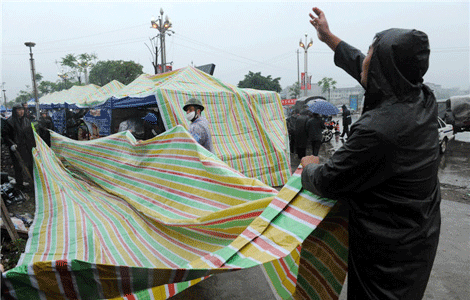 Rainfall poses new threats to quake-hit region
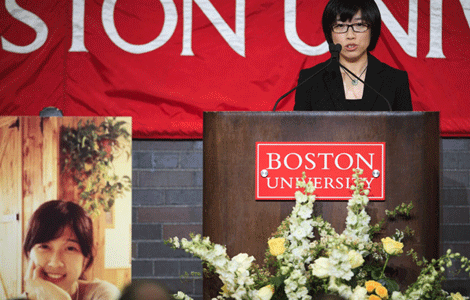 Funerals begin for Boston bombing victims
 Quake takeaway from China's Air Force
 Obama celebrates young inventors at science fair
 Earth Day marked around the world
 Volunteer team helping students find sense of normalcy
 Ethnic groups quick to join rescue efforts
Most Viewed
Editor's Picks
|

|


|

|

|

|
Today's Top News
Health new priority for quake zone
Xi meets US top military officer
Japan's boats driven out of Diaoyu
China mulls online shopping legislation
Bird flu death toll rises to 22
Putin appoints new ambassador to China
Japanese ships blocked from Diaoyu Islands
Inspired by Guan, more Chinese pick up golf
US Weekly

|

|