Taxing times for China's tax reformers
Updated: 2012-08-20 09:02
By Wei Tian (China Daily)
|
||||||||


Changes in VAT will benefit some companies but hurt others: Experts
It has been quite a busy month for Su Chenhui, financial manager at LabCorp Clinical Trials, but more challenges seem to lie in the months ahead.
|
 |
|
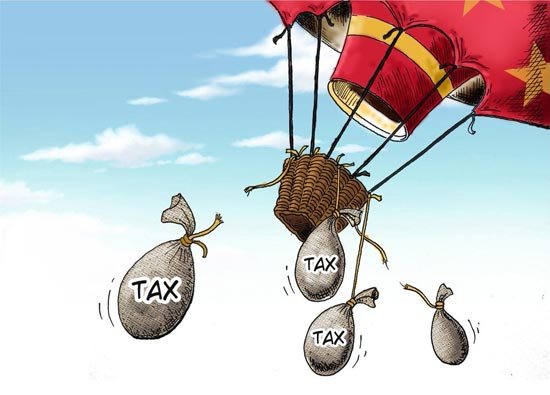
A series of policy measures adopted by Chinese authorities seems to have had little positive effect on the world's second largest economy, which expanded at its slowest pace in three years in the second quarter at 7.6 percent. However, tax reform is likely to give a shot in the arm to industries because it will lead to a reduction in tax bills of more than 100 billion yuan ($16.7 billion) once expanded nationwide, experts say. [Photo/China Daily] |
To prepare his company for the value-added tax reform that will become effective on Sept 1, Su has been sent to two training sessions organized by the local tax bureau and his tax adviser.
What Su has learned was that there might be more paperwork to deal with, tougher supervision from authorities and the possibility of renegotiating contracts with clients of his company, a Beijing-based US medical test service provider.
Fortunately, however, all the hard work will pay off once his company adopts VAT instead of business tax.
"Under the new system, the company will be eligible for a deduction of 17 percent VAT in our material costs, mainly reagent in our case, which accounted for about 40 percent of our revenue.
"That will translate to a saving in taxation equivalent to 6.8 percent of our revenue, which is even more than the 6 percent VAT we are required to pay," Su said.
LabCorp's case is not unique, as the policy will also benefit 138,000 other corporate taxpayers in modern-service and transportation sectors that will be involved in the tax reform in the capital city.
Instead of paying business tax on all transactions in the industrial chain, modern service providers will pay 6 percent VAT. Transporters will be charged 11 percent VAT. Both levies are deductible with the input tax receipt from their suppliers.
According to a statement from the local tax authorities, the program is expected to save Beijing's businesses 16.5 billion yuan ($2.6 billion) a year.
"As for our company, it is reflected in a lower break-even point," Su said.
"We would have to achieve at least 24 million yuan annual sales before starting to make profits if still paying business tax but, under VAT, the company could start making money at 20 million yuan sales."
Backed by the favorable conditions, LabCorp Clinical Trials Beijing is expecting a 15 percent growth in annual revenue, according to the financial manager.
This is exactly the result policy makers want to see when they pushed forward VAT reform in the first place. Later it will be expanded across eight other provinces.
Booster of confidence
Business tax applies to a production process, with the tax rates varying from 3 to 15 percent according to different sectors, while VAT is deduced from the difference between a commodity's price before taxes and its cost of production.
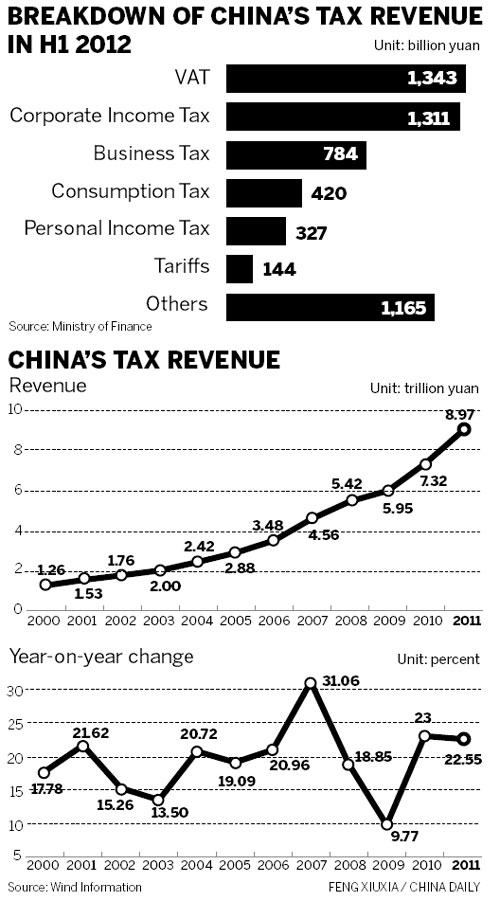
VAT and business tax together accounted for more than 50 percent of China's tax revenue in 2011.
Following Beijing on Sept 1, VAT will be further applied to the transport sector and some modern service industries, replacing business tax, in the provinces of Jiangsu and Anhui on Oct 1, Fujian and Guangdong on Nov 1 and Tianjin, Zhejiang, and Hubei on Dec 1.

 Relief reaches isolated village
 Rainfall poses new threats to quake-hit region
 Funerals begin for Boston bombing victims
 Quake takeaway from China's Air Force
 Obama celebrates young inventors at science fair
 Earth Day marked around the world
 Volunteer team helping students find sense of normalcy
 Ethnic groups quick to join rescue efforts
Most Viewed
Editor's Picks

|

|


|

|

|

|
Today's Top News
Health new priority for quake zone
Xi meets US top military officer
Japan's boats driven out of Diaoyu
China mulls online shopping legislation
Bird flu death toll rises to 22
Putin appoints new ambassador to China
Japanese ships blocked from Diaoyu Islands
Inspired by Guan, more Chinese pick up golf
US Weekly

|

|