Swedish firm finds its bearings
Updated: 2012-10-25 09:14
By He Wei in Shanghai (China Daily)
|
||||||||


China's slowing growth fails to dent SKF's enthusiasm
Even two decades later, Rakesh Makhija, president of SKF Group AB's Asia operations, still recalls his very first experience of China.
|
 |
|
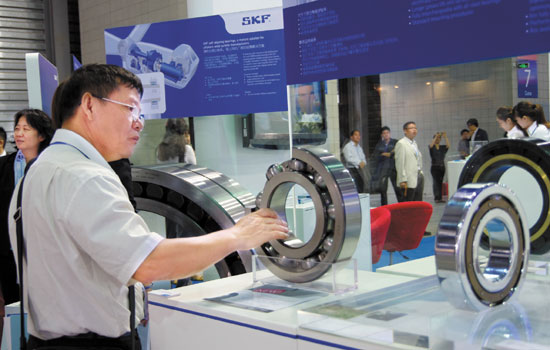
SKF wind generator bearings on display at the 2012 Offshore Wind China Conference & Exhibition, in Shanghai, on May 30. [Photo/China Daily] |
He remembers it was around 11 pm that he looked up from his book, glanced at the snaking waters below him, took in the squared-off landscape and realized the aircraft he was in was about to land at Shanghai's Hongqiao airport.
Upon arrival, he recalled the neon-lit night in Hong Kong, from where he departed. Memories of it still lingered as he made his way to a dimly lit room the size of a basketball court that constituted the terminal.
The luggage was dumped on to a creaking conveyor belt mottled with stains.
"Those must be really poor bearings," Makhija thought.
He grabbed his bag and hopped on a hotel shuttle bus, seeing it as a sanctuary amid thousands of bicycles scattered around the exit.
The year was 1991.
It's become a clich to say China underwent tremendous changes in the subsequent years. But Makhija said he is more than a witness to the country's achievements. His company joined the influx of Western businesses and began "riding the largest ever industrialization boom".
SKF Group AB, a Swedish bearing-to-lubrication conglomerate, celebrated its centennial in China in early September. As in many business narratives, SKF's early presence in China followed the route of appointing an agent, setting up a sales company and, after decades of inactivity, resuming business and introducing manufacturing facilities following the launch of the reform and opening-up policy.
It makes products for a range of sectors including automobiles, aerospace, wind energy, construction and industrial transmission.
But its China ambitions were not turned on full-force until SKF China Investment Co began operations, Makhija said.
"Back in the early 1990s, there were a lot of discussions about massive industrial development in China, notably in areas such as oil, gas, automobiles, refinery and steel plants," he said.
At that time he had yet to join SKF, but he could not help noticing the unlocked market potential.
Makhija was trained as a chemical engineer in his hometown in India and spent his early career days in Europe. He brought with him technical expertise garnered from a global chemical giant, where he worked in the oil and gas business, both onshore and offshore.
Makhija said the combination of engineering and business management makes him perfectly positioned for his current post. "It gives you a strong base to build on," he said.
 Relief reaches isolated village
 Rainfall poses new threats to quake-hit region
 Funerals begin for Boston bombing victims
 Quake takeaway from China's Air Force
 Obama celebrates young inventors at science fair
 Earth Day marked around the world
 Volunteer team helping students find sense of normalcy
 Ethnic groups quick to join rescue efforts
Most Viewed
Editor's Picks
|
|


|

|

|
|
Today's Top News
Health new priority for quake zone
Xi meets US top military officer
Japan's boats driven out of Diaoyu
China mulls online shopping legislation
Bird flu death toll rises to 22
Putin appoints new ambassador to China
Japanese ships blocked from Diaoyu Islands
Inspired by Guan, more Chinese pick up golf
US Weekly

|

|