Making it all work in the real world
Updated: 2012-11-09 16:22
By Zhang Haizhou (China Daily)
|
||||||||


Beijing Hyundai, a joint venture established about a decade ago by the South Korean carmaker, is also now in partnership with Chongqing Lixin Vocational Education Center to train workers in the required skills.
Tan Sheng, a teacher in automobile repair at Lixin, says Germany's world leading global supplier of technology and services, Bosch, and the Japanese carmaker Toyota, have also set up classes there.
"More and more such programs have been set up in China in recent years."
The increasing prevalence of such projects highlights the growing importance China attaches to vocational education, but experts say there is still a long way to go before they can meet the demand from foreign companies.
|
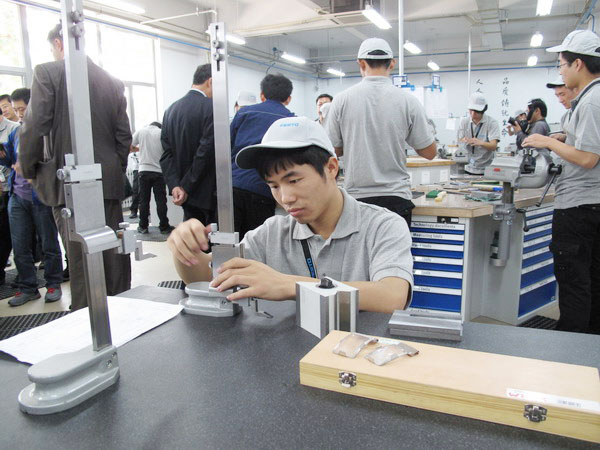 Apprentices practices at a training center of Festo (China) Production Ltd. [Photo/China Daily] |
These projects are just provisional measures taken by companies because there are no better options, says Feng Xiao, director of Tongji University's Institute of Vocational Instructors in Shanghai.
"The problem is how to address the loss of trained talent," he says, referring to the exodus of many skilled workers to other companies.
In Festo's case, apprentices have signed a contract to work at the company for at least three years after graduation.
Buschfeld, of the AHK in Shanghai, points out the limits foreign firms face when signing contracts with their apprentices. She says there is "no status of apprenticeship" in China's labor laws, so the contracts are not strictly binding.
She says this is a major challenge for her organization when promoting "dual education" in China.
Another drawback, Buschfeld says, is the perceived quality of the country's vocational training system. Normally, the better performers in the annual national college entrance exam go to universities, while those with lower grades turn to vocational colleges.
Buschfeld also sees the low respect paid to blue-collar work as a hurdle to promoting vocational education in China. In Germany, she says, many company bosses started off as apprentices.
However, she remains optimistic about promoting German-style vocational education in China, because "Chinese leaders are so open-minded" now and the "mind of the people has changed a lot".
Festo apprentice Wu is also optimistic about his future, especially since his first job is already secured.
"No matter what position I finally get here after I graduate, I'll be diligent and try my best to win promotion. Going to Germany? That will always be my target."
Cecily Liu contributed to this story.
zhanghaizhou@chinadaily.com.cn
 Relief reaches isolated village
 Rainfall poses new threats to quake-hit region
 Funerals begin for Boston bombing victims
 Quake takeaway from China's Air Force
 Obama celebrates young inventors at science fair
 Earth Day marked around the world
 Volunteer team helping students find sense of normalcy
 Ethnic groups quick to join rescue efforts
Most Viewed
Editor's Picks

|

|


|

|

|

|
Today's Top News
Health new priority for quake zone
Xi meets US top military officer
Japan's boats driven out of Diaoyu
China mulls online shopping legislation
Bird flu death toll rises to 22
Putin appoints new ambassador to China
Japanese ships blocked from Diaoyu Islands
Inspired by Guan, more Chinese pick up golf
US Weekly

|

|