L'Oreal's alluring number: 1 billion
Updated: 2012-11-23 15:39
By Yao Jing (China Daily)
|
||||||||


L'Oreal came to China in 1997, starting from four brands to 20 today, including Garnier, Kerastase, Lancome, L'Oreal Paris, Matrix, Maybelline, Vichy and Yue-Sai.
In the fist half of this year, the company's mass-beauty division had turnover of 5.45 billion euros, a rise of 4.7 year-on-year, while turnover in the luxury division, though just under half that amount, rose at more than double the rate.
In China, the situation is almost the same.
"Luxury is expanding geographically in China while mass is already everywhere," Perakis-Valat says.
For L'Oreal that means grabbing a greater share of the mass market and beating others to take luxury cosmetics to new cities, he says.
|
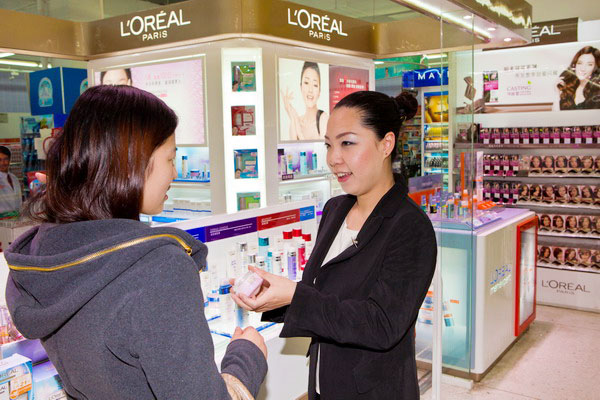 A saleswoman introduces L'Oreal products to a potential customer. L'Oreal China says it is dedicated to research and innovation to serve the needs of Chinese and Asian consumers. [Photo/China Daily] |
Another component of staying ahead is research and innovation, something in which L'Oreal takes particular pride. It boasts that it has research centers worldwide, and that last year alone it spent 720 million euros on research and registered more than 600 patents. But that innovation and experimentation is not limited to chemicals and test tubes.
Electronic skin-care devices are now emerging as an important market category, and L'Oreal plans to introduce Clarisonic, a market leader in such devices, to China at the end of this month.
L'Oreal completed its acquisition of Pacific Bioscience Laboratories Inc at the end of last year, Perakis-Valat says, and "we hope to grab the opportunity in instrumental cosmetics in China also".
While such devices may have universal appeal, L'Oreal, after 104 years in business, is wise enough to know that with certain products you have to carefully choose your markets.
"Beauty is not a one-size-fit-all business," Perakis-Valat says. "We have to respect diversity and should not come up with one brand that serves all the needs."
More than 70 percent of what it sells in China is specifically formulated for this marketplace, the company says. Maybelline BB cream is a case in point.
"Chinese women want their skin to look much more natural, with much less covering and more hydrating," he says. "This was developed for China and in China, and now other countries have adopted it."
 Relief reaches isolated village
 Rainfall poses new threats to quake-hit region
 Funerals begin for Boston bombing victims
 Quake takeaway from China's Air Force
 Obama celebrates young inventors at science fair
 Earth Day marked around the world
 Volunteer team helping students find sense of normalcy
 Ethnic groups quick to join rescue efforts
Most Viewed
Editor's Picks
|
|

|
|
|
|
Today's Top News
Health new priority for quake zone
Xi meets US top military officer
Japan's boats driven out of Diaoyu
China mulls online shopping legislation
Bird flu death toll rises to 22
Putin appoints new ambassador to China
Japanese ships blocked from Diaoyu Islands
Inspired by Guan, more Chinese pick up golf
US Weekly

|
|