Arming itself for a new business
Updated: 2012-12-17 10:51
By Gao Yuan (China Daily)
|
||||||||


China will play a more important role in 2013 for ARM Ltd, a British multinational semiconductor and processer design company, whose technology is powering nine out of 10 smartphones globally, one of the company's executives said.
|
 |
|
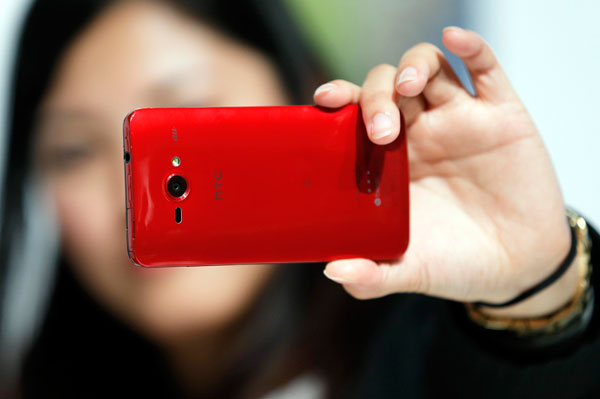
An employee testing the picture quality of the HTC J Butterfly smartphone, produced by HTC Corp. Hot demand for smartphone chips, triggered by a surging number of cellphone subscribers worldwide, has led to tough market competition between suppliers. [Kiyoshiota/Bloomberg] |
"China is absolutely a key market for us both in terms of manufacturing and as the end market," said Graham Budd, chief operating officer of ARM. "Over the last two years, ARM has seen strong growth in the tablet market using China-developed silicon components."
Unlike other microprocessor companies, ARM licenses its technology as intellectual property, rather than manufacturing its own products. Companies such as Qualcomm Inc, Samsung, Nvidia and Texas Instruments have all licensed ARM technology.
As China adopts more cutting edge technology such as communication network infrastructure, the company, based in Cambridge, in the United Kingdom, is ready to face the challenge from competitors including Intel Corp, the world's top microprocessor maker.
"ARM is better placed in China than its competitors such as Intel because of its partnership and business model," said Budd. "We have a broad ecosystem that has already been developed for ARM technology."
The competition between ARM and Intel heated up this year after the United States company announced plans to reenter the mobile chip making sector. In 2006, Intel sold its mobile processor business to Marvell Technology Group for about $600 million as well as other liabilities.
In November, Intel announced it would ship 22 nanometer chips for smartphones. The new chip "will be ready for high-volume manufacturing in 2013," said Intel.
Industry insiders believe the return of Intel could put a lot pressure on ARM, the current No 1 in the sector.
But Budd is not taking Intel's threat seriously. He predicted that Intel will only have a "single digit" market share in the mobile sector by the end of 2013.
"The first few already-launched devices based on Intel's X86 technology are at least a generation behind the devices powered by ARM-based devices in terms of performance and power consumption," Budd said, adding that current X86-based devices are mid-range handsets.
But Intel's deep pockets will help it to maintain heavy investment in technology development.
In October, six out of 10 of the latest investment deals announced by Intel Capital, Intel's investment subsidiary, were startup companies delivering services in the mobile sector. The company's chief executive officer, Paul Otellini, also pledged to beef up its research and development team in making chips for mobile devices, such as tablets and smartphones.
Budd said that competition with Intel is not like it was in the old PC world because ARM has been offering a completely different business model in the mobile chip manufacturing market.
"We are enabling many chip-making companies to produce complex systems on chips, making Intel just one of many companies providing solutions," he said. And while ARM's R&D continues to make progress, Intel will never catch up, Budd argued.
ARM is also eyeing the personal computer chip market, a territory long-claimed by Intel.
ARM-based PC chips will take about 10 percent of the global market share by the end of next year, a report released by Morgan Stanley predicted.
"The market is changing very quickly. You had the PC and now you have mobile computing devices and the boundary in the middle is not clear. There are hybrid devices," said Budd, adding that much of the 10 percent market share will be generated by devices that cannot be categorized as PCs.
Looking forward, ARM sees China as one of the biggest buyers of such devices.
"The Chinese smartphone market is different from other regions because it has grown from a very low base but enjoyed a very rapid growth in adoption in both mobile handset technology and tablets," he said.
In addition, the lower end of the market in the country is, and will remain, big, another thing ARM wants to see.
"If the market needs low-cost products or high-performance devices, we can enable semiconductor manufacturers to produce chips to meet the different demands," said Budd. "Everything in China is happening very fast in terms of technology adoption."
Nonetheless, the speed at which China adopts new technology will also post challenges to the company.
The biggest difficulty for ARM is responding quickly to the needs of the local market, said Budd.

 Relief reaches isolated village
 Rainfall poses new threats to quake-hit region
 Funerals begin for Boston bombing victims
 Quake takeaway from China's Air Force
 Obama celebrates young inventors at science fair
 Earth Day marked around the world
 Volunteer team helping students find sense of normalcy
 Ethnic groups quick to join rescue efforts
Most Viewed
Editor's Picks

|

|


|

|

|

|
Today's Top News
Health new priority for quake zone
Xi meets US top military officer
Japan's boats driven out of Diaoyu
China mulls online shopping legislation
Bird flu death toll rises to 22
Putin appoints new ambassador to China
Japanese ships blocked from Diaoyu Islands
Inspired by Guan, more Chinese pick up golf
US Weekly

|

|