Mental patients may access courts
Updated: 2012-08-28 07:45
By Zhao Yinan (China Daily)
|
||||||||


People who believe they are being forced to receive mental health treatment when they do not need it will be able to take their cases to court, under the proposals in a new draft law.
Institutionalized mental patients and their relatives could be entitled to file lawsuits against administrative agencies, hospitals, other institutes and individuals, if they believe their rights are being infringed, according to the second reading of the draft law on mental health put to lawmakers at the National People's Congress Standing Committee on Monday.
The second reading of the law differs from the first one, put to lawmakers in October, in which mental patients would only be allowed to apply to receive two new medical appraisals if they disagree with their treatment.
The proposed change was made to meet calls for judicial involvement in disputes regarding alleged forced mental health treatment.
There are concerns that forcibly sending people to medical institutions in the name of mental problems could lead to abuses of power.
The change targets patients forced to receive residential treatment because they are considered to "threaten the safety of others or have impeded the safety of others".
Along with allowing a judicial review, the draft law also proposes streamlining the medical appraisal procedure. The first draft version of the law in October allowed patients to apply for two medical appraisals but not take their matters to court if they disagree with residential treatment. Monday's draft, however, only allows them to receive one new medical appraisal before they must turn to the courts for help.
Hong Hu, deputy director of the NPC Law Committee, explained at a bimonthly session on Monday, that the proposed change is to make the system more cost-effective, because it takes 60 days to complete two medical appraisals, which is too long.
Wang Yue, a health law professor at Peking University welcomed the proposals, noting that forced residential treatment can illegally deprive a person of freedom and there should be a means for patients to appeal to prevent abuses of power.
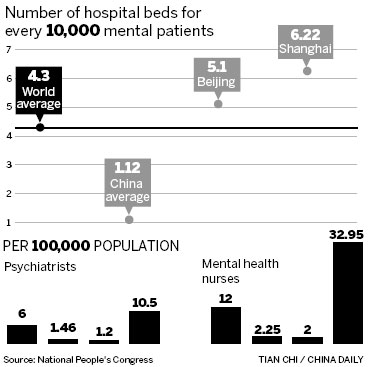
The draft has also asked governments to invest more financial and human resources to promote the mental health industry.
Tang Hongyu, vice-president of Peking University No 6 Hospital, a well-known mental hospital, said mental health facilities and psychiatrists are under-resourced, and many patients cannot receive treatment due to a lack of access to clinics.
A patient surnamed Zhou, who is receiving treatment at Tang's hospital, said he has to travel by bus and train from his hometown in Central China's Henan province to Beijing, because good mental health hospitals in Henan are rare.
Some provinces do not have specialized mental health hospitals and the income of mental health doctors are often lower than doctors providing other kinds of medical services, according to materials provided by the top legislature.
zhaoyinan@chinadaily.com.cn

 Relief reaches isolated village
 Rainfall poses new threats to quake-hit region
 Funerals begin for Boston bombing victims
 Quake takeaway from China's Air Force
 Obama celebrates young inventors at science fair
 Earth Day marked around the world
 Volunteer team helping students find sense of normalcy
 Ethnic groups quick to join rescue efforts
Most Viewed
Editor's Picks

|

|


|

|

|

|
Today's Top News
Health new priority for quake zone
Xi meets US top military officer
Japan's boats driven out of Diaoyu
China mulls online shopping legislation
Bird flu death toll rises to 22
Putin appoints new ambassador to China
Japanese ships blocked from Diaoyu Islands
Inspired by Guan, more Chinese pick up golf
US Weekly

|

|