Earthquakes threaten ancient rock art


 |
|
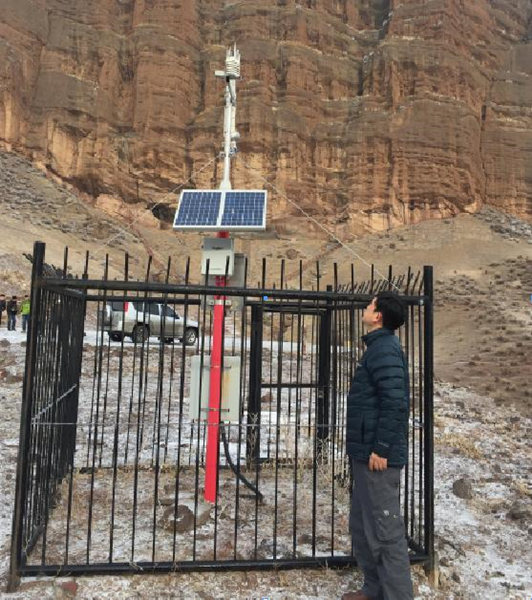
Professor Liu Cheng from Northwestern University in Xi’an, Shaanxi province, checks a weather-monitoring facility during an inspection tour of the Kangjiashimenji petroglyphs after the Dec 8 earthquake hit Hububi county. Photos provided to china daily |
Gao said the authority was currently working with imaging experts so that a scan of the carvings can be carried out to ascertain if any microscopic damage has occurred.
"There may be some damage that is imperceptible to the human eye. We need to compare pictures from these three-dimensional scans to determine what needs to be done," she said.
According to Gao, the China Earthquake Administration have warned that Xinjiang could be experiencing a period of increased seismic activity, as the region was hit by two earthquakes in as many weeks.
Liu Cheng, a professor of archaeology at Northwestern University in Xi'an, Shaanxi province, has also conducted an on-site check of the petroglyphs.
"After an initial look, the earthquake does not seem to have affected the body of the mountain where the petroglyphs are located. But other parts of the mountain were significantly affected, and they could pose a danger to tourists in the future," he said.
Liu urged the authorities to erect signs warning of falling rocks and to take all necessary preventive measures.
"We might also have to control the number of tourists allowed into the scenic area," he said.
Once a detailed analysis of the damage has been carried out, Liu believes more will need to be done to protect the petroglyphs.
While it is not possible to remove or completely shield the carvings from future earthquakes, "we do need to come up with more protection measures, and be prepared for the worst", he said.
The site's remote location, where temperatures fall as low as -15 C in winter, is further hampering efforts to assess the damage using highly sensitive equipment.
xuwei@chinadaily.com.cn