Putting youngsters in the fashion frame
Updated: 2012-08-02 08:00
By Xu Junqian in Shanghai (China Daily)
|
||||||||


|
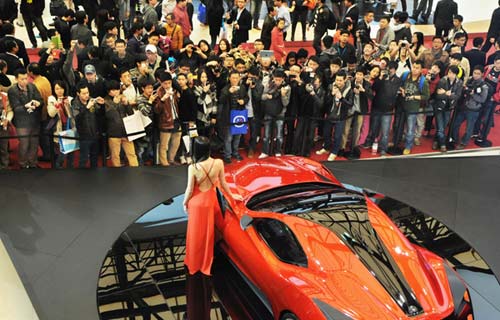
A children's clothing store in Shanghai. Frost & Sullivan predicts that by 2015 the market for youngsters' clothes in China would keep growing at a high rate close to 20 percent annually. Yong Kai / China Daily |

Bonpoint's CEO seeks to dress China's single children in high-end designer clothes
If ever a father enjoys and is actually good at dressing his girls with laced shirts and floral-patterned cotton skirts, that man is Eric Vallat.
For the past couple of years, the father of three daughters and chief executive officer of French high-end children's wear brand Bonpoint has not only been the "free fashion adviser" at home for "four of the most important women in his world", but also a trendsetter that has shaped the wardrobe of such well-publicized figures as Harper Seven Beckham, the latest baby daughter of Victoria and David Beckham, offspring of US President Barack Obama and scions of Hollywood celebrities and European royal families.
Now, at 41, he is setting his sights on the wardrobes of the precious single child in millions of Chinese families.
"I have three most difficult 'customers' at home. I have served them very well and now I think it's time to move on to a more challenging (clientele)," said Vallat while sitting comfortably on a brown sofa in the brand's store in Shanghai's most sleek shopping mall.
"Of course, we don't want to miss the fast train of China," Vallat added.
Founded in 1975, Bonpoint started off as a "mom-and-pop" children's apparel store on the Boulevard Saint-Germain on the Left Bank in Paris, with Marie-France Cohen, the "mom", as the core spirit of the business. A descendant of a Parisian upper-class family, Cohen quickly and successfully made the brand a household name in the world fashion capital by offering what is called "effortless chic for kids".
While the founder has now shifted her interest mainly to charity work, selling the business to French luxury group EPI, where Vallat reigns, the store has remained a cult wardrobe for some of the world's most famous mothers such as Katie Holmes, Angelina Jolie and Kate Moss, who have been known to dress their daughter head-to-toe in signature items such as little pin-tucks and fitted Harris Tweed coats or gorgeous Liberty-print dresses from the store.
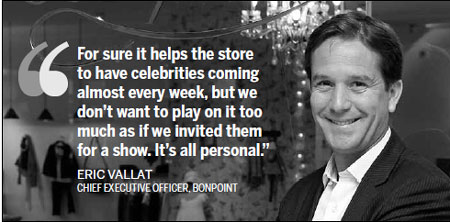
"For sure it helps the store to have celebrities coming almost every week, but we don't want to play on it too much as if we invited them for a show. It's all personal," said Vallat.
But in China, a market the brand entered a mere six years ago, Vallat believes the key to growth is not serving a Suri, (the daughter of Tom Cruise and Katie Holmes and perhaps the world's youngest fashion icon) but dressing millions of Suris from middle-class families, the most powerful customers in the Chinese luxury market.
"In luxury, it always starts with women, then men, then children. In China, it may start with men, gain momentum from women, but now it's definitely the time for children," said Vallat, who has been in the industry since 1996, when he became a store manager for Louis Vuitton Avenue Montaigne, Paris, after leaving the bank industry.
A report released in October by the US business consulting firm Frost & Sullivan predicted that by 2015 the market for youngsters' clothes in China would keep growing at a high rate close to 20 percent annually.
"With the arrival of the fourth Chinese baby boom since 1949, the market is welcoming a new generation of clientele mostly dominated by the post-1980s generation, who were born after the country's economic reforms and who are less price-sensitive and more brand-aware," the report said.
"We had a very slow start when coming to China in 2006 because we started our first boutique in the country as a street store, as we did in Paris. But after relocating to Plaza 66 (one of Shanghai's most high-end department stores), business started to pick up very quickly," said Vallat.
Although the Chinese market still accounts for a very small proportion of income for Bonpoint - no more than 5 percent - it is quickly catching up thanks to a double-digit growth rate. Vallat forecast it will contribute at least 10 percent of sales to the French house as young parents in the country seem happy to spend 1,000 yuan ($157) apiece on cotton dresses and jackets.
One of the major challenges believed to ail the market would be shoushika, a demographic terminology created by the Japanese to describe a decline in the growth rate, especially in well-developed and well-off cities and countries where couples are only willing to have one or two children instead of several.
"If the 20th century was the century of the population explosion, the 21st century is looking like the century of the fertility implosion," political and cultural commentator David Brooks wrote in a March opinion piece for the New York Times.
"Already, nearly half of the world's population lives in countries with birth rates below the replacement level. According to the Census Bureau, the total increase in global manpower between 2010 and 2030 will be just half the increase we experienced in the two decades that just ended," he added.
In China, the average birth rate has dropped below 1.5, meaning fewer than two children are being born to every three women, according to the most recent national census in 2010. Shanghai, the financial capital of the country, has the world's lowest level with an annual rate of 0.7.
This has, inevitably, led to a decline in the market.
But Vallat, on the contrary, sees the positive side of the phenomenon, at least regarding luxury apparel for children.
"When you have only one or two kids, you would indulge them so badly that you would be more generous with their daily expenses," he said.
A survey conducted in January by Albatross Global Solutions, a Hong Kong-headquartered marketing services provider, supported Vallat's point of view. It found that 60 percent of the 900 respondents said they would spend more than 3,000 yuan every month to dress their children.
Generous Chinese parents have, unsurprisingly, attracted attention from other luxury houses to the market. Familiar names in the country such as Burberry, Gucci and Dior have all introduced collections under such names as "Baby Dior" or "Armani Junior" in recent years.
Despite the lack of a breakdown of sales in the market, the growing number of luxury children's clothes stores has proved to be a lucrative business.
Vallat regards the presence of these luxury brands as a boon for small companies such as Bonpoint.
"These brands have helped to create a market, showing consumers a new choice for their kids, which would be helpful for companies with little advertising budget like us," he said. "But as much as it sounds not so good, we are the only pure player working like a couture brand in the industry, rather than just making mini-versions of adults' attire."
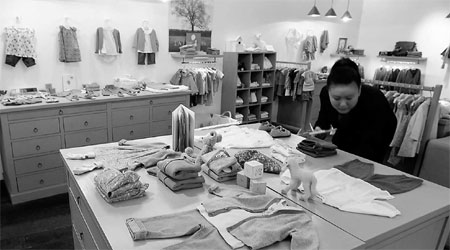
Following the fashion calendar of most high-end luxury brands, Bonpoint provides three seasons of clothing every year (spring/summer, autumn/winter and a Christmas special) with more than 300 collections, each with a specially tailored size and cut for different age groups.
Vallat admits that having a store next to women's luxury brands is good for business.
Bonpoint now has more than 110 stores worldwide, most of which are located in prime luxury-shopping streets in cities including Paris, New York and London. The company plans to open six to eight new stores a year, three of which will be in China.
"We want to remain selective and primarily improve what we have first," said Vallat. Part of that drive involves store decoration revamps every two weeks in all Bonpoint stores around the world.
The tradition started with the birth of the brand. The window displays at Bonpoint have become as famous as its floral-patterned cotton dresses, if not more so. In the 1970s, most shops in Paris simply displayed their clothes by the window. Bonpoint's designers need to make their window display as imaginative and magical as they hope their products sell through storytelling. Store themes have varied from fairy tales such as Alice in Wonderland to science fiction featuring robots, a strategy Vallat believes will be especially helpful in China to attract new customers and enhance brand awareness.
"Three or four years ago, luxury for the Chinese was a way of expressing a successful life but now the Chinese are very close to the tastes of people in Japan or France, caring more about quality, service and store setting," said Vallat.
"It will lead the industry to a new stage, ideally a positive stage for companies such as Bonpoint," he said.
xujunqian@chinadaily.com.cn
(China Daily 08/02/2012 page17)
 Relief reaches isolated village
 Rainfall poses new threats to quake-hit region
 Funerals begin for Boston bombing victims
 Quake takeaway from China's Air Force
 Obama celebrates young inventors at science fair
 Earth Day marked around the world
 Volunteer team helping students find sense of normalcy
 Ethnic groups quick to join rescue efforts
Most Viewed
Editor's Picks

|

|


|

|

|

|
Today's Top News
Health new priority for quake zone
Xi meets US top military officer
Japan's boats driven out of Diaoyu
China mulls online shopping legislation
Bird flu death toll rises to 22
Putin appoints new ambassador to China
Japanese ships blocked from Diaoyu Islands
Inspired by Guan, more Chinese pick up golf
US Weekly

|
|