Don't want you under my skin
Updated: 2012-08-08 08:10
By Liu Zhihua (China Daily)
|
||||||||


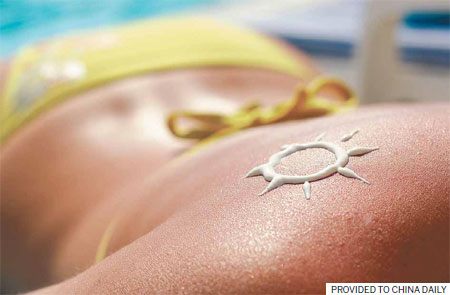
Skin cancer is on the rise in China and experts say this is because most people do not know how to protect themselves properly from too much sun. Liu Zhihua finds out the details.
Experts are saying they are seeing more skin cancer among Chinese, and they warn that this deadly form of carcinoma is likely to increase. They say people are going the wrong way about protecting themselves from exposure to strong sunshine. And that a little sun can actually be good for you.
Although there are no national surveys as yet, numbers in Beijing and Shanghai show that the incidence rate of melanoma is five times higher than it was five years ago, according to Guo Jun, chairman of Society for Melanoma Research in Asia and Pacific Area, and vice-president of Beijing Cancer Hospital.
That means one out of every 100,000 people in these two cities have the skin cancer.
Dermatologists are also seeing more patients with these symptoms, says Tu Ping, a famous skin cancer specialist at the Peking University No 1 Hospital.
"Among the possible factors contributing to skin cancers, sun damage is the prime cause, and it is a cumulative effect," Tu says. He sees about 600 skin cancer patients a year on average.
"Some people are not aware of the importance of sun safety, and some others try to block out sunlight as much as possible. Both approaches are wrong," Tu says.
All cancers are caused by DNA mutations, which can be inherited, but in most cases, are built up over a person's lifetime by environmental factors.
Ultraviolet rays, mostly, ultraviolet-B in sunlight, is responsible for DNA mutation in skin cancers, Tu explains.
"People think they should avoid getting tanned, when they think of sun protection. That's not correct," says Guo Jun, the melanoma specialist.
"Repeated overexposure to sunlight will lead to skin irritations, such as allergies and blisters. But, there is a more dangerous effect - it may trigger skin cancers," Guo says.
When too much sun damages skin cells, the human body will try to repair them. In the process, DNA mutations and abnormal growth may happen, Guo says.
Different skin cancers result when various types of skin cells are affected. The good news is: Unlike other cancers, most skin cancers, such as basal cell carcinoma, can be treated, although the treatment can be disfiguring.
Melanoma is actually easy to treat if diagnosed early. However, it is usually not noticeable at the beginning, and without treatment, it can spread quickly throughout the body, and become life threatening.
"People have been wearing less and less in past decades, and they travel more and participate in outdoor sports more as well," Guo says. "These factors may also contribute to the rising rates of skin cancers."
It takes years or decades to develop skin cancers, but each time, sunburn increases the possibilities, he adds.
"Most of my skin cancer patients are over 40, and they cared little about sun safety in their younger days," Tu, the dermatologist, says.
"Nowadays, ordinary people, especially young people, are more aware of their appearance and getting protection from the sun, but they sometimes go overboard."
While Westerners consider tanned skin healthy and attractive, most Chinese think a fair complexion is more desirable.
Many Chinese women try to avoid ultraviolet exposure as much as possible, and use a lot of whitening products.
Tu thinks that is unwise.
Beijing resident Chen Yingshu, for instance, wears sunscreen in all seasons, no matter whether it is sunny or raining, and she rarely goes without her umbrella in summer.
It takes her half an hour to remove her sunscreen and make-up, but she thinks it's worth the effort because she says her skin looks tighter, fairer and younger, compared with her peers.
Experts say she is actually increasing her risk of getting skin cancers.
"The whiter the skin is, the more vulnerable it will be to skin cancers," Tu says.
For those who grew up in areas that are exposed to strong sunshine, being in the sun is part of life.
Yin Chao is a writer now living in Beijing, but he grew up in Dehong Dai and Jingpo autonomous prefecture in Yunnan province. It is a place where the sun shines strongly almost every day of the year.
Yin says he is amused to see how people from Beijing go overboard in hiding from the sun.
"Women always wear sun lotion and use umbrellas, and even men use sunscreen, too," Yin observes. "That is absurd to me. A man doesn't need to look fair-skinned."
At home, he says, only women use sunscreen. He himself is happy to go unprotected, even years after he came to Beijing.
"My skin is always as red as a shrimp in summer," Yin says. "I never use sunscreen, and I don't wear sunglasses, either."
Generally, ultraviolet-A is the major cause of skin tanning and aging, and ultraviolet-B is responsible for blisters and cancers. Because darker skin has a stronger ability to reflect and absorb ultraviolet rays, the tanning process is actually a natural defensive mechanism the skin uses to protect itself from skin cancers, Tu explains.
"Sunlight helps the body produce vitamin D needed to better absorb calcium and to produce chemicals that fight depression," he says.
"The human body needs sunlight. It is not necessary to stay out of the sun all day."
In summer, when ultraviolet rays are stronger, normal, everyday clothes are protection enough against harmful ultraviolet-B radiation. For limbs, the face and hair, an umbrella and a hat may help.
But even so, the experts themselves have differing opinions. For example, Wang Xin, director of the dermatology department of Tsinghua University No 1 Hospital, does not agree completely with what Tu says.
"Ultraviolet A and B are man-created concepts. In nature, there is no such clear-cut division," Wang says. "Just as there is no evidence to show ultraviolet-A directly causes skin cancers, there is also no evidence that ultraviolet-A does not cause them either."
He suggests people wear protective clothing in ultraviolet-saturated environments, such as in summer and on the beach.
He also says that it is unnecessary to bleach the skin with chemical products.
Contact the writer at liuzhihua@chinadaily.com.cn.
(China Daily 08/08/2012 page19)

 Relief reaches isolated village
 Rainfall poses new threats to quake-hit region
 Funerals begin for Boston bombing victims
 Quake takeaway from China's Air Force
 Obama celebrates young inventors at science fair
 Earth Day marked around the world
 Volunteer team helping students find sense of normalcy
 Ethnic groups quick to join rescue efforts
Most Viewed
Editor's Picks

|

|


|

|

|

|
Today's Top News
Health new priority for quake zone
Xi meets US top military officer
Japan's boats driven out of Diaoyu
China mulls online shopping legislation
Bird flu death toll rises to 22
Putin appoints new ambassador to China
Japanese ships blocked from Diaoyu Islands
Inspired by Guan, more Chinese pick up golf
US Weekly

|

|