Games mean really big business for companies
Updated: 2012-08-09 08:07
By Diao Ying (China Daily)
|
||||||||


|
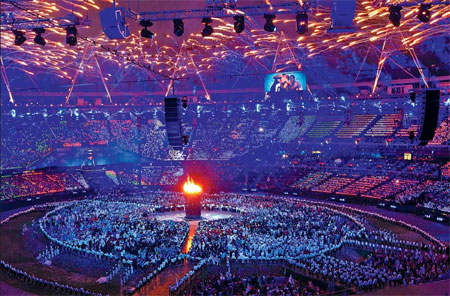
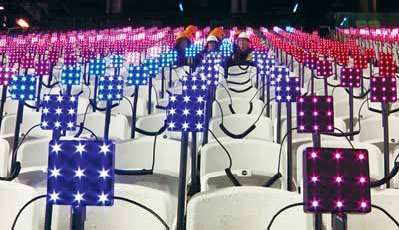
A scene from the opening ceremony of the 2012 Olympic Games. The lights on the seats were made by the Chinese company, Crystal CG International. Photos by Cui Meng / China Daily |
|
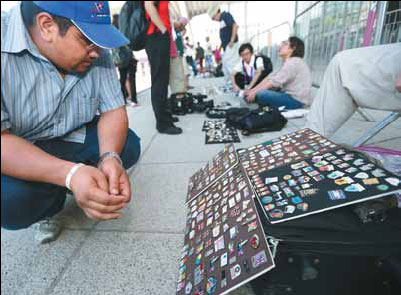
Pin collectors trade their favorites outside the Olympic Village in London, including the official 2012 mascots Wenlock and Mandeville, Produced by Chinese manufacturers. |
|
LEDs at London 2012 by Crystal CG International, which rose to fame during the 2008 Beijing Games. The company also provided animations for the opening ceremony in London. Provided to China Daily |
Olympics provide opportunity for commercial success, reports Diao Ying from London.
The most expensive ticket for the opening ceremony of the London Olympics cost $3,140 and a ticket for one of the track finals could cost as much as $1,130. With a special pass slung across his neck, hanging from a purple lanyard, George Hamilton, a Chicago businessman, has access to all the events.
However, he has no time to watch sport. As the head of Olympic marketing for Dow Chemical, a worldwide partner of the London Olympics, Hamilton is far too busy. "I've got accreditation to all the venues but, as a top sponsor, I have no time to see any of the events," he said.
Dow Chemical declined to disclose how much it paid to sponsor the Olympics, but Hamilton said that the company is aiming to garner business worth $1 billion over the next 10 years. He and his colleagues are busy selling their wares during the Games.
Those lucky enough to attend London 2012 - from officials from more than 100 countries, to construction companies, designers and engineers - are all potential clients for Hamilton and Dow Chemical.
The modern Olympics are as much about money as celebrating sporting prowess. "Olympic" is the world's second most-valuable brand, next only to the computer and phone manufacturer Apple Inc, according to the consultancy Brand Financial in London, which estimates that the Olympic brand is worth $47.6 billion. That's 134 times more than the value of the National Bank of Greece, the country in which the Games originated.
TOP sponsors
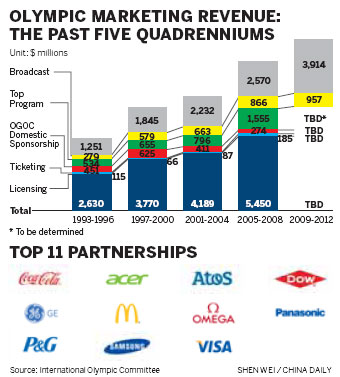
The most expensive way to be associated with the Olympic brand is to become what's known as a TOP sponsor, meaning that a company is allowed to use the famous "Five Rings" logo as part of its global marketing and promotional activities. None of the companies was willing to reveal the financial details involved in their sponsorship deals, but there were 11 TOP sponsors for the period 2009 to 2012, providing the International Olympic Committee with revenue of $957 million. That works out at an average of $87 million per sponsor, but some of the companies will have paid more than others.
The Olympics is marketed as an event for everybody, but sometimes the sponsorship deals can lead to friction. Sebastian Coe, the head of the London Organising Committee of the Olympic and Paralympic Games, admitted on Today (BBC Radio's flagship news program) that a Nike T-shirt would not be popular at the event, because the rival sportswear manufacturer Adidas is one of the major sponsors, or "partners" as the corporate jargon has it, of London 2012.
And in the unlikely event that you arrive at the Games without cash, you'd better make sure you have a Visa card, another sponsor, close at hand, because no other cards are accepted onsite.
Not even the famous British staple meal of fish and chips has been left untouched by the regulations. Visitors to the event can buy fish and chips, of course, but independent vendors are not allowed to sell the two items separately, because the US burger chain, McDonalds, is the only accredited supplier of fries at the event.
"The Olympics is one of the most successful businesses in the world," said Roger Yin, chief executive officer of Honav UK Ltd - a subsidiary of the Chinese company Beijing Huajiang Culture Development Co, known informally as Honav - which holds the rights to make pins featuring the official 2012 mascots, Wenlock and Mandeville, for the Games. Despite the expense, 90 percent of the top sponsors renew their contracts year after year, with Coca-Cola Co, for example, boasting the longest continuous partnership with the Olympics, a link that goes back to its sponsorship of the 1928 Games in Amsterdam.
Olympic sponsorship has been a turning point for many companies in terms of brand value. For example, the consumer electronics giant Samsung Electronics Co was hardly known outside South Korea, its home country, until it became a TOP sponsor in 1997. "It was a difficult decision to invest a huge amount of money, since it was during the Asian financial crisis," said Sunny Hwang, head of sports marketing at Samsung.
However, the company was desperate to be associated with the Olympics and other top companies. The move "was very successful" and Samsung's brand value is now $25 billion, five times as much as in 2000, according to Hwang. "Sports marketing played a significant part in that," he said.
Sponsorship also boosted sales. The market share of Samsung's cell phones in China doubled after the 2008 Beijing Olympics, thanks to a successful marketing campaign during the event, according to Hwang.
Transformation
Although none of the 11 TOP sponsors of London 2012 are from China, the Games have seen the transformation of Chinese companies. Some have distinguished themselves by their creativity, usurping the standard image of cheap Chinese products; while others are seeking, and gaining, brand recognition after previously existing only at the lower end of the manufacturing scale.
Before the Games, the leader of the US senate, Harry Reid, called for TeamUSA's uniforms to be piled in a heap and burned. Reid was outraged that the outfits were designed by the US couturier Ralph Lauren, but made in China.
However, boycotting one Chinese product probably also means skipping TV, the opening and closing ceremonies, and the main venues, since Chinese companies are involved in all of those aspects.
Danny Boyle, the Oscar-winning film director (Slumdog Millionaire, Trainspotting) responsible for the opening ceremony at London 2012, gave special thanks to Crystal CG International, the Chinese company responsible for the animations at the event.
The ability to change raw materials into end products as quickly as possible and at the lowest feasible cost has been a key strength of Chinese manufacturing.
For instance, Honav started out making pins for the Atlanta Olympics under contract to a Western company. A pin is sold at around $10, and the Chinese manufacturer earns less than $1 of the retail price. The factories also have to bear the high environmental and labor costs of production.
Other important aspects of modern business practice, such as branding and marketing, are relatively new concepts to these entrepreneurs.
Manufacturing has been transformed over the past several decades. The 2008 Beijing Olympics was a turning point for many companies. Honav designed and made pins for the Beijing Games and Crystal CG made the "hand-roll" animation featured at the start of the opening ceremony. The organizers of the London Games were impressed with the performances of these two companies and invited them to bid to become official sponsors and licensing companies for 2012. Both companies acted on the invitation and won.
Going forward
Honav probably has gained as much business experience as profit from its involvement with the Olympics. The main theme of the London Olympics is sustainability and specific requirements were instigated across the board, said Yin. "The requirements could be as specific as: Which side will a door open?" he noted.
Meanwhile, partnering with the Olympics also requires companies to pay attention to the welfare of their workers in terms of the length of shifts and the level of wages. Those rules, well established in the West, still appear unusual to Chinese entrepreneurs, who are used to their factories working 24 hours a day, seven days a week. Workers are now subject to a shift pattern, but the machines are never idle.
Crystal CG represents a completely different style of management for a Chinese company going global. Unlike Honav, which sent its management team to London from Beijing, one could be forgiven for gaining the impression that Crystal CG is not really a Chinese company at all. Its art director, Will Case, is British and the managing director, Gilles Albaredes, is French. However, Albaredes is adamant that nationality is irrelevant, merely commenting, "It is the quality of the work that counts."
Looking ahead, these companies have opportunities beyond the London Games. For example, Crystal CG has produced promotional films for Olympic bids from Moscow and a number of other countries.
Involvement in the Olympics has also provided the opportunity to work with other companies related to the Games. Crystal CG was hired by Panasonic Corp to make displays for Olympic venues, while Honav counts Coca-Cola and Dow Chemical as clients.
In fact, even before the London Games began, Honav had won the bid to design and make pins for the 2016 Games in Rio de Janeiro. Even as people are still celebrating London 2012, Jack Chen, Honav's chairman, is already counting down to the next games. "There are 1,430 days to go, and we need to try our best," he said.
Contact the reporter at diaoying@chinadaily.com.cn
(China Daily 08/09/2012 page1)
 Relief reaches isolated village
 Rainfall poses new threats to quake-hit region
 Funerals begin for Boston bombing victims
 Quake takeaway from China's Air Force
 Obama celebrates young inventors at science fair
 Earth Day marked around the world
 Volunteer team helping students find sense of normalcy
 Ethnic groups quick to join rescue efforts
Most Viewed
Editor's Picks
|
|


|
|
|
|
Today's Top News
Health new priority for quake zone
Xi meets US top military officer
Japan's boats driven out of Diaoyu
China mulls online shopping legislation
Bird flu death toll rises to 22
Putin appoints new ambassador to China
Japanese ships blocked from Diaoyu Islands
Inspired by Guan, more Chinese pick up golf
US Weekly

|
|