Out of this world
Updated: 2012-08-09 08:05
By Liu Xiangrui and Yang Jun (China Daily)
|
||||||||


|
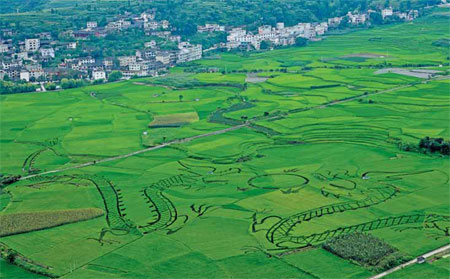
Two dragon patterns are created in the paddy rice fields around Shuitou village to celebrate the Year of the Dragon. Photos by Wang Jing / China Daily |
|
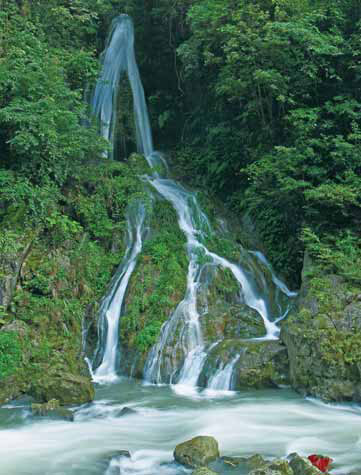
Nanjiang Canyon, where the Qinglong River runs through, has plenty of waterfalls and is an ideal site for rafters. |
|
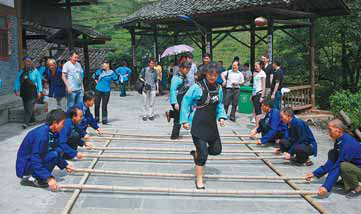
Local residents perform a bamboo dance to greet guests to Shuitou village. |
Liu Xiangrui and Yang Jun check out Kaiyang county in Guizhou province and find an idyllic refuge for those seeking tranquility.
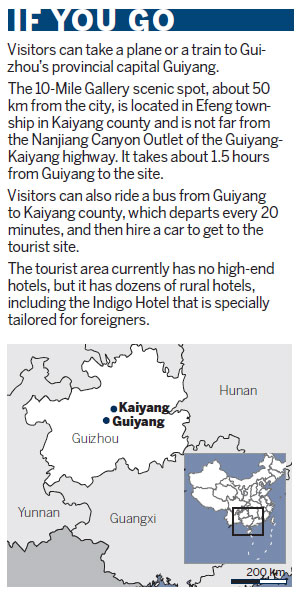
Kaiyang county, situated about 80 km northeast of Guizhou's provincial capital Guiyang, enjoys growing popularity with those who want to experience the peace of rural life.
With a combination of rural scenery, canyon landscape and ethnic Miao and Bouyei culture, the town has a lot to offer.
What's more, the splendid green mountains, clear rivers and agreeable climate are big attractions especially in summer.
By taking the most popular itinerary - "The 10-Mile Gallery" along the Qinglong River valley, we feast our eyes on the essence of Kaiyang's beauty during a two-day trip.
We first stop in Phoenix village, a Bouyei habitat built by the hillside and only connected by a suspension bridge over the Qinglong River. The waterway appears to separate the village from the rest of the world and provides an idyllic refuge for guests seeking tranquility.
The residences reflect the typical local style, with blue tiles and white walls half hidden in the greenery. Under the roofs are strings of golden corns and red chili - the fruits of the farmers' labor.
At the center of the village lies a lotus pond, while loquat, cherry and mountain peach plants decorate the surroundings.
As we approach neighboring Pingzhai village later in the day, singing voices greet us. They belong to farmers, who stand in threes and fives, crooning under some old trees in the village. We are told that the farmers are performing the traditional Yangxi Opera, an old art form to entertain themselves during leisure time.
Further on from Pingzhai village, about 5 km up Qinglong River, there is an old and huge stone arch bridge named Longevity Bridge. Even after more than two centuries, it still serves people on both banks as their main link.
The bridge is also an ideal starting point to raft down the river, another popular activity during summer. Or, be like the locals - plunge into the clear waters to swim with the young and old.
Not far from the bridge is Matou village, which has a 700-year-old history. It used to be the place where the rulers of the region, an influential tusi, or chieftain, family resided. The village has become a national heritage site.
The thoroughfare of the village is a stone-paved path, where more than 90 ancient buildings are scattered on both sides, with the earliest dating back to the Yuan Dynasty (1271-1368).
Facing the river and flanked by mountains on three sides, these old buildings are mostly traditional courtyard houses bearing wooden structures, with delicate Bouyei carved patterns all over. Layers of gray roofs form a spectacular patchwork.
The Red Army of Communist Party of China (forerunner of the People's Liberation Army) once stayed here, leaving behind dozens of slogans on the walls - more than 20 of these are still recognizable.
Further upstream, there is an even quieter Bouyei community called Shuitou village. At the village gate, villagers in traditional costumes greet us with home-made wine and invite us to join their traditional bamboo dance.
In Shuitou, we learn from locals about the ancestral method of making tofu and the distillation of rice wine.
We are also treated to fresh soybean milk and glutinous rice cake.
A French-style countryside hotel situated on the slope by the babbling river, Indigo Lodge, is popular especially with foreign tourists. From the design, one can tell that a lot of thought went into the elegant accommodation, which skillfully combines ethnic elements with modern tastes.
There is a cafe in Indigo Lodge, serving simple Chinese and Western food, coffee and wines. Travelers can also sit around to read or surf the Internet.
The hotel, with only nine quaint rooms, is run by a local tour guide. Each year, more than 100 foreign tourist groups make the hotel their home.
We find the main courtyard an ideal place to chill in this valley with its picturesque view - a calm river flowing in front of us, with buffalos grazing in the paddy fields just a short distance away and mountains in the background.
According to the villagers, the area is a sea of yellow as rapeseed flowers bloom in spring and rice field gets ready for harvest in autumn, giving the place the nickname "gold basin".
Before we head out for the nearby Nanjiang Canyon for a gorgeous bonfire party and lodging, we visit the highest point of the "gallery" - a tea plantation of some 333 hectares on top of the Baihua Mountains.
Qinglong River's origin is said to be hidden somewhere in the mountains, often wreathed in mist.
The acidic soil is suitable for producing good quality teas. Experts say that tea produced here is rich in selenium, a trace mineral believed to enhance immunity and slow down the aging process.
Tourists are invited to spend a day as a tea farmer, to experience picking and processing tea leaves themselves.
For us, we feel recharged just by looking out into the beautiful sunset beyond the mountain stretches, while savoring a cup of fresh tea in the old-styled pavilion. If there be paradise on earth, this is it.
Contact the writers at liuxiangrui@chinadaily.com.cn and
yangjun@chinadaily.com.cn.
(China Daily 08/09/2012 page19)

 Relief reaches isolated village
 Rainfall poses new threats to quake-hit region
 Funerals begin for Boston bombing victims
 Quake takeaway from China's Air Force
 Obama celebrates young inventors at science fair
 Earth Day marked around the world
 Volunteer team helping students find sense of normalcy
 Ethnic groups quick to join rescue efforts
Most Viewed
Editor's Picks

|
|


|

|

|

|
Today's Top News
Health new priority for quake zone
Xi meets US top military officer
Japan's boats driven out of Diaoyu
China mulls online shopping legislation
Bird flu death toll rises to 22
Putin appoints new ambassador to China
Japanese ships blocked from Diaoyu Islands
Inspired by Guan, more Chinese pick up golf
US Weekly

|

|