Essential elements
Updated: 2012-08-10 07:54
By Chen Nan (China Daily)
|
||||||||


|
Tibetan dancer-choreographer Wanma Jiancuo (middle) with dancers for his new work Shambhala. Photos by Zou Hong / China Daily |
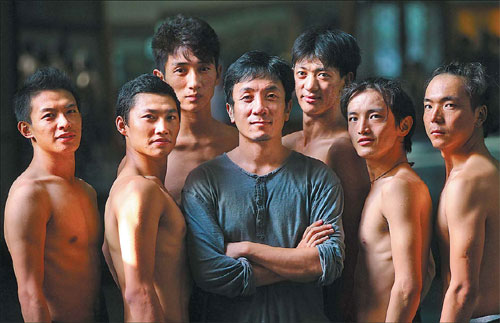
Tibetan dancer-choreographer Wanma Jiancuo says his new work Shambhala depicts the spiritual pursuit of tranquility, balance and happiness. Chen Nan reports in Beijing.
Tibetan folk dances and songs are widely performed at national galas as they are thought to be mysterious and charming, attracting millions of tourists to explore the country's Tibetan areas. However, Tibetan dancer-choreographer Wanma Jiancuo says it's not the real Tibet that is being portrayed.
"I have choreographed and performed Tibetan dances for some big extravaganzas, such as CCTV's Spring Festival Gala, which requires colorful, grand costumes and cheerful, uplifting moves. However, when I finished dancing, I couldn't help wondering 'Why did I dance like that?'" says the 34-year-old from Hainan Tibetan autonomous prefecture in Qinghai province.
"Those superficial decorations cover the essence of Tibetan culture."
He has also choreographed a 60-minute dance, Shambhala, which means pure land and blissful heaven, in the Tibetan language, depicting the spiritual pursuit of tranquility, balance and happiness. He calls it a "private work", expressing his emotions for Tibetan culture.
"For many people, Shambhala, or Shangri-La, is a popular tourism site. But for Tibetans, it's a spiritual resting place, not something tangible or concrete," he says.
"When I was a kid, my parents told me that you should be a virtuous man and then you will find your Shangri-La," Wanma Jiancuo recalls. "Everyone has his own Shangri-La in their heart."
The dance will be performed at the National Center for the Performing Arts on Aug 15 and 16, as part of Chinese Dance Masterpieces, a month-long event featuring six dance shows by Chinese dancers and choreographers.
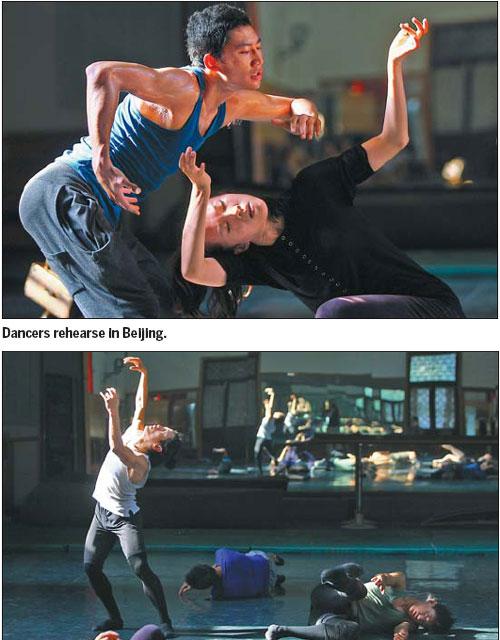
On a scorching afternoon, Wanma Jiancuo and eight Tibetan dancers gather in a dance rehearsal room at Minzu University of China. Sitting around an incense burner, they relax.
"I need them to be focused, serious and show respect to the dance," says Wanma Jiancuo. "It's a rite of passage."
As one male dancer rings a bronze Tibetan hand bell and walks slowly, the others follow him with their eyes staring forward. They pick up some objects and worship them sincerely, such as a horse saddle, wooden box, and the beam of a house, which were collected by Wanma Jiancuo from Tibetan families.
Most of the time, there is no music but deep, slow Tibetan chanting. The only sounds are the dancers' feet stepping on the floor and their heavy breaths. Their costumes are simple and gray.
"The clothes at galas are not worn daily by Tibetans. We only wear formal dress during festivals," 22-year-old dancer Tsering Norbu says.
The big-eyed curly-haired young man has studied dancing since childhood and now works at Song and Dance Troupe of Tibet Autonomous Region. He is a big fan of Wanma Jiancuo and volunteered to perform.
"Like the costumes, the dance overturns Tibetan dance impressions. It's real and powerful. Usually I dance on national occasions and assigned missions to celebrate some event. I have to smile happily and dance like it's a festival. But this is anything but conventional," says the dancer, who arrived in Beijing a month ago from Lhasa.
The choreographer also invited Tibetan eagle flute players to perform. The flute is made from the wing bones of eagles.
The choreographer first had the idea for Shambhala when he studied at Minzu University in 2000, to express his love for Tibetan culture and his pursuit of freedom.
"I hate being constrained by restrictions. That's why I quit from a stable job at a national dance troupe after graduation. It was like setting free a bird from a cage," he says. "My dance works were all from my roots - Tibetan culture. Shambhala is a landmark in my career."
Wanma Jiancuo's name means "sea of wisdom" in the Tibetan language, and was conferred by his father, who was the director of Song and Dance Troupe of Hainan Tibetan Autonomous Prefecture and the only choreographer in the troupe then.
His father hoped he will carry on his career. However, Wanma Jiancuo says that it was not love at first sight with dance.
Running with friends among mountains and grasslands, he had a happy and close-to-nature childhood.
His father sent him to a kung fu class at Minzu University of China, at age 12. However, when he enrolled he realized that kung fu was just one part of the classes and most courses were about dancing.
Though reluctant and unhappy, he studied there for six years and entered the folk dance department of the university.
"You know, I learned various dance genres, such as ballet, folk dance and modern dance, and the influences were unconscious," he says. "Dancing is like my second language."
"I appreciate his resilient spirit as a Tibetan dancer. He is pioneering and really found his role, the reasons and significance of his work and that's truly amazing for independent dancers in China now," says Tanzhou Dorje, a 56-year-old folk dance professor at the university for 30 years, who taught Wanma Jiancuo and considered him one of his best students.
In 2003, Wanma Jiancuo founded his dance studio, Beijing City Shepherd Studio, together with four like-minded friends. Like many independent artists, besides choreographing dances for the studio, they also made shows for companies and governmental events to make ends meet.
In 2011, Wanma Jiancuo stayed in Yunnan province for several months to create a dance show for a tourism company.
"Those dances require interaction with the audiences. Dancers would step off stage and communicate with audiences through their dancing. However, what I want in my own work is not like that," he says.
"Dancers and audiences are equal. I don't want the dancers to serve the audiences. I want something abstract, leaving a space for the audiences to think and imagine."
As a veteran dancer and choreographer, he has another crucial mission - cultivating young Tibetan dancers, who will carry on his ideas.
Laba Zaxi, a 21-year-old Tibetan dancer, won a gold award at Seoul International Dance Competition 2012 for his performance in Silent Marnyi Stone, a dance work choreographed by Wanma Jiancuo.
"He can barely speak Mandarin but when he dances, you can feel what he wants to say," Wanma Jiancuo says. "I am glad that the young Tibetan generation is passionate about its culture. Though urbanization and globalization influence them and they wear hip-hop clothes and dye their hair, they still reserve a respectful place in their hearts for Tibetan culture."
(China Daily 08/10/2012 page18)
 Relief reaches isolated village
 Rainfall poses new threats to quake-hit region
 Funerals begin for Boston bombing victims
 Quake takeaway from China's Air Force
 Obama celebrates young inventors at science fair
 Earth Day marked around the world
 Volunteer team helping students find sense of normalcy
 Ethnic groups quick to join rescue efforts
Most Viewed
Editor's Picks
|
|


|

|

|

|
Today's Top News
Health new priority for quake zone
Xi meets US top military officer
Japan's boats driven out of Diaoyu
China mulls online shopping legislation
Bird flu death toll rises to 22
Putin appoints new ambassador to China
Japanese ships blocked from Diaoyu Islands
Inspired by Guan, more Chinese pick up golf
US Weekly

|

|