High US grain prices have little effect on Chinese pork imports
Updated: 2012-08-14 07:56
By Joseph Boris and Wei Yu in New York (China Daily)
|
||||||||


As a result of the worst drought to hit the United States in 56 years, pork prices are estimated to jump, slowing exports to China and other countries.
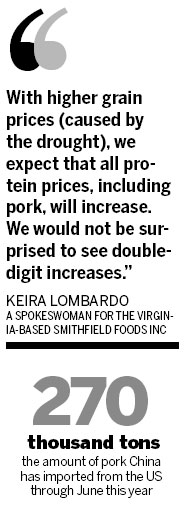
"With higher grain prices (caused by the drought), we expect that all protein prices, including pork, will increase," said Keira Lombardo, a spokeswoman for the Virginia-based Smithfield Foods Inc. "We would not be surprised to see double-digit increases."
Smithfield produces and processes more pork than any other company in the world, and is the largest US pork exporter to China, shipping about 1.1 billion pounds (499 million kilograms) of it in 2011.
As much as two-thirds of the contiguous United States - the "lower 48", excluding Alaska and Hawaii - has been scorched by severe heat this summer, the government estimates. That has caused crops to shrivel and led to forecasts of unusually low yields.
The Arkansas-based Tyson Foods Inc, one of the biggest US meat producers, announced earlier this month that its profit in its fiscal third quarter, which ended on June 30, decreased by 61 percent. Its earnings from its pork business alone fell by 44 percent.
"Grain costs have been increasing significantly and rapidly, largely as a result of the drought," said Donnie Smith, Tyson CEO. "While we ultimately expect to pass along rising input costs, these costs, coupled with continued soft demand, are likely to pressure earnings in 2013."
That scenario could be disastrous for pork producers and the livestock industry. While drought-ravaged crops threaten farmers with serious economic losses, a dearth of corn, soybean and hay could be even more harmful to raisers of livestock, said Chris Hurt, a professor of agricultural economics at Indiana's Purdue University.
"Normally, the first thought is that crop producers will suffer the financial loss, but losses in livestock industries will be enormous over the next year - perhaps considerably greater than for the crop sector," Hurt said.
He predicted that the US pork industry will begin losing money during the fall, and that its fortunes will continue to decline in the winter before hog prices rebound next spring and summer.
If the crop returns to normal in 2013 and there is no drought, feed prices will go down significantly, helping to ensure the industry can make a profit in the fourth quarter of 2013.
"The message for hog producers is that they must suffer the losses in the short run to have the opportunity to reach the potential financial rewards of the longer run," Hurt said. "Some will not have the financial stability to get through the short run (the next 12 months). Others are not willing to take the losses, and will reduce herd size."
China produces and consumes more pork than any other country and is the third largest importer of US pork products.
Erin Borror, an economist at the Denver-based US Meat Export Federation, said China imports specific items from the US mainly to supplement domestic production. When there's a shortage of pig's feet, stomachs or tongues, the US is able to supply these meats at relatively low prices.
Conversely, exports to China have helped US producers sell off excess supply that would otherwise depress prices at home. Any decrease in exports to China, whether it results from increases in feed prices or other causes, will make it difficult for the US pork industry to match the supply of its products to the demand for those products, Borror said.
The two countries' trade relationship in pork dates back 15 years and is now worth several hundred million dollars a year.
The amount has gone from 3,600 metric tons in 1997 to 77,000 metric tons in 2005 and a record of 375,243 metric tons last year, according to Wang Xiaoyue, an analyst with Beijing Orient Agribusiness Consultant Ltd.
Price is the most important driver of Chinese imports of US pork. While the domestic price of the meat hovers around 22 yuan ($3.46) a kg, US-imported pork costs about 14 yuan per kg, giving the US an advantage, Wang said.
Through June this year, China had imported 270,000 metric tons of US pork, up 50 percent from the first six months of 2011 and making up 48 percent of the country's total pork imports.
Despite the increases in imports, Chinese produces nearly five times as much pork as the US. Since only a small fraction of the pork that China consumes comes from abroad, overseas price increases are likely to curtail pork imports to only a small extent, Wang said.
That view was reinforced by Jing Jizhong, operations director at the China Animal Husbandry Association, who also explained that Chinese consumers are far more likely than US residents to eat offal made from the internal organs of hogs and other types of specialty meats.
Even a sharp decline in overall US supply won't be likely to disrupt shipments of pork offal to the Asian markets, where it's most popular, he said.
Contact the writers at josephboris@chinadailyusa.com and yuwei12@chinadailyusa.com
(China Daily 08/14/2012 page16)

 Relief reaches isolated village
 Rainfall poses new threats to quake-hit region
 Funerals begin for Boston bombing victims
 Quake takeaway from China's Air Force
 Obama celebrates young inventors at science fair
 Earth Day marked around the world
 Volunteer team helping students find sense of normalcy
 Ethnic groups quick to join rescue efforts
Most Viewed
Editor's Picks

|

|


|

|

|

|
Today's Top News
Health new priority for quake zone
Xi meets US top military officer
Japan's boats driven out of Diaoyu
China mulls online shopping legislation
Bird flu death toll rises to 22
Putin appoints new ambassador to China
Japanese ships blocked from Diaoyu Islands
Inspired by Guan, more Chinese pick up golf
US Weekly

|

|