Heritage on the verge of extinction
Updated: 2012-08-15 08:03
By Xu Junqian in Shanghai (China Daily)
|
||||||||


|
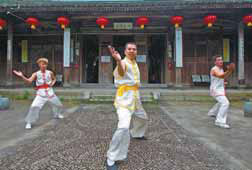
Wu Shouwu, a Southern Boxing practitioner, imparts his skills to students in Yongjia county, Zhejiang province. Gao Erqiang / China Daily |
When a place in China is recognized as a UNESCO World Heritage site, it is normally associated with money making, where tourists and cash are expected to flow in, and jobs created.
But Nanxijiang, a 1,000-year-old town with 27 intangible cultural heritages designated by the country and UNESCO, is an exception.
There is no trace of prosperity - only some weather-beaten houses - and not much tradition is left.
Home to 900,000, many of the town's cultural heritages are on the verge of extinction. They include Yongjia Kunqu Opera and nanquan (Southern Boxing), according to the Intangible Cultural Heritage Protection Center of Yongjia county, the administrative body of the area.
"In the past, the area was abuzz with bread-making handicrafts and other local entertainment. But now, nobody cares," says Wang Lingxiao, vice-director of the center.
"Both the practitioners and audiences are few in numbers and old. But they are the most precious and unique cultural wealth of our nation. We need to pass it down to the next generation."
According to the latest national survey about intangible culture heritage, one-third of traditional operas that originated in Zhejiang province have died out over the past 60 years and 30 percent of traditional dances have disappeared.
Wu Shouwu, a 49-year-old practitioner of Southern Boxing, describes the situation as embarrassing.
The descendant of a family with the tradition of practicing and teaching Southern Boxing since the Song Dynasty (960-1279) has been giving free lessons to youngsters for more than two decades. But the number of students has diminished over the years. He has only three to four students now - all from families with martial arts backgrounds.
"Young people are more interested in going to gyms," says Wu, who runs an orthopedic clinic to support his family.
Even Wu's 21-year-old son shows little interest in the tradition that Wu believes could "prevent most of the chronic diseases and promote longevity".
He says he also uses his Southern Boxing remedies to cure his patients at his clinic, which was started by his grandfather.
Yongjia Kunqu Opera is in an even more dire state.
"We have no place for rehearsals, no money to recruit students, and what's even sadder is, we've no stage to perform," says Lin Meimei, a 70-year-old performer.
Lin recalls that during the heyday in the 1940s, everyone - from the central government officials to the general public - was drawn to the graceful opera.
"It's hard to persuade parents to have their only kid quit school and spend the best years of their lives learning the opera, and ending up jobless," says Lin, who began learning opera at the age of 12.
The Yongjia Kunqu Opera Troupe has some 20 young performers, which is only half the strength of a regular troupe. Their last recruitment drive was in 2005 when they could still afford it.
"If the situation remains like this in the next five years, the opera will be dead," says Lin dejectedly.
xujunqian@chinadaily.com.cn
(China Daily 08/15/2012 page19)
 Relief reaches isolated village
 Rainfall poses new threats to quake-hit region
 Funerals begin for Boston bombing victims
 Quake takeaway from China's Air Force
 Obama celebrates young inventors at science fair
 Earth Day marked around the world
 Volunteer team helping students find sense of normalcy
 Ethnic groups quick to join rescue efforts
Most Viewed
Editor's Picks
|

|


|

|

|

|
Today's Top News
Health new priority for quake zone
Xi meets US top military officer
Japan's boats driven out of Diaoyu
China mulls online shopping legislation
Bird flu death toll rises to 22
Putin appoints new ambassador to China
Japanese ships blocked from Diaoyu Islands
Inspired by Guan, more Chinese pick up golf
US Weekly

|

|