Flushless success for inventor
Updated: 2012-08-15 11:23
By Chen Jia in Seattle (China Daily)
|
||||||||


|
Chinese inventor Ning Jing (right) talks to researchers, designers, investors, advocates and representatives of the communities who will ultimately adopt these new inventions, at the toilet fair in Seattle. Chen Jia / China Daily |
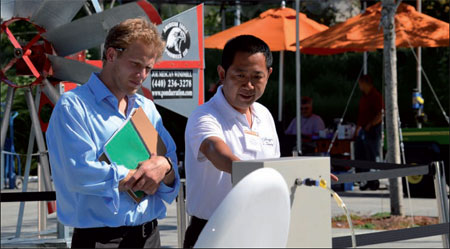
The Chinese inventor of a solar toilet has attracted the attention of the US media and venture capitalists at a fair held by the Bill & Melinda Gates Foundation in Seattle.
"China will see more than hundred billion dollars of solar industrial upgrading in the next two to three years," Ning Jing, the inventor and guest professor of Shijiazhuang University of Economics, told China Daily at the Re-invent the Toilet Fair on Tuesday.
"That's why I have the ambition and courage to become a start-up at this age."
Ning, who is 49, is also CEO of Beijing Sunnbyreeze Technologies Inc, which is showcasing its prototypes and projects at the two-day event held at the foundation's headquarters.
The fair brings together participants from 29 countries, including researchers, designers, investors, advocates, and representatives of the communities who will ultimately adopt the new inventions.
The solar toilet designed by Ning's team not only discharges pollutants, but also generates energy and recovers water and other nutrients.
Last year, he received $100,000 from the Grand Challenge Explorations program, funded by the Bill & Melinda Gates Foundation.
Launched in 2008, more than 700 GCE grants have been awarded to innovative, toilet-related projects in 45 countries. Initial grants of $100,000 are awarded twice a year. Successful projects have the opportunity to receive a follow-up grant of up to $1 million.
"Chinese researchers are very smart and responsible," said Carl Henzman, the foundation's program officer of water, sanitation and hygiene.
"The key thought of the Chinese presentation of its solar toilet is total upgrade, which means we don't need to take power to it," he said. "And it also makes human waste into something potentially useful."
Before joining the foundation, Henzman was an energy program manager for King County, Washington, focusing on resource recovery in the wastewater treatment division.
Although this toilet program is aimed at Africa and Southeast Asia, China is an important technology partner, Henzman said.
The program aims to create a toilet that is the basis for a sanitation business and can be easily adopted by local entrepreneurs living in poor urban settings.
"The fundamental criteria in reinventing a toilet are that it can't cost more than people are willing to pay now," he said.
The toilet should be hygienic and sustainable for the world's poorest populations, and have an operational cost of 5 cents per day for each user, Henzman said.
The fair aims to inspire collaboration in a shared mission to deliver a reinvented toilet for the 2.5 billion people worldwide who don't have access to safe and affordable sanitation.
However, Ning believes China could be a direct beneficiary as well as a technology partner. "Though people in big cities like Beijing don't lack access to sanitation, they are facing a serious water resources crisis," he said.
The environmental pollution caused by toilet waste is also a big problem for China, he added. "We are creating a toilet that does not rely on water to flush waste or a septic system to process and store waste," he said. "That's how the program benefits the whole world, including China."
The Chinese inventor's post-doctorate focused on sensor research at Stevens Institute of Technology, New York University, and Wayne State University, Michigan, between 2005 and 2010.
He also has a previous research background in China in radar, mechanical-electrical integration, and radioactive waste management.
Improving access to sanitation can also bring substantial economic benefits.
According to the World Health Organization, improved sanitation delivers up to $9 in social and economic benefit for every $1 invested because it increases productivity, reduces healthcare costs and prevents illness, disability and premature death.
"Innovative solutions change people's lives for the better," foundation co-chair Bill Gates said at the fair on Tuesday.
"Many of these innovations will not only revolutionize sanitation in the developing world, but also help transform our dependence on traditional flush toilets in wealthy nations," Gates said.
Chris Elias, the president of global development program with the Gates Foundation, said that Ning's team is the only Chinese presence at the fair, but he expects more Chinese researchers or scientists to be involved next year.
chenjia@chinadailyusa.com

 Relief reaches isolated village
 Rainfall poses new threats to quake-hit region
 Funerals begin for Boston bombing victims
 Quake takeaway from China's Air Force
 Obama celebrates young inventors at science fair
 Earth Day marked around the world
 Volunteer team helping students find sense of normalcy
 Ethnic groups quick to join rescue efforts
Most Viewed
Editor's Picks

|

|


|

|

|

|
Today's Top News
Health new priority for quake zone
Xi meets US top military officer
Japan's boats driven out of Diaoyu
China mulls online shopping legislation
Bird flu death toll rises to 22
Putin appoints new ambassador to China
Japanese ships blocked from Diaoyu Islands
Inspired by Guan, more Chinese pick up golf
US Weekly

|

|