Metro man takes on mass market
Updated: 2012-08-16 08:07
By Tang Zhihao in Shanghai (China Daily)
|
||||||||


|
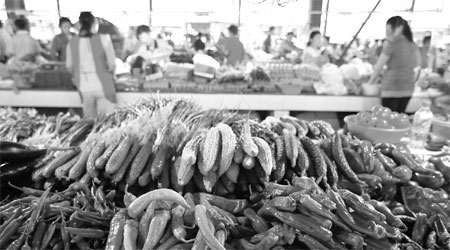
A wholesale market in Shanghai. Local wholesale markets are Germany-based Metro Cash and Carry's biggest competitors in China. Guo Bin / for China Daily |
|
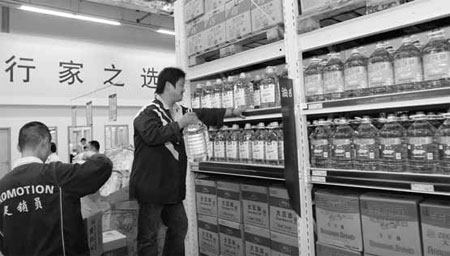
A Metro Cash and Carry outlet in Nantong, Jiangsu province. The international self-service wholesaler currently has 56 stores around China. Xu Congjun / for China Daily |
Uwe Hoelzer has ambitious plans to attract more buyers from small and medium-sized companies and to expand
Just a 10 minute walk from Metro Cash and Carry's China headquarters, in Shanghai's Putuo district, there is a famous seafood wholesale market where restaurant owners and individual buyers can find everything they want. There is also a fruit market trading in both imported and local produce. The single range of goods on offer is even wider than what can be bought at Metro, the international self-service wholesaler.
"These are clearly our main competitors in China," said Uwe Hoelzer, president of Metro China, adding that when asking restaurant owners in China where they buy things, their answers include not only Carrefour, Auchan and Walmart, but also open markets.
"It is similar in other countries as well. In countries such as Poland you have these kinds of markets, but they are not so big as in China," said Hoelzer. "Vietnam is very similar to China and is also part of the Asian culture."
Although it's a challenge to Metro China, Hoelzer said: "Competition is always important and good. It drives you and pushes you even harder to work on your own solutions and to be even better."
Metro is well-known for its service to five-star and four-star hotels, companies and offices, as well as small and medium-sized eateries; around half of its clients are canteens and restaurants.
The Germany-based company is determined to make full use of its advantages and improve services to cater to local customers, said Hoelzer.
The international chain wholesaler's one-stop, under-one-roof purchasing experience, guarantees of quality and detailed invoice provision services are something that cannot be copied by open market operators.
As a feature of Metro's operation, buyers are equipped with detailed shopping lists, on which prices and product information are presented.
"I guess some customers or potential customers do not want to have that transparency so far. But we see more and more customers who rely on our transparency and this gives us a big advantage," said Hoelzer, suggesting that bargain hunters in China are not so keen on receipts.
Metro has a quite high market share in the canteen business in China due to its safe food and competitive prices offered to buyers. However, it is not successful in the restaurant sector, partly because of competition from open markets. "We are okay with international restaurants but not with Chinese restaurants, which would be the biggest piece of the cake for us," said Hoelzer. "We do not have all of the solutions for them."
Chinese restaurants usually pay more attention to prices and require more frequent delivery services.
Hoelzer said that Metro is sparing no efforts to further optimize its pricing policies and provide a more frequent delivery service for these restaurants.
At present, 20 percent of the products sold in Metro China are delivered to buyers, but "we are not flexible enough", said Hoelzer. "Many restaurants need delivery two or three times a day and we only do this once a day. This is what we have to work on."
One of Metro's key tasks in the next few years is developing relationships with small and medium-sized traders. They tend to be operations with little capital investment and many are run by couples. Consultants will be sent to advise them on store design and marketing to them.
The president said he is aiming to make China the biggest market on the company's global map thanks to its growing population and increasing demand.
Assigned to president of Metro China in October 2011, Hoelzer said the job fulfilled his wish to return to Asia and was "a big honor". He worked in Vietnam for a few years.
To achieve his mission, Hoelzer has set out a series of plans to accelerate Metro China's expansion. These include developing an online trading platform, increasing the number of traditional brick-and-mortar stores around China and strengthening relationships with more Chinese restaurants.
The online platform started operations in May. "I admit that our speed of expansion was not so high in the past. On average we open a little more than three stores a year. This is not something that is really good," said Hoelzer.
Having entered China in 1995, Metro currently has 56 stores around the country, with six in Shanghai. It celebrated the opening of its second store in Xi'an, Shaanxi province, on Wednesday.
Metro China's sales revenue totaled 1.5 billion euros ($1.84 billion) last year, an increase of 18 percent from 2010.
For the company, it was an extremely good year. However, compared with locally developed wholesale markets, the sales performance was not that outstanding.
For instance, Shanghai Jiangyang Agriculture Products Trading Market, one of the largest wholesale markets in Shanghai's Baoshan district, reported 3.75 billion yuan ($589 million) in sales revenue in 2007. In addition, China Commodity City in Yiwu, Zhejiang province, one of the largest small commodity wholesale markets in China, generated 50 billion yuan in sales revenue last year, 12 percent higher than the figure in 2010.
According to data from China Chain Store & Franchise Association, Metro China ranked a distant 38th among the top 100 chain store operators in China in 2011 in terms of sales volume.
As a chain wholesale operator with a different business model, Metro China's store opening speed is much slower than some large international rivals such as US-based Walmart Stores Inc (branded as Walmart since 2008) and France-based Carrefour SA. By the end of 2011, Walmart had opened 267 stores in China and Carrefour had 203 around the country. Carrefour reported 42 billion yuan in sales revenue in China in 2010.
However, Metro remains positive about the Chinese market. It estimated that the nation's wholesale market size is worth roughly 4 trillion yuan, which provides tremendous business opportunities for the company.
However, slow speed in expansion may not mean something bad for Metro China from Hoelzer's perspective, especially for a foreign company that might not be familiar with the Chinese market at this early stage.
Learning by trial and error is a strategy taken by many foreign companies, including Sweden-based Ikea, which said it would undergo rapid expansion from 2011.
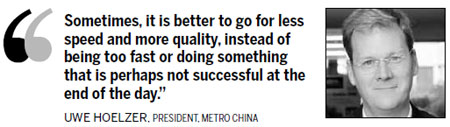
"On the other hand, sometimes, it is better to go for less speed and more quality, instead of being too fast or doing something that is perhaps not successful at the end of the day. What I want to say is, we have a business model which is well-developed now," said Hoelzer.
Metro will open seven to 10 stores this year and similar numbers annually in the years to come.
"My target to open seven to 10 stores is already a big challenge because first of all, we have to find the right store location," said Hoelzer. "You lose money immediately if you make a mistake in choosing a new store location."
Before coming to China, Hoelzer was the chief executive officer of Metro in Vietnam and then in Poland. His experiences in those two countries make him quite confident about the company's performance in China.
He said there is competition in China, but it is not comparable with some foreign countries.
According to Hoelzer, in European cities each with 40,000 to 50,000 residents, normally there will be four to five hypermarkets, which leads to intense competition among rivals.
"And here (in China), we are still far away from having similar high competition as in western Europe or eastern Europe," said Hoelzer. "I always tell our store managers: 'Look, there is competition but it is not yet comparable to what we know from other countries'. "
Currently, Hoelzer seems quite confident and ready to deal with the complex market situation in China.
Engaged in the retailing and wholesale sector since he graduated from university, Hoelzer said being the president of Metro China is his greatest achievement. He started his career in a retail company and became one of the youngest managing directors at Aldi when he was 30. Aldi is a Germany-based supermarket chain operator specializing in inexpensive goods.
Hoelzer said it was a coincidence he entered retailing. "My grandma was shocked when I told her I would start my career life with a retailing company. My whole family was working in the legal arena. She wanted to see me as a state attorney or as a lawyer working in the retailing industry," said Hoelzer. "She was quite impressed after she saw I became successful in my career life.
"I wrote my thesis about key account management. The key account management approach was founded in the fast-moving consumer goods sector. For me, it is interesting to work on this topic. And it was the reason I applied for a job with one of the big German retail companies."
tangzhihao@chinadaily.com.cn
(China Daily 08/16/2012 page16)
 Relief reaches isolated village
 Rainfall poses new threats to quake-hit region
 Funerals begin for Boston bombing victims
 Quake takeaway from China's Air Force
 Obama celebrates young inventors at science fair
 Earth Day marked around the world
 Volunteer team helping students find sense of normalcy
 Ethnic groups quick to join rescue efforts
Most Viewed
Editor's Picks
|
|


|

|

|

|
Today's Top News
Health new priority for quake zone
Xi meets US top military officer
Japan's boats driven out of Diaoyu
China mulls online shopping legislation
Bird flu death toll rises to 22
Putin appoints new ambassador to China
Japanese ships blocked from Diaoyu Islands
Inspired by Guan, more Chinese pick up golf
US Weekly

|

|