Inventors need investors to keep the wheels turning
Updated: 2012-08-21 08:02
By Hu Yongqi (China Daily)
|
||||||||


|
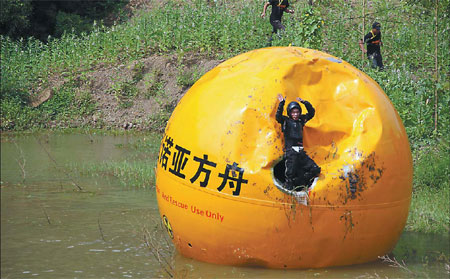
Yang Zongfu, suitably dressed for the occasion, gets ready to test his invention in Yiwu, Zhejiang province, earlier this month. Dong Qi / for China Daily |

|
Yang Zongfu, an inventor, emerges from his ark after rolling down a hill into a pool in the test in Yiwu, Zhejiang province early this month. Dong Qi / for China Daily |
|
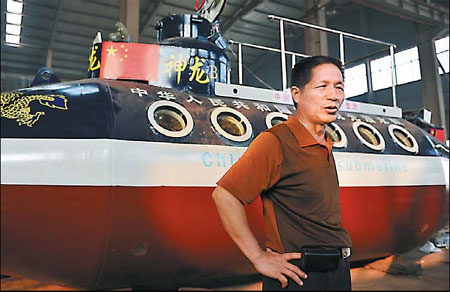
Zhang Junlin, stands beside his submarine in Fuyang, Anhui province. The submarine, which he designed, is 9 meters long, 2 meters wide and 2.8 meters in height, and can hold 12 passengers. An Xin / for China Daily |
|
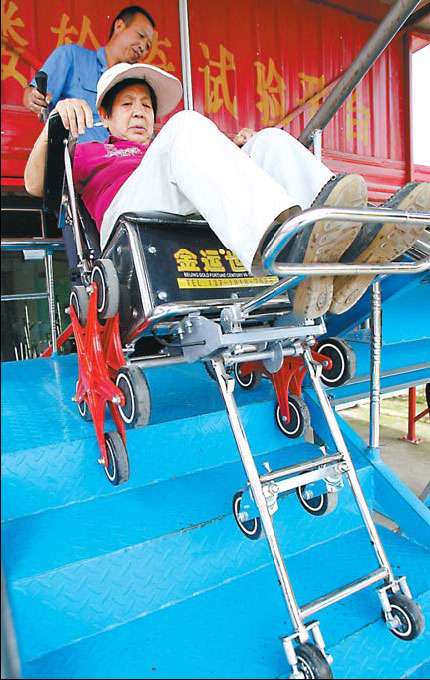
Zhao Shuying in the wheelchair her husband Li Rongbiao designed and manufactures in Beijing. Zhang Wei / China Daily |
Imagination and creativity can only go so far, reports Hu Yongqi in Beijing.
In the movie 2012, mankind is threatened with annihilation by a deluge, the likes of which has never been seen. Those who survive escape the flood in a gigantic ark.
The idea of this ark grabbed the popular imagination, particularly given the many floods China has experienced in recent years. Where would you find such a vessel?
In Yiwu, Zhejiang province, inventor Yang Zongfu provides if not the gargantuan ark of the movie, at least a diminutive alternative.
Yang invented and is producing a spherical ark 4 meters in diameter that weighs 6 metric tons. It has seats you can strap yourself into, windows and a ventilation system. It's designed to withstand collisions, radiation and high temperatures. Three people could survive for up to a year on the pilot biscuits, water and oxygen it carries.
Yang, 32, was confident in his design after its field test in which he tumbled down a hill inside the ark and into a pool. "It proved to be a success because it didn't shake at all inside. It's safe, very safe," he said.
The ark is just one of Yang's creations in the past six years. He has 300 inventions to his credit and holds 36 patents, which bring his business annual revenue of 100 million yuan ($15.9 million).
Other inventors seem doomed to disappointment. Guo Tianqiao, 80, who holds four patents, retired from a shipyard in Dalian, Liaoning province, 20 years ago. No one has shown interest in his patents, and he has been begging around Beijing South Railway Station since February.
Guo started researching how to clean automobile exhaust in 1995 and was granted a patent for his method in 2003. For 30 years, he devoted himself to his inventions, and the only thing he cared about was how to perfect them.
But he had no experience in developing a business and he had difficulty pitching his ideas to investors. His efforts to find investments always failed.
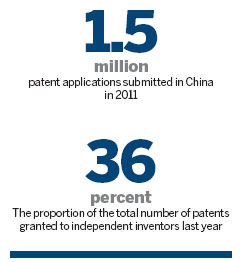
In 2011, independent inventors contributed 36 percent of the 1.5 million patent applications submitted to the State Intellectual Property Office. However, they hold just 58,797 patents, making up 8 percent of patents in China.
According to the China Association of Inventions in Beijing, 1.4 million independent inventors nationwide are developing ideas they hope to patent. Many of them have quit their jobs, even left their families behind to make inventing their profession.
However, their fates vary greatly, experts say, depending on their business awareness and financial support.
Profitable inventions
After testing his ark on Aug 6, Yang's two cellphones rang nonstop. He was getting 50 calls a day about the vessel. One businessman calling from Shanxi province wanted to order 15 arks.
Yang said he plans to change the design, make the vessel smaller and more affordable. "The ark could shrink to 3 meters in diameter and sell for about 1 million yuan."
He hired a crew of 30 workers for two years to make the craft. It cost him 1.5 million yuan, which he had saved from selling shape-shift scarves he invented - scarves whose design changes depending on how they are folded. Yang was on the road to making his fortune inventing, but it was hard work.
In 2002, after graduating from university, the native of Jiangxi province found a low-paying job as a tourist guide in Guangdong province. Unsatisfied with that, he started a trading business to earn more, but through inexperience lost everything on some bad deals.
In May 2004, he went to Yiwu to trade daily commodities. By the next year, he had made only a meager profit, owing to the ferocious competition among local traders. In 2006, he was granted a patent on a new type of zipper.
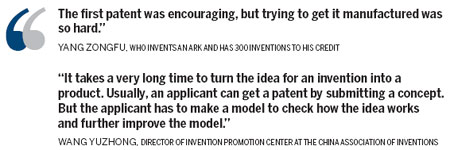
"The first patent was encouraging, but trying to get it manufactured was so hard," said Yang. Twice he was cheated when looking for investors in neighboring cities. "The fraudsters took my schematic drawing, and that was the last I saw of them," he said.
However, Yang did not give up. Unlike many other young men, he does not play computer games, and he has no hobbies. He studied about 16 hours a day and mastered physics, chemistry and other disciplines. Whenever he came across technical problems with his designs, he would turn to experts, and he wasn't put off by criticism.
Yang's persistence bore fruit a year later when he designed the shape-shift silk scarf. He used all his savings to have the scarves made in 2007. The product was wildly popular with young women. In 2009, his factory had 120 million yuan in revenue.
He now owns three companies, which yield a net income of more than 100 million yuan a year.
Hard to industrialize patents
Yang said 90 percent of his inventions have not gone into production. But Li Rongbiao, 68, was lucky the first time around when he managed to put his patented electric wheelchair into production in 2008.
Hidden amid the cornfields in Beijing's Tongzhou district, Li's bungalow is no different from his neighbors' homes. But it is where he fulfills his dream of building the best possible electric wheelchairs. His wheelchair can climb up and down stairs, a useful feature for people who cannot walk and live in buildings that do not have elevators.
In 2002, his wife Zhao Shuying, 70, was unable to walk for six months after breaking her ankle in a fall on a staircase. The couple then lived in an apartment building with plenty of stairs. Li racked his brain thinking of ways to make a wheelchair so he could bring his wife outside. He got the idea for an electric wheelchair that could climb the stairs in his building while talking with a Japanese friend.
For four years, Li perfected his model, going from three to five wheels to give it better balance. In 2006, he sold his apartment in downtown Beijing for 400,000 yuan to start his business. His wife, Zhao, was against spending their 500,000 yuan savings, and she distrusted the feasibility of the wheelchairs.
Li's two daughters, who live in Los Angeles, were also strongly opposed to his plan. They e-mailed that they would gladly pay for daily needs their parents might have, but not if their father lost everything if his business failed.
"I called every friend and relative in Beijing to tell them all that I would not borrow money from them if my factory was short of funds," said Li. "I told them that if my factory collapses, I'd jump off the roof to kill myself."
In the end, Li's wife stood by him and the couple made their first wheelchair in 2007 in a rented house in Qianzhaifu village. Zhao was the first one to go downstairs in the wheelchair. In 2009, Li recruited nine workers as orders for the wheelchairs grew.
Before setting up his own factory, Li tried to outsource some of the work, but his attempts proved futile. In 2009, he ordered 200 stainless steel pipes from a manufacturer in Haidian district. According to the contract, the manufacturer would deliver the pipes in one month, but Li had to wait for three.
This month, the nine workers in Li's factory have been busy assembling wheelchairs with cushions, wheels, and metal bars that were cut and polished for arm- and backrests. They can make one wheelchair a day, and three within two days during peak seasons, such as the spring.
The wheelchairs cost 9,900 to 13,000 yuan, depending on how expensive the metal bars are. As of July, Li had sold more than 500 and donated a few to disabled friends.
Long way to go
Yang Zongfu and Li Rongbiao both attribute their success to their preparation before going into production - compiling meticulous surveys and accurate marketing strategies.
China has more than 120 million people older than 65. In his research, Li found that more than 20 million of the 82 million people with disabilities in China have difficulty walking. He concluded that the market for electric wheelchairs has great potential. What's more, imported electric wheelchairs cost at least 24,000 yuan, twice as much as his.
Li designed a five-wheel wheelchair connected by metal bars shaped in a regular pentagon. The length of metal bars is based on the national standard height of a stair step, so the wheelchair can easily go up and down the stairways. Because staircases in old buildings are extremely small, Li installed two wheels under the seat that can turn 360 degrees so his chair could navigate tight corners.
Li studied at a university in the 1960s, and he worked for 20 years importing goods from Japan. Most inventors, however, are not well educated and finished only middle or high school, said Wang Yuzhong, director of invention promotion center at the China Association of Inventions.
"It takes a very long time to turn the idea for an invention into a product. Usually, an applicant can get a patent by submitting a concept. But the applicant has to make a model to check how the idea works and further improve the model," said Wang. Most inventors earn less than 50,000 yuan a year, according to a survey the association conducted.
Inventors can also authorize companies to manufacture their patents, but it's extremely difficult to get paid. Like Yang, many inventors have been conned when they tried to do this. Guo Tianqiao, from Dalian, was cheated by five companies, in Changli county, Hebei province, and Heze, Shandong province. Now he has to rely on donations from strangers to pay the 8,000 yuan annual fees for his patents each patent costs 2,000 yuan in annual fees.
The leadership in China attaches great value to grassroots inventors and their contributions. This month, Zhao Zhengyi, a farmer and inventor - of concrete foundations for heavy duty cranes - from Beijing was received by Vice-president Xi Jinping.
In January 2008, Premier Wen Jiabao met Yang Zongfu in Beijing when he submitted his idea for snow removal equipment, at a time when continuous snow and icy rain wreaked havoc in South China.
"In the 10-minute meeting, Premier Wen told me to make more inventions that will help our people, especially when they face destructive disasters," Yang recalled.
Li and his wife have no plan to expand production - the equipment and labor would cost more than they have, and investors have shown little interest because there are no quick investment returns in wheelchairs. Li wrote to the China Disabled Persons' Federation three times in an attempt to get subsidies because, to his mind, the federation is responsible for the welfare of people with disabilities. His letters went unanswered.
In 2011, the inventors of more than 60 percent of the 10,270 patents authorized for production got contracts of less than 10,000 yuan from companies buying the rights. Only 4.3 percent of the contracts were worth 1 million yuan, according to Zou Dingguo, a researcher at Tsinghua University's TusPark Research Institute for Innovation.
Zou said China needs to better protect intellectual property rights to create fair and equitable competition.
Yang Zongfu has a plan to open a training center for inventors, to produce more good ideas and help them apply for patents. The next step would be to establish a platform for inventors to connect with companies to make the most of the patents.
"As long as new ideas are accepted by businesses, patents can promote economic and social development. That way, our economy can be more sustainable and healthy," Yang said.
Contact the reporter at huyongqi@chinadaily.com.cn
(China Daily 08/21/2012 page1)

 Relief reaches isolated village
 Rainfall poses new threats to quake-hit region
 Funerals begin for Boston bombing victims
 Quake takeaway from China's Air Force
 Obama celebrates young inventors at science fair
 Earth Day marked around the world
 Volunteer team helping students find sense of normalcy
 Ethnic groups quick to join rescue efforts
Most Viewed
Editor's Picks

|
|


|

|

|

|
Today's Top News
Health new priority for quake zone
Xi meets US top military officer
Japan's boats driven out of Diaoyu
China mulls online shopping legislation
Bird flu death toll rises to 22
Putin appoints new ambassador to China
Japanese ships blocked from Diaoyu Islands
Inspired by Guan, more Chinese pick up golf
US Weekly

|

|