Imitation is flattering
Updated: 2012-08-23 08:03
By Zhou Huiying and Tian Xuefei in Harbin (China Daily)
|
||||||||


For Huang Zuxiang, Volga Manor is a tribute to his fond memories of Harbin, where he has lived for 60 years.
Huang is the chairman of Dongjian Group, which has invested more than 400 million yuan ($63 million) in the manor - one of the city's most popular tourist attractions.
Sitting in the manor's picturesque garden, Huang talks about his decades-long connection with the city.
He moved with his father from Shanghai to Heilongjiang's provincial capital at age 4, and his home was around Central Avenue, the city's commercial hub.
"The city was so beautiful," says Huang, recalling that he often sat on the bank of Songhua River for hours without doing anything. What he liked most were the magnificent Russian-style buildings, which could be found at every corner of the city.
In 2004, Huang and his friends bought the 60-hectare plot of land in Harbin's suburb to build houses and gardens, where they could "relax in their leisure time". But then they changed their plan.
"We share the same affection for the city's old buildings. Every time we got together, we talked about those unforgettable buildings which have disappeared," Huang recalls.
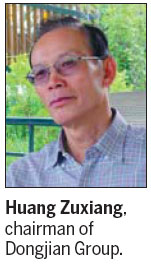
Then the idea to build a theme park with Russian-style architecture came to Huang's mind.
Huang chose St. Nicholas Church - one of Harbin's disappearing landmarks - as the first project.
"The recreation of the church can realize my dream, as well as those of all Harbin people," Huang says.
As soon as he made the decision, Huang immediately started to collect information about the church. He found 21 original design drawings from a museum in St. Petersburg, which provided valuable information for the construction of the church.
Then he invited Russian architect Nicola Petrovic Cragin to be the chief designer of the project.
In order to make the recreation similar in every detail, Huang went to Russia and imported pine logs to construct the church. "I hoped to present a perfect Volga Manor to all people who really love the culture of our city," Huang explains.
Huang, executive director of the Sino-Russian Friendship Association, has made the manor a base for Sino-Russian cultural communication.
He invited experts on Russian culture and arts to give him suggestions and divided his time between Russia and China. He became a frequent visitor to museums in St. Petersburg.
"Most of the buildings at Volga Manor are exactly the same as their models, but they still lack rich cultural content. We plan to build several historical and cultural museums where people can enjoy the blend of Russian culture and Harbin culture."
As for the future, Huang paints a bright future.
"From the beginning of construction, I realized that it was no longer mine but belongs to the city and the whole of society. So in the future, I will donate it to society."
Contact the writers at zhouhuiying@chinadaily.com.cn and tianxuefei@chinadaily.com.cn.
(China Daily 08/23/2012 page19)

 Relief reaches isolated village
 Rainfall poses new threats to quake-hit region
 Funerals begin for Boston bombing victims
 Quake takeaway from China's Air Force
 Obama celebrates young inventors at science fair
 Earth Day marked around the world
 Volunteer team helping students find sense of normalcy
 Ethnic groups quick to join rescue efforts
Most Viewed
Editor's Picks

|

|


|

|

|

|
Today's Top News
Health new priority for quake zone
Xi meets US top military officer
Japan's boats driven out of Diaoyu
China mulls online shopping legislation
Bird flu death toll rises to 22
Putin appoints new ambassador to China
Japanese ships blocked from Diaoyu Islands
Inspired by Guan, more Chinese pick up golf
US Weekly

|

|