The innkeeper from Japan
Updated: 2012-08-28 08:00
By Huo Yan in Guangxi and Gan Tian in Beijing (China Daily)
|
||||||||


|
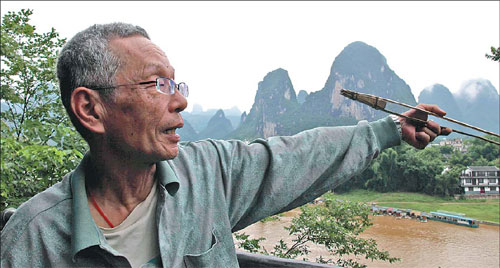
Japanese Katsuyuki Hayashi stands on top of Laozhai Hill in Yangshuo county, the Guangxi Zhuang autonomous region. Photos by Huo Yan / China Daily |
My China Dream | Katsuyuki Hayashi
He had arrived in China for an international symposium, but he loved what he saw so much he decided to stay. Now, he plays host to other visitors from abroad, including his fellow Japanese. Huo Yan in Guangxi and Gan Tian in Beijing piece together his story.
Katsuyuki Hayashi is far from home, but where he is now, he has become a local celebrity. He was the first foreigner to have opened an inn at the foot of Laozhai Hill, in Xingping town, Yangshuo county, in the Guangxi Zhuang autonomous region.
His story has become a local legend. Hayashi, known to his neighbors as Lin Kezhi, came to Xingping in 1996, to attend an international forum on ethnic groups.
The 66-year-old Japanese was immediately attracted to the rugged beauty of the karst landscape and the Lijiang River, and he asked local citizens where the best view was.
He was told to go to the top of Laozhai Hill, which rises 300 meters straight above the Lijiang River like a giant bamboo shoot. Hayashi was undeterred by the tough climb and made his way up with little else but his mountaineering skills, ropes and climbing gear.
"I was so attracted by the beautiful scenery. The air was so fresh," Hayashi remembers, with a deep breath. In fact, he was so enamored with what he saw that he made up his mind. He was going to stay, and help make it more accessible for others to share the same amazing view.
That was the start of his mission to develop the spot into a natural tourist attraction.
"If there were stairs leading to the top of the mountain, more visitors will come, and that will translate to economic benefits for the local people," he explains.
After getting official permission, Hayashi started work on his project. He did not know much about construction, so he bought books for reference. He plotted out the topography, bought gunpowder and carried bricks up the hill with the help of local workers. And he funded the project on his own.
Six months later, there were 1,149 steps and a pavilion on the mountain for visitors to rest and enjoy the view. (He later added another pavilion at the half way mark so visitors could take a break for the demanding climb.)
Initially, the locals were suspicious of Hayashi's efforts. They thought he was a rich man and when they found out he was not, the rumors started that he was the son of a Japanese soldier in the war with China from 1937 to 1945. In fact, Hayashi's father was a farmer in Shizuoka and had never been to China.
"Many people thought that I did this to 'atone for my sins'. They even insulted me and called me names. I did not explain. Time will tell," says Hayashi, who worked as a taxi driver for a long time back in Japan.
In spite of his meager income, the Japanese, who majored in literature in college and always had a strong interest in minority ethnic culture, spent much time and money traveling to remote villages in Asia, studying customs and culture. Often, their plight would galvanize him into action.
In 1979, he had gone to a remote foothill village in Nepal, where he found locals cutting down trees for fire at night. They had no electricity, but the chopping of trees was damaging the fragile environment.
Hayashi noticed that there was abundant water, but the villagers could not afford hydroelectric power. Hayashi decided to help build a hydropower station.
It took him nearly 10 years shuttling back and forth between the village and Japan, supervising construction and fund-raising at home. But it was completed.
His feats slowly gained recognition in Japan. In 1987, he fell off a mountain while carrying wood and sustained 13 fractures. The story captured the attention of the Japanese media and he became a celebrity.
News about him snowballed and Hayashi is now a household name back in his country, and his story is even told in English textbooks in Japanese schools.
His project in Xingping didn't stop with the construction of the stairs and pavilions on the hill. He also wrote articles to media back in Japan promoting the beautiful scenery the mountain boasts.
Thanks to his efforts, Laozhai Hill became increasingly popular among photographers, backpackers and travelers, especially those from Japan. Over the past years, tourist arrivals have jumped from a few thousand to almost a million.
The locals stopped calling Hayashi names and instead, he is now one of the most respected leaders in the community.
He decided to build his inn at the foot of the hill soon after he finished the building of stairs. But, his decision to stay for good took a toll on his marriage. In 2000, he was divorced.
Two years later, he was interviewed on television when his inn was finally ready. Dong Bincai, a 28-year-old shop-owner, saw him on TV where he spoke about his life and his quest for someone to share his life.
Dong was moved by his story, but did not think more about it - until she had a dream that night in which she saw herself with Hayashi and two children. Dong decided it was fate knocking on her door.
"As we communicated through letters and phone calls, we found we had many things in common. That's how our love just blossomed," Dong says, eyes shining.
They were married in 2002 and two years later, their son, Kitaro Hayashi, was born. He is named after the famous Japanese musician, a favorite of both parents.
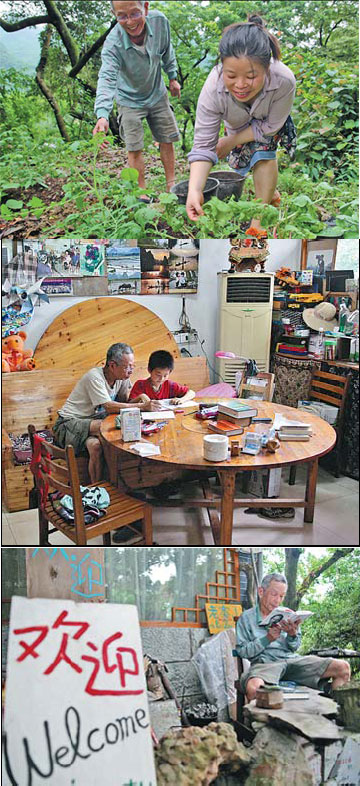
The couple now runs the inn as their main source of income. It has five guest rooms, and enjoyed a constant flow of visitors in the first few years, Dong says.
"But due to the economic recession in Japan, the situation isn't as good as before," she says. But the couple still keeps all the rooms ready for visitors every day.
Hayashi not only cleans the inn, he also keeps Laozhai Hill litter free, and does a rubbish-collecting trip at least once a week.
"In peak seasons when there are more tourists than usual, his workload is much heavier," Dong says. "It often takes him five hours to go up and down the hill."
Hayashi brushes this away, saying "I don't feel tired at all. It's good for our environment. And sometimes, I have Kitaro for company".
His face brightens up whenever he talks about his son, and his wife says his greatest joy is giving his son a piggyback ride to and from school.
Kitaro is effectively bilingual and takes turns teaching his father Chinese and his mother Japanese.
"He is very smart," Hayashi declares. "Kawaii," he adds in Japanese, which means cute or darling.
Hayashi has a brother and sister back in Japan, but since he settled down in Xingping, he has only gone home once in 2011, to settle his pension. But Dong says her husband pays close attention to news about Japan.
When earthquakes and tsunami hit Japan in 2011, Hayashi watched television all day to follow the latest developments.
But for Hayashi, home is now where his young family is, along with his beloved Laozhai Hill. He takes great pains inscribing the names and greetings left by visiting media, and hangs the stone tablets in front of his inn.
For him, these are the little pleasures that make life wonderful.
Huang Feifei contributed to the story.
|
From top: Hayashi and his wife Dong Bincai work in their garden. Hayashi and his son Kitaro in their home at the foot of Laozhai Hill. The innkeeper enjoys reading at home. |
(China Daily 08/28/2012 page18)

 Relief reaches isolated village
 Rainfall poses new threats to quake-hit region
 Funerals begin for Boston bombing victims
 Quake takeaway from China's Air Force
 Obama celebrates young inventors at science fair
 Earth Day marked around the world
 Volunteer team helping students find sense of normalcy
 Ethnic groups quick to join rescue efforts
Most Viewed
Editor's Picks

|

|


|

|

|

|
Today's Top News
Health new priority for quake zone
Xi meets US top military officer
Japan's boats driven out of Diaoyu
China mulls online shopping legislation
Bird flu death toll rises to 22
Putin appoints new ambassador to China
Japanese ships blocked from Diaoyu Islands
Inspired by Guan, more Chinese pick up golf
US Weekly

|

|