A Chinese oasis in Manhattan
Updated: 2012-08-29 08:05
By Kelly Chung Dawson in New York (China Daily)
|
||||||||


As was customary in the day, nine powerful Chinese officials gathered in a private garden in 1437 to enjoy literary and music performances. The painter Xie Huan depicted the scene in Elegant Gathering in the Apricot Garden, currently on display in the Metropolitan Museum's Chinese Gardens: Pavilions, Studios, Retreats.
|
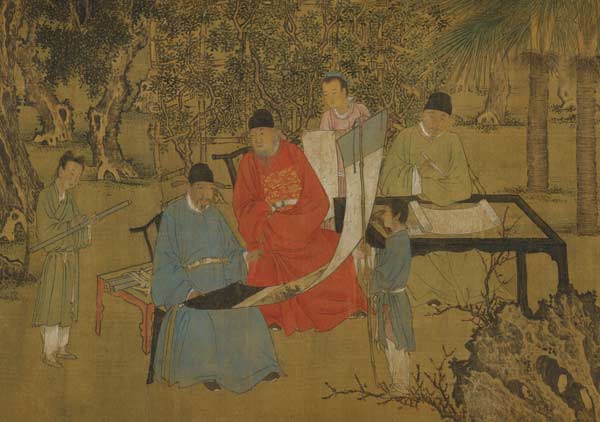 The Elegant Gathering in the Apricot Garden is exhibited at the Metropolitan Museum in New York. [Provided to China Daily] |
These same men were responsible for calling a stop to Admiral Zheng He's exploratory voyages, which they believed to be an extravagantly unnecessary government expense. China was a "walled garden", and should focus instead on self-cultivation, they said.
"This metaphor of China as a garden, and the garden as a place of inward exploration, is particularly fitting," says Maxwell Hearn, curator of the Metropolitan Museum's department of Asian art.
"It's a Chinese mindset that everything you need in life can be found within your walls. One needn't go looking abroad for enlightenment, because what you need is within you. It's the image of China as the peaceful kingdom."
The exhibition, which features more than 60 works including paintings, ceramics, photographs and textiles, spans 1,000 years and is drawn entirely from the museum's permanent collection. Summer Mountains, the oldest piece in the exhibition, dates back to 1050. The most recent works are photographs.
Organized by theme, the exhibition features categories including Palaces, Secluded Temples, Literary Gatherings and Gardens as Embodiments of Scholarly Ideals.
Chinese Gardens will serve as a complement to the Metropolitan's upcoming November presentation of the 16th-century Kunqu opera The Peony Pavilion, in the museum's own Chinese courtyard garden. The opera will be directed by the composer Tan Dun, and will feature choreography by dancer Huang Doudou.
Gardens have long been an integral part of Chinese culture, Hearn says.
"The creation of miniature worlds that emulated and distilled the natural world emblemized what nature has always meant to the Chinese," he says. "They have played the role of escapist space, dwellings for the immortals and a place for recluses to flee from government affairs."
The link between gardens and art has always been particularly strong in China, he says.
"I suspect that there have always been garden architects in every country who have been artists, but the fact that in China the same people who were patrons were often themselves poets and amateur painters, meant that there was a particularly close relationship. These gardens were often designed by painters, and were also a source of inspiration for the painters," he says.
"The role of gardens has been central to the Chinese mind and therefore has also played a very important role as a theme in art, and a source of inspiration."
Although gardens are not as prevalent in China as they once were, Hearn believes that the function they play has not changed. The most prominent example of recent garden architecture is I.M. Pei's work with the Suzhou Museum, which features pavilion architecture, bridges and waterways.
"I think the challenge for contemporary garden architects is how you modernize a tradition and still identify strongly with that tradition," he says. "But I think this idea will continue to be explored in China."
The last four exhibitions in the Chinese galleries at the Metropolitan have been loans from other institutions, so the gardens exhibit is noteworthy, Hearn says.
"This is an extraordinary moment, because the Met has really come of age with its Chinese collection," he told media recently. The museum was in possession of only four pieces in the current show before 1970.
"The exhibition includes pieces from the 10th century right up to the 20th century, and that's a special thrill. It's a great moment to really explore the strengths of our collection."
Hearn believes that Western audiences will connect with the idea of self-cultivation, he says.
"Voltaire once said that we should all cultivate our own gardens, and I think that concept has been present in China for many, many centuries," he says.
"We all need to find our own personal gardens, in the sense that a garden is a place to discover not only nature but oneself. That's something we can certainly learn from today."
kdawson@chinadailyusa.com

 Relief reaches isolated village
 Rainfall poses new threats to quake-hit region
 Funerals begin for Boston bombing victims
 Quake takeaway from China's Air Force
 Obama celebrates young inventors at science fair
 Earth Day marked around the world
 Volunteer team helping students find sense of normalcy
 Ethnic groups quick to join rescue efforts
Most Viewed
Editor's Picks

|

|


|

|

|

|
Today's Top News
Health new priority for quake zone
Xi meets US top military officer
Japan's boats driven out of Diaoyu
China mulls online shopping legislation
Bird flu death toll rises to 22
Putin appoints new ambassador to China
Japanese ships blocked from Diaoyu Islands
Inspired by Guan, more Chinese pick up golf
US Weekly

|
|