Wanda optimistic in real estate market
Updated: 2012-12-14 14:45
By Hu Haiyan (China Daily)
|
||||||||


China's property prices will grow moderately over the next 10 years, according to the chairman of one of China's biggest conglomerates.
"As China's urbanization process develops, there will be strong demand in the domestic property market over the next 10 years. A tumble is not likely, but (there will be) an increase in the nation's property prices. But the growth will be limited because more rigorous real estate policies are expected to be put in place," said Wang Jianlin, chairman and founder of Dalian Wanda Group.
Wang, who made the comments at the 2012 CCTV Chinese Economic Figure Awards Ceremony on Wednesday, said that by the end of 2012, Wanda will exceed its annual revenue target of 116 billion yuan ($18.6 billion). The group will have 35 new Wanda plazas within two years.
Last year, the Wanda Group, which has holdings in the real estate, tourism, hotels and entertainment sectors, reported revenue of 105.1 billion yuan, of which commercial property contributed 95.3 billion yuan.
In recent years, the central government has repeatedly restated its determination to control the property market. It has also vowed to keep in place measures such as higher down-payments and restrictions on third-home purchases.
Despite the measures, China's real estate market is showing signs of recovery.
According to a report released by the China Index Academy this month, home prices in most major cities increased for the sixth consecutive month in November.
The report from the property research organization said that the average price of new homes in 100 monitored cities increased by 0.26 percent in November to 8,791 yuan per square meter. In October, prices increased by 0.17 percent.
Among the 100 cities, 60 witnessed an increase in property prices, rising from 56 in October, and 38 cities saw a decline, down from 42 in October.
New home prices in 10 major cities, including Beijing and Shanghai, rose by 0.39 percent in November from October, marking a year-on-year rise for the first time in 2012.
Yu Liang, president of China Vanke, the nation's largest real estate developer by sales value, said it's unlikely that home prices will see massive gains.
"It is expected that more tightening real estate policies will be put in place by the government in the future. But the key to solve skyrocketing home prices and make prices reasonable is to provide sufficient land efficiently to reduce costs," Yu said on Wednesday.
In anticipation of future restrictions, many property developers have been attempting to expand to other sectors.
In September, the Wanda Group completed a $2.6 billion acquisition of US cinema chain AMC Entertainment, making it the largest global owner of movie theaters.
At the 11th China Entrepreneur Summit 2012 held on Dec 8, Wang said revenue from its ventures into sectors outside real estate are expected to surpass 22 billion yuan this year.
"It is expected that the figure will rise to 80 billion yuan by 2020, making Wanda among the top 10 culture corporations globally in terms of sales," Wang said.
China Vanke, on the other hand, is considering a plan to expand overseas.
"Although we haven't made a specific overseas expansion plan, we will not just build Chinatowns overseas. What we want to gain from the overseas expansion is to gain more experiences and technologies from the overseas market," Yu said.
In November, Vanke established its Hong Kong business division to manage its overseas markets. Yu said markets in developed nations, such as the United States, are the group's primary investment targets.
Wei Dong, senior associate director of research department in DTZ North China, said it is important that real estate developers refashion their business model in light of restrictive policies, rising costs and the global economic recession.
"Although property prices are expected to rise, costs - such as land acquisition costs - will also rise. Maintaining high profits is a big challenge to real estate developers," Wei said.
She said because of stringent regulations governing the domestic property market, Chinese companies are looking overseas.
She noted that new ventures, especially overseas expansion efforts, will not be an easy path because of cultural differences.
"Going overseas represents leaving safe domestic markets for unknown foreign markets. It will be challenge for companies to find enough talent who have local knowledge and at the same time, are versed in the company culture," Wei said.
huhaiyan@chinadaily.com.cn

 Relief reaches isolated village
 Rainfall poses new threats to quake-hit region
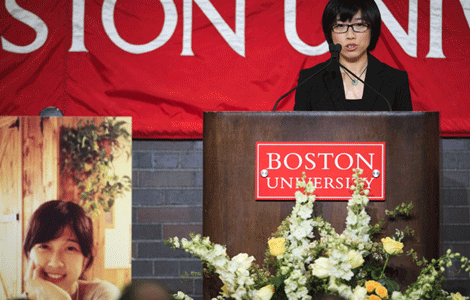 Funerals begin for Boston bombing victims
 Quake takeaway from China's Air Force
 Obama celebrates young inventors at science fair
 Earth Day marked around the world
 Volunteer team helping students find sense of normalcy
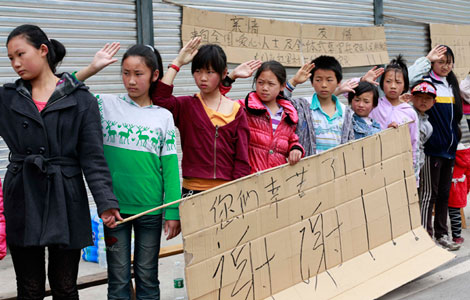 Ethnic groups quick to join rescue efforts
Most Viewed
Editor's Picks

|
|


|

|

|

|
Today's Top News
Health new priority for quake zone
Xi meets US top military officer
Japan's boats driven out of Diaoyu
China mulls online shopping legislation
Bird flu death toll rises to 22
Putin appoints new ambassador to China
Japanese ships blocked from Diaoyu Islands
Inspired by Guan, more Chinese pick up golf
US Weekly

|

|