Seeing ability, sensing possibility
Updated: 2014-07-04 08:44
By Mike Peters (China Daily USA)
|
||||||||


I once made a blind man cry.
It was one of those days when my cellphone wouldn't stop ringing. After a series of calls from the important to the trivial - including two nuisance calls during dinner - I was heading for an end-of-the-day massage in Nanjing. It was at one of those studios with blind masseurs, in a room with six tables, and I had just climbed onto my table when the phone rang again.
I quickly rolled off the other side, and stepped in the hall so as not to disturb the other customers. Like an idiot, I waved at my masseur and held up one finger, the "universal" sign that means "one minute".
Of course, it meant nothing to my masseur, and as I stood out in the hall to complete my call, I heard a plaintive wail from inside the massage room. My masseur was in a frightened panic: He knew I'd been on the table - and now he'd lost me.
I'm deeply shamed by the episode in hindsight, but it comes to mind often when I hear people talk about blind people doing massage in China. Does their lack of vision mean their other senses are more keenly honed - to a level of extraordinary perception?
That's the prevailing mystique, that these masseurs have heightened senses not in spite of their blindness but because of it.
While not all champions of the blind massage industry in China support that idea, many contend this is valuable work a blind person can do well, providing the dignity of a job and some independence. Critics say there's little independence in the deal, that blind people are funneled into the massage or music industries as their only options, with small salaries, communal housing and little assistance in daily life. Many advocates for the visually impaired say the "special powers" of blind masseurs are romanticized to make us all feel better about taking advantage of these folks.
I've been ambivalent about the idea, dubious that all blind folks can muster extrasensory gifts - though something in me always wants it to be true. Some blind people may indeed have the touch, but is it nature or nurture?
Enter Daniel Kish, president of World Access for the Blind. Recently featured on CNN on a show hosted by Dr Sanjay Gupta, Kish is one of the champions of "echo-locating".
Animals like bats and dolphins can navigate by sound, using sound waves to help them find their way around their environments, light or dark. Kish - and others - say they've trained themselves to do the same thing. I was spellbound by the TV screen as small children with white canes were taught to click loudly with their tongues as they moved around a playground and clambered up a rocky hillside. Their coach and mentor insisted that, like he has, they can learn to distinguish trees, people, buildings or cars by interpreting the echo of returning sound waves.
The CNN crew took him to an unfamiliar hiking trail, and he navigated the entire route with his cane and his clicking without any mishap.
I suspect that, like massage, this is not for every unfortunate soul who loses sight. But it was heartening to see possibilities where I'd never imagined them.
China, where the population of 5 million blind people is the world's largest, is beginning to see possibilities for a disabled population that has often been kept out of sight and mind.
This year, blind candidates were allowed to take the gaokao - the tough university admissions exam - using Braille. I was also intrigued by extensive, state-of-the-art handicapped access I saw at two Beijing universities and one middle school.
Some observers say such measures are putting the cart before the horse. What good is a university exam in Braille, they say, when applicants also need a high-school diploma, and most disabled kids never get past primary school?
But even if many of the shiny new wheelchair ramps and voice-activated cross-walks, for example, are still awaiting their first use by a person with a disability at those campuses, they send a powerful message of awareness and commitment.
And opportunity - even for those who can't massage or tongue-click their way to an independent life.
michaelpeters@chinadaily.com.cn
|
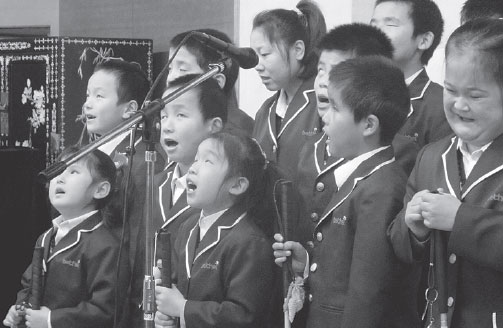
A choir of blind children from the Bethel residential home in suburban Beijing sing at a charity concert held last year. Mike Peters / China Daily |
(China Daily USA 07/08/2014 page11)
 'God father' of HK art honored for Smithsonian exhibit
 Grateful blessings
 Visitors tour Chinese warships
 Chinese-American police officers rise in NYPD
 The world in photos: June 30 - July 6
 Chinese navy to join 2014 RIMPAC naval drill
 Gettysburg reenactment marks 151st anniversary
 Washington splashed with fireworks
Most Viewed
Editor's Picks
|
|

|
|

|
|
Today's Top News
China urges US to stop abusing remedy measures
China, US to discuss yuan, monetary policy
Investor visa program sprouting US jobs nationwide
Exhibit marks 30 years' relationship between Beijing and Washington
WWII memorial announced for Bay Area
Investing in art, bit by bit
US promises to work with Germany over spy row
`God father’ of HK art honored for Smithsonian exhibit
US Weekly
|
|