High speed ahead: China seeks US rail role
Updated: 2015-10-23 11:35
By William Hennelly and Hezi Jiang(China Daily USA)
|
||||||||


The world leader in high-speed rail travel, China is exporting its industry know-how to the United States, which is showing signs of adopting the mode of transportation, but costs and politics remain hurdles, report William Hennelly and Hezi Jiang from New York.
In the high-speed rail arms race, the United States is not a superpower. That title is being contested by countries such as China, Japan, France, Germany and Spain.
Politics, cost and the distance between cities are some of the reasons why high-speed rail (HSR) in the US hasn't really gotten on track.
In April 2009, during President Barack Obama's first year in office, the Department of Transportation issued a report called Vision for High-Speed Rail in America.
"After leading the world in rail development during the 19th and early 20th centuries, the United States has more recently lagged behind other countries in developing modern intercity passenger rail," the report said. "Over the last several decades, many countries in Europe and Asia have developed HSR systems."
The obstacles to HSR cited in the report were lack of expertise and resources; state fiscal constraints; a need for partnerships with private railroads that own some of the track; multi-state partnerships (because some HSR lines will cross state lines) and a need for safety standards.
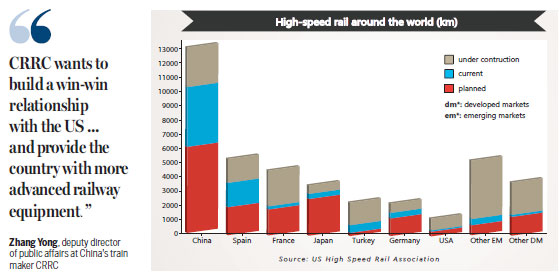
While the US has been slow to embrace HSR, China has built the largest HSR network in the world with more than 16,000 kilometers (9,900 miles) of track as of December 2014, followed by Spain, Japan and France.
Japan is a pioneer in HSR; the Tokaido Shinkansen line, which began operating in 1964, is considered the world's first high-speed rail line.
Manufacturing might
China has the manufacturing muscle to build the track and trains and is exporting that technology globally. CRRC Corp Ltd, a state-owned enterprise, became the largest train maker in the world in June after a merger between CNR and CSR. CRRC has projects in more than 100 countries and regions.
As President Xi Jinping continues his state visit to the United Kingdom this week, British officials are soliciting bids for an $18 billion HS2 link between London and northern English cities.
CRRC will be competing with other world giants such as Germany's Siemens, Japan's Hitachi and France's Alstom.
Six years after the US transportation department report, there are signs of progress. In January, California broke ground on a $68 billion HSR network to connect San Francisco and Los Angeles by 2029 and eventually go from Sacramento to San Diego, totaling 800 miles with up to 24 stations. The line's top speed will be 220 mph.
On Sept 30, the California High-Speed Rail Authority (CHSRA) announced that it had received 36 responses from private companies interested in financing, building and operating the first 300-mile segment.
"Until now we have been saying 'There will be private-sector interest.' Now the private sector is saying 'There will be private-sector interest,'" CHSRA CEO Jeff Morales said on Oct 2.
Lisa Alley, CHSRA chief of communications, told China Daily, that interviews are being held with companies that responded, all of which she said have completed high-speed rail and other major projects all over the world. She said the companies confirmed key parts of the authority's 2014 business plan relating to leveraging the private sector to develop and operate the project and drive down costs.
"It is important to differentiate between private-sector financing for construction and maintenance of the system, which would be repaid subject to the private party maintaining a high-level of performance versus private-sector investment based on the ridership and revenue to be generated by a long-term concession for the operation of the system," Alley said.
About $13.2 billion of the $68 billion has been provided by state and federal sources, plus a pledge of California's cap-and-trade proceeds, funds paid by companies to offset carbon emissions, Reuters reported.
Environmental concerns are paramount in California.
In a January 2014 op-ed page article in the Los Angeles Times, Brian P. Kelly, California secretary of Transportation, and Mary D. Nichols, chairman of the California Air Resources Board wrote: "By 2040, it (HSR) could reduce car miles traveled in the state by 3.6 billion miles a year, the equivalent of taking 317,000 cars off the road daily. And by 2020, the project is estimated to eliminate between 278,000 and 674,000 net metric tons of greenhouse gases from voluntary emissions reductions, electrification of local rail and other efforts."
The Chinese High-Speed Rail Delivery Team was one of the 36 groups expressing interest in California's plans.
China looks to deliver
Led by China Railway International, the Chinese team said it could provide design, construction, equipment-procurement and rolling stock (trains). It also proposed financing from the Export-Import Bank of China.
The team said that packaging large pieces of the high-speed rail line together by a single contractor would cut the project's cost and construction timeline.
"To the Chinese team, a relatively large-scale contract is proper and reasonable," said the letter, obtained by Reuters via a Public Records Act request.
The Chinese proposed that under "appropriate loan conditions" the Export-Import Bank of China could "satisfy the financing needs of the project".
But the Chinese also cautioned that California should provide more public financing and guarantee future project debt to satisfy investors, Reuters reported.
"Due to the huge financing gap of the project, potential private investors and lenders may be cautious," the Chinese team wrote.
The California authority is expected to seek bids by mid-2016.
"Of course Chinese companies will be actively involved in the bidding process once it has started," Zhang Yong, deputy director of public affairs at CRRC, told China Daily.
"The US has a need for HSR. We believe that one day all the major cities in the US will be connected by high-speed rail.
"CRRC wants to build a win-win relationship with the US, integrate into American society and provide the country with more advanced railway equipment," Zhang said.
Zhao Jian, a professor at the School of Economics and Management at Beijing Jiaotong University, sees high-speed rail endeavors in the US as too costly and risky for Chinese companies.
"If American governments pay for the high-speed rail project, Chinese companies should get involved," Zhao told China Daily. "Our prices for train manufacture and rail construction are very competitive, better than Japan, Germany, France, and so on.
Zhao said "however, if China wants to invest in high-speed rail projects in the US and earn money based solely on ridership and revenue, it's impossible," he said. "High-speed rail projects in the US will not be profitable.
Zhao also wondered about demand.
"America does not have a market for high-speed rail," he said. "To be profitable, the cities connected by the HSR must have a very large and dense population. The cities in the US are too spread out, and the population is far from enough,"Zhao said. "Currently, the passenger trains in the US are losing money, while only cargo trains are profitable. There are no cargo trains on HSR.
Zhao also questioned whether there was demand.
"There is almost no place in the world that has a market for high-speed rail," he said. "In Europe, the governments want to do it, and they subsidize it.
Questions on revenue
"The annual revenue from the Chinese high-speed rail rides cannot even cover the interest from its debts," Zhao said. "The only line that's not losing money is the Beijing-to-Shanghai HSR, and maybe Beijing to Guangzhou in the future. The only profitable HSR line in the world is the Tokyo-to-Osaka rail."
Of a possible Export-Import Bank role, Zhao said: "Probably they didn't see very clearly and thought they could profit from it, but it's impossible. Or maybe the bank does it to promote itself, and Chinese companies want to go out for the sake of going out."
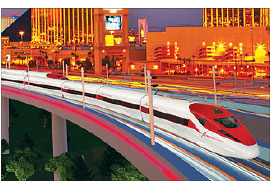
XpressWest, a subsidiary of Las Vegas-based Marnell Companies, a gaming-resort developer, last month unveiled plans for a 235-mile high-speed link between Victorville, California (and eventually Los Angeles) and Las Vegas along Interstate 15. It will be built by a consortium led by China Railway, from which it has received an initial $100 million investment.
According to a Sept 17 release on the XpressWest site, that team consists of: China Railway International USA Co Ltd, "a newly formed Nevada limited liability company owned by a consortium of the world's premier experts in designing, building, financing and operating high-speed passenger rail projects, including: China Railway International Co Ltd, China Railway Group Ltd, CRRC Qingdao Sifang Co Ltd, China Construction America Inc, CREEC USA and CRSC International Co Ltd".
XpressWest plans to start building by September 2016.
"As China's first high-speed railway project in the United States, the project will be a landmark in overseas investment for the Chinese railway sector and serve as a model of international cooperation," Yang Zhongmin, chairman of China Railway International, told Xinhua on Sept 17.
"The United States market is huge because the fact is that their railway tracks and facilities are aging and need upgrading," Cao Gangcai, CRRC's vice-chief economist, told Reuters in an interview on Sept 16, before the XpressWest deal was announced.
In Texas, another private venture by Texas Central Planners is looking to raise up to $12 billion to build a 240-mile HSR link between the Houston and Dallas-Fort Worth metropolitan areas. The company expects to break ground in 2017.
Central Japan Railway Co (JR Tokai) has been pushing for its technology to be adopted for the project.
"We are committed to shinkansen (bullet train)," Texas Central CEO Tim Keith told the Japan Times. The Japanese technology has "an unparalleled track record" of safety, he said.
Florida East Coast Industries, based in Coral Gables, has broken ground for All Aboard Florida, a $3 billion express passenger train between Miami and Orlando, expected to roll in mid-2017.
The Sunshine State's entry won't move much faster than the capability of a typical automobile: The train will travel an average of 81 mph with a maximum speed of 125 mph. (By comparison, the fastest train in the world, Central Japan Railway's maglev, set a speed record of 366 mph on a test track near Mount Fuji. The generally accepted minimum of what constitutes high-speed rail is 200 mph.)
The HSR back story in Florida was driven by state and national politics. The Obama administration had dedicated $2.4 billion (almost all of the funding) in January 2010 to build a Tampa-to-Orlando high-speed line. The 84-mile route (which many considered too short by HSR standards) would have gotten land for a stop from Disney World and was scheduled to roll this year, with a speed of 168 mph.
Florida's governor at the time, Charlie Crist, then a Republican, had received the federal funding commitment, but the HSR line was scuttled when Rick Scott, also a Republican and still the state's governor, rejected the money in February 2011, amid concerns Florida would be responsible for future costs, The New York Times reported then.
The plan also met resistance by some Republicans around the country because it would have given Obama a showpiece in a key state in the 2012 US presidential election.
Obama even included the line in his 2010 State of the Union address: "Tomorrow, I'll visit Tampa, Florida, where workers will soon break ground on a new high-speed railroad. There is no reason why other countries can build high-speed rail lines and we can't."
"You ever read The Power Broker?" asked Joseph Shelhorse of the US High-Speed Rail Association, referring to Robert Caro book's about the "master builder" of New York in the mid-20th century.
"If Robert Moses was in charge (of the Tampa-Orlando project), even without FRA approvals Robert Moses would have sent out dump trucks and just would have guessed where it was going to go and put down a million loads of fill and graded it and said, 'Listen, this project is underway."'
The US' fastest train is Amtrak's Acela Express, which runs from Boston to Washington. Its top speed is said to be 150 mph, but it averages around 70 mph.
The Federal Railroad Administration (FRA), which is part of the US Transportation department, has solicited applications for more than $10 billion in grants for HSR funding across the US.
So far, 39 states, the District of Columbia and Amtrak have requested more than $75 billion - far more than available - for projects and corridors across the country. Approximately 99 percent of the nearly $10.1 billion allocated to the HSIPR (High-Speed Intercity Passenger Rail) Program has been pledged, according to the FRA's website.
In an April speech to the USHSR, Sarah Feinberg, acting administrator of the FRA, said: "High speed rail and higher performing passenger rail are finally moving forward and delivering results. We're pushing for the growth of America's high-performance rail network - not because high speed trains and infrastructure are big-picture projects but because they are necessary.
"By the year 2050, 100 million more people will need to use our surface transportation system," she said. "We simply must improve and build out our rail infrastructure to give people the travel options they need and deserve."
To realize Obama's goal of giving 80 percent of Americans access to high-speed rail over a 25-year period, Congress made $8 billion available through the American Recovery and Reinvestment Act of 2009. Congress appropriated $2.1 billion more in fiscal years 2009 and 2010.
FRA has invested in five "mega-regions": Seattle-Portland, San Francisco-Los Angeles, Charlotte-Raleigh-NC, Midwest hub and Northeast Corridor.
Political football
The US High Speed Rail Association, based in Washington, says it is the only organization in America focused on advancing a national high speed rail network. The independent, nonprofit trade association has a vision for a 17,000-mile national HSR system built in phases by 2030.
This week, USHSRA hosted a "Transit-Oriented Development and Urban Real Estate Conference" in Washington, with 45 guest speakers from industry and government.
"We have developers focused on putting 100-story office towers on top of train stations," Shelhorse, vice-president of member services, told China Daily. "You step off your train and you go up your elevator, ready to go."
Shelhorse sees political gridlock as a major obstacle to HSR in the US.
"So much bureaucracy. There's just an unwillingness to deal," he said. "The Republicans and their voting districts are all rural and suburban. And the Democrats, their centers of power are the big cities.
"You can't think you're going to get somebody to fork over billions and billions of dollars to upgrade big-city infrastructure," Shelhorse said. He said the opposition would say "we need to build some highways in the Republican districts and come up with some bipartisan compromises."
Shelhorse said he met with officials from China's Ministry of Transportation a few years ago in China.
"They took me on a fancy tour, and I saw all their factories. Stations are just unbelievable. One corner of the station connects to the interstate, one corner connects to the airport, one corner connects to the bus. The fact that you can view a dozen different types of transportation and view them all under one roof is incredible," Shelhorse said.
Andy Kunz, president of USHSR, in a September interview on inverse.com about HSR's prospects, said: "We have a lot of forces in this country that are trying to stop it. Mainly, the big industries in transportation who are making money now: big oil, big roads, aviation. Most of those industries do not really want to see a major rollout of high-speed rail all over America because they see that as a huge threat to their businesses."
A September survey by the American Public Transportation Association found that 63 percent of Americans would use high-speed rail for business or leisure if it were available. That number rises to 78 percent in the 18-24 age group.
Contact the writers at williamhennelly@chinadailyusa.com and hezijiang@chinadailyusa.com

|
Rendering of XpressWest high-speed rail line that would connect Las Vegas (above) and Southern California. Xpress west |
(China Daily USA 10/23/2015 page20)

 President Xi visits Man City football club
 British PM Cameron treats President Xi to beer, fish and chips in English pub
 Xi hails role of Confucius institutes
 First Lady visits London's prestigious Royal College of Music
 From Bond to Beckham: Highlights of Xi's speech at the Guildhall banquet
 Beloved panda was wartime ambassador warming hearts of people
 China and UK in the eyes of each other's painters
 President Xi, first lady Peng attend Guildhall banquet in London
Most Viewed
Editor's Picks

|

|


|

|

|

|
Today's Top News
Tu first Chinese to win Nobel Prize in Medicine
Huntsman says Sino-US relationship needs common goals
Xi pledges $2 billion to help developing countries
Young people from US look forward to Xi's state visit: Survey
US to accept more refugees than planned
Li calls on State-owned firms to tap more global markets
Apple's iOS App Store suffers first major attack
Japan enacts new security laws to overturn postwar pacifism
US Weekly

|

|