Freedom of navigation: a tale of two interpretations
Updated: 2016-02-17 08:22
By Zhou Bo(China Daily USA)
|
||||||||


Freedom of navigation is a buzzword of the day. Admiral Harry B. Harris Jr, Commander of the US Pacific Command, said on January 27, 2016, that the US navy will "continue down the path of freedom of navigation operations" and "you will see more of them, and you will see them increasing in complexity and scope".
Both China and the United States agree to freedom of navigation, a fundamental principle of the law of the sea. But they have different interpretations of it.
China and more than 20 other developing countries, such as Brazil, India, Vietnam and Malaysia, believe that military activities, such as the close-in surveillance and reconnaissance by a country in another country's Exclusive Economic Zone, infringe on a coastal state's security interests and therefore cannot be simply categorized as freedom of navigation.
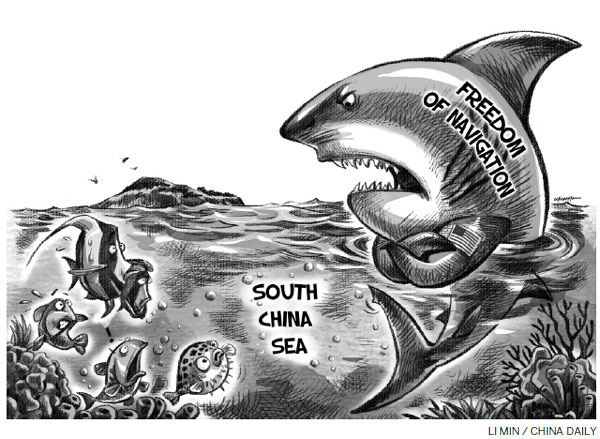
The US, however, maintains that military activities fall within freedom of navigation and other internationally lawful uses of the sea.
The US is never shy of claiming freedom of navigation as its higher moral ground. But the irony is it still refuses to ratify the UN Convention on the Law of the Sea (UNCLOS). Even President Barack Obama admitted that "it's a lot harder to call on China to resolve its maritime disputes under the Law of the Sea Convention when the United States Senate has refused to ratify it".
China, on the other hand, upheld freedom of navigation as a principle in line with the UNCLOS as early as 1998 in its Law on the Exclusive Economic Zone and the Continental Shelf.
US "freedom of navigation" naval operations are even a contradiction to the US' claimed policy of taking no position on competing territorial claims in the South China Sea.
The US believes China's Meiji and Zhubi reefs are "artificial islands" that are not entitled to 12 nautical mile territorial seas. However innocent passage can only be made through territorial waters, according to UNCLOS. When the US announced that the USS Lassen made an "innocent passage" within 12 nautical miles of Meiji and Zhubi, some in the US criticized the US Navy for tacitly recognizing China' sovereignty.
The US tries to look "innocent" in its provocations. It also attempts to trade "innocence" with China. As if to lay ground for planned operations to come, the Pentagon described Chinese naval ships transiting the Aleutian Islands last September as innocent passage, in other words, China should reciprocate by allowing US vessels to sail in its territorial waters one day. It even praised the Chinese ship monitoring the USS Lassen for being professional. But the Chinese Ministry of Defense quickly pointed out its naval task force transiting Aleutian Islands was conducting transit passage rather than innocent passage in an international sea lane.
No matter how bullish the US might seem, it has a deep sense of insecurity about what it considers China's "salami-slicing" militarization of the South China Sea: land reclamation being China's first step, which will lead, if unchecked, to China's announcement of an Air Defense Identification Zone, occupation of other uninhabited land, or the taking of Ren'ai Reef on which the Philippines deliberately grounded a vessel. Its worst-case scenario being China finally turns the South China Sea into a Chinese lake and drives the US out of the Western Pacific.
But China can effortlessly point out it is the US that is now militarizing the South China Sea. With the implementation of its rebalancing strategy to deploy 60 percent of its air and naval forces in the Asia-Pacific by 2020, the US has clearly decided to step up its military presence in the region. The recent sail-throughs by the USS Lassen and the USS Curtis Wilbur and the overflights by B-52 bombers have only increased the tensions in the region. The US has added more wood to the fire by encouraging its allies Japan and Australian to patrol in the South China Sea. And all this is in addition to the military assets deployed by other claimants.
China's land reclamation is only on China-controlled islands and reefs. It is not prohibited by any international law. And it is not meant to challenge the US. But should the US provocations continue, Beijing may feel it has to respond decisively. One of the options is to increase its own military presence in the South China Sea. The South China Sea's militarization would then become a self-filling prophecy.
The South China Sea issue is not an issue between China and the US, but unfortunately it is looming large as one. The best agreement at present on freedom of navigation would be to disagree and maintain self-restraint. Admiral Harris's remarks are not helpful in avoiding the miscalculations that neither China nor the US wants to see.
The author is an honorary fellow with the Center of China-American Defense Relations, Academy of Military Science.

(China Daily USA 02/17/2016 page12)
- Paid menstrual leave provokes controversy in China
- MIT establishes supply chain education center in China
- One of the two dead sperm whales in East China salvaged
- 20,000 yuan eaten by ants gives artist a frame for inspiration
- Chinese military sets up corruption hotline
- Foreigners working in Beijing can now buy apartments immediately
- 'Grim Sleeper' murder trial begins six years after arrest
- Cameron defends EU deal as lawmakers offer no guarantees
- Sarkozy placed under investigation in campaign funding probe
- Moscow dismisses accusation of Russia bombing Syrian hospitals
- 2016 Westminster Kennel Club Dog Show held in New York
- Pakistan confirms participation in Saudi-led military drills

 Excitement, charm and grace: Chinese New Year in UK
 Taylor Swift wins Album of the Year at Grammys
 Stars spotted at film academy exam in China
 Record number of Chinese travel abroad for Spring Festival
 Future bodyguards undergo brutal training in Beijing
 Chinese Lunar New Year marked in central London
 Top 10 most difficult cities in China to get a taxi
 Sichuan opera charms British children
Most Viewed
Editor's Picks
|

|


|

|
|

|
Today's Top News
Will US-ASEAN meeting be good for region?
Accentuate the positive in Sino-US relations
Dangerous games on peninsula will have no winner
National Art Museum showing 400 puppets in new exhibition
Finest Chinese porcelains expected to fetch over $28 million
Monkey portraits by Chinese ink painting masters
Beijing's movie fans in for new experience
Obama to deliver final State of the Union speech
US Weekly

|

|
